
-
Your next favorite book
is waiting.
Summary | Excerpt | Reviews | Beyond the Book | Readalikes | Genres & Themes | Author Bio

A Novel
by Billy-Ray Belcourt Book Reviewed by:
Excerpt
A Minor Chorus
In the end, the idea came to me suddenly, as I was walking with River in a park near their neighbourhood. We were talking about the summer night I had sex with a man in the basement of a parking garage. I said it was the most alive I had ever been because I felt so close to death. "Don't worry, I'm not going to kill you," the man said before he stripped naked. River said people didn't naturally make the kinds of decisions I did when I was cruising. Once we stopped laughing, it occurred to me that I wanted to examine how we live under conditions of duress, both visible and invisible. My novel, then, would be a kind of literary ethnography of sadness and hope, of constraint and possibility. My informants would all come from the same place: the town in which I was raised, in a region heretofore unexplored in Canadian letters. I would write a book that reflected a community's emotional lives rather than just my sensory experience of the present. I would drive into town with graffitied fists and make art that would matter. If I wanted to study what was and wasn't worth living for, I told River, I had to make the trek to northern Alberta. They bought us a second round of coffees as a celebratory gesture.
Within hours, I had devised a methodology: I would collect the testimonies of those who were, in an existential sense, contortionists, people whose personal histories were marked by structural neglect, by cruel fate, by heavy silence, by a joy that pressurized sociological theories of deficiency. Why not do this in Edmonton? For starters, it represented a past life I disavowed, it stood for an embargo on creativity and revolution. It was true that history could fabricate a world anywhere, could become the contours of a body, a person, a house, a neighbourhood; I suspected, however, that in some places this fact was hidden. There was nothing new to say about the city and everything still to say about the outskirts of the modern, about the zones of existence where the present was always the past, or, more precisely, was always the past reverberating like the aftershocks of an earthquake. Rural Alberta was where I'd reacquaint myself with the preciousness and wildness of life. In talking to those who came from where I came from, I also hoped light would be shed on the person I was or the person I might become. Perhaps I was no longer repressing the fact that I was as determined as anyone else by the milieu into which I was born.
This is what I knew about where I come from: It's a place where history begins and ends. Before it was part of Alberta, it was the District of Athabasca, and before that it didn't have an English name. It's the homeland of the Cree and Dene and Métis, and for centuries my ancestors lived in harmony with the land and water and forests and animals. At the close of one century and the start of another, those from whom I descend signed a treaty near the shores of the lake around which many reserves are now located, including my own. They signed in the spirit of communality and peace and in the name of future generations, though what followed was an era defined by a systematic assault on Indigenous livability: death schools, open-air prisons, child abductions. Many sick experiments were carried out by the federal government and its henchmen from which we're still recovering, though recovery isn't always an option. All the while people resisted, loudly and quietly, but always creatively. This was one way to tell a story about northern Alberta. There was another way, one that was embodied and consequential for the living, one that zoomed in on emotion and intimacy. It was this more corporeal mode of storytelling that enticed me.
What I knew about being queer and Indigenous and in my twenties was desperation. It is we who experience aliveness as both inescapable and a shimmering impossibility. We improvise life outside the frame of futurity while also being ensnared by it. We don't die. We proliferate life as if machines engineered to do so; that's it. I would return to my hometown and go about the practice of not dying, I thought. My liveliness would be artful.

Excerpted from A Minor Chorus by Billy-Ray Belcourt. Copyright © 2022 by Billy-Ray Belcourt. Excerpted by permission of W.W. Norton & Company. All rights reserved. No part of this excerpt may be reproduced or reprinted without permission in writing from the publisher.
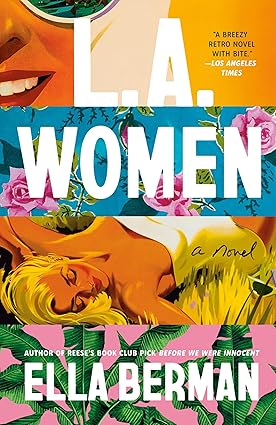
L.A. Women by Ella Berman
Two ambitious writers in 1960s LA face betrayal when one writes a novel based on the other's life.

Your guide toexceptional books
BookBrowse seeks out and recommends the best in contemporary fiction and nonfiction—books that not only engage and entertain but also deepen our understanding of ourselves and the world around us.

