
-
Your next favorite book
is waiting.
Summary | Excerpt | Reviews | Beyond the Book | Readalikes | Genres & Themes | Author Bio

 Book Reviewed by:
The next week, Cybil was introduced to the son of a local lord, sixteen and pimpled, with one tooth already rotted from a diet of sweetmeats. The boy's father had come too, and he had taken a lock of Cybil's hair in his hand and grunted in approval, for Cybil had the queen's hair, flaming red, and this was considered beautiful enough to make up for her low forehead and squarish jaw.
The boy spent the entirety of his visit bullying her and trying to peek down her bodice. As the sun set that day, he had shoved her into the garden pond. Cybil, silent and sodden and furious, had stared and stared at him as he laughed and wished that he would die. A bough from the oak tree above them cracked and fell on top of him, breaking his neck. Shocked, Cybil stood in the water, skirts pooled around her, hands balled into fists. She did not know whether to laugh or to cry.
"A terrible accident," Bess had said. "Oh, how terrible, my dove. Trouble yourself not over it."
But Cybil's father did not believe it was an accident. He believed it was magic. Not the wild, uncontrolled power of a curse—of course not; to admit as much would be admitting defeat—but perchance something more useful. Perchance Cybil did have the powers he and his forefathers laid claim to: not doomed and uncontrollable, but the sort that could be honed and applied—the stuff of miracles, the blessings of a saint. So, for one extraordinary year, Christopher Harding had cared for his daughter. He had permitted her to read from the grimoire. He provided her incantations and elixirs, and showed her strange dances to do around ritual circles, teaching her an alphabet of angel letters that squirmed upon the page like leeches. Then he had taken her to the gardens, standing her before the apple trees in the orchard. "Break the bough, Cybil," he would say, watching her with wads of parchment notes crumpled in his fists. "Break the bough."
But nothing ever occurred. When Cybil saw the darkness begin to surge beneath her feet like floodwaters swelling across a plain, when she felt the furious, hungry tug of those shadows reaching within her, eager to swallow her whole—Cybil had feared the power too much to allow it purchase. She felt the burning of magic within her, and she made herself douse it. The pain was too much, as if a wound deep within her were being opened anew—and even more so, the possibility was too much, the sense that if she gave the darkness what it wanted, she would set the world itself aflame. She closed her eyes and pulled her light within her until it was smothered. She was not a saint—she was a First Daughter. Cybil had seen the grimoire, and she knew the legacy she carried.
Cybil felt the hunger of the shadows; she heard the voices in the dark.
Her father may have believed the curse was gone, but Cybil knew that he was wrong.
Once it was clear his daughter had no talent for magic—or, at least, none that she could control—Christopher ignored her once more.
No more local lords sent their sons for courting. Cybil told herself she did not mind. She had never liked the manner in which young men observed her, as if she were ripe fruit on the turn, as if they wanted to both eat her and throw her away to rot. Better for her to be alone, surrounded by her books and her mother's love, without any distractions within the walls of Harding Hall.
That winter, the winter of her fourteenth year, Cybil's mother bought her a marchpane-and-jam dollhouse for her birthday. It was a reproduction of the Hall: a perfect confection of quince-paste brick, blown-sugar windows, oozing black-red raspberries from its foundations and almond-studded roof. There was even the orchard in miniature, the marchpane trees growing comfits for leaves and fruit: sugar-glazed seeds of fennel and caraway, stained red and orange with beet and turmeric.
Cybil did not like sweet things; she never had. Bess continued to hope she would, for loving sugar was that most basic of childhood traits, a last hope of Cybil's normalcy. So, she pretended to like it, pretended she would eat it later, but then she brought the entire thing down to the servants in the hopes it might make them like her better.
From the book AS MANY SOULS AS STARS. Copyright © 2025 by Natasha Siegel. To be published on November 25, 2025 by William Morrow, an imprint of HarperCollins Publishers. Reprinted by permission.
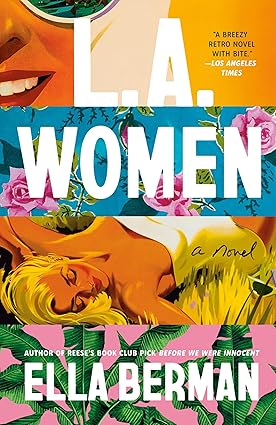
L.A. Women by Ella Berman
Two ambitious writers in 1960s LA face betrayal when one writes a novel based on the other's life.






Your guide toexceptional books
BookBrowse seeks out and recommends the best in contemporary fiction and nonfiction—books that not only engage and entertain but also deepen our understanding of ourselves and the world around us.


