
-
Your next favorite book
is waiting.
Summary | Excerpt | Reviews | Beyond the Book | Read-Alikes | Genres & Themes | Author Bio

 Book Reviewed by:
This article relates to As Many Souls as Stars

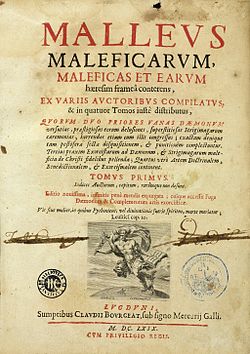 The history of witch hunting in Europe is broad and varies by locale and time period. However, one of the unifying factors across these different contexts is the Malleus Maleficarum—translated as the "Hammer of Witches"—a 1487 German handbook on witchcraft that inspired witch hunt movements for centuries after its publication. Written by Heinrich Kramer, a professor of theology and inquisitor in Austria who was given authority by Pope Innocent VIII to investigate and prosecute cases of sorcery, the Malleus Maleficarum includes descriptions of witches, condemnation of them, and legal procedures to be followed while conducting witch trials, including torture and burning at a stake (the traditional punishment for religious heresy).
The Malleus marked a turn in European understandings of magic and specifically female mysticism. Prior to its publication, witchcraft was often perceived in much more general terms; folk magic and sorcery were regarded with fear and respect in equal measure, and it was generally understood that magic had the capacity for good as well as evil. But thanks in part to the Malleus Maleficarum, all magic eventually became associated with witchcraft and specifically "maleficium"—evil works.
Maleficium itself means simply "wrongdoing" in Latin, but the word became tied to sorcery during the medieval period in Europe. In the small villages of England, such as the one Cybil inhabits in the first scenes of As Many Souls as Stars, this "malevolent magic" was often targeted toward the cornerstones of a village life: the farm. Women were said to curse the harvest or livestock, whether those of their own households or that of rivals, using their dark arts to hasten the natural sources of decay.
From the Malleus, we find the basis for the modern, "classic" witch. It is one of the first sources to specify that witches have the power of flight (although the addition of the broomstick came later). It also claims that witches "eat babies," reflecting a common fear in medieval and early modern Europe. Most commonly laid at the feet of European Jewish communities, the fear of blood libel—the stealing of Chrisitan children to use their blood in rituals—fanned the flames of oppression in Europe up to the 20th century. Following this thread, we can see the anti-Semitic stereotypes behind the cartoon vision of witchcraft that returns year after year at Halloween.
We also see, in the Malleus, an increased emphasis on promiscuity: while the folk practitioners of the pagan ages might have been wise old women, these early modern witches were depicted as being young and beautiful. Rather than striving for the good of their community through medicinal potions or amulets, these "new" witches were tempted into their power by promiscuity and promises of intercourse with the devil. This idea, popularized by the Malleus, is what many historians hypothesize directly tied the witch-hunting craze to women. An independent woman, and especially an independent woman who might be finding sexual pleasure outside the bounds of socially approved marriage, was likely one being tempted by the devil into maleficium.
Image of the Malleus Maleficarum title page courtesy of the Wellcome Collection, CC 4.0 International.
Filed under People, Eras & Events
 This article relates to As Many Souls as Stars.
It first ran in the January 14, 2026
issue of BookBrowse Recommends.
This article relates to As Many Souls as Stars.
It first ran in the January 14, 2026
issue of BookBrowse Recommends.

L.A. Women by Ella Berman
Two ambitious writers in 1960s LA face betrayal when one writes a novel based on the other's life.






Your guide toexceptional books
BookBrowse seeks out and recommends the best in contemporary fiction and nonfiction—books that not only engage and entertain but also deepen our understanding of ourselves and the world around us.


