
-
Your next favorite book
is waiting.
Summary | Excerpt | Reviews | Beyond the Book | Readalikes | Genres & Themes | Author Bio

A Memoir of Sorts
by Margaret Atwood Book Reviewed by:
CHAPTER 1
FAREWELL TO NOVA SCOTIA
A THING MY MOTHER SAID:
MY MOTHER: Because our father's name was Dr. Killam, kids at school used to tease us. They'd say, "Killam, Skin'em, and Eat'em."
ME: Did they hurt your feelings?
MY MOTHER: Pooh. I wouldn't give them the satisfaction.
A THING MY FATHER SAID:
"How long would it take two fruit flies, reproducing unchecked, to cover the entire Earth to a depth of two miles?"
(I don't remember the answer to this, but it was a remarkably short time.)
Both my parents were from Nova Scotia. My father was born in 1906, my mother in 1909. Counting forward, you can see they would have been entering the job market just as the Great Depression of the 1930s was at its height. Coupled with that was the general decline of the Canadian Maritimes: Halifax had been a prosperous seaport in the nineteenth century, but then came the building of the railroads and the shift of the financial gravitational centre, first to Montreal, then Toronto. The city had a brief uptick during the First World War; later, after my parents had left Nova Scotia, it was the staging area for the Atlantic convoys due to its sheltered harbour. Some in Nova Scotia benefited from American Prohibition in the 1920s and early 1930s. A brisk smuggling business had fishing boats picking up booze from Saint-Pierre and Miquelon—French territory—and running it into the deep coves and estuaries of Maine. If Uncle Bill suddenly got a new roof on his barn, you didn't ask him how he'd paid for it. But to profit from that trade you had to have a boat. Those who didn't have boats were out of luck.
A joke from that time: "What's the chief export of Nova Scotia?" "Brains."
During those years, many Nova Scotians moved west in search of jobs. My parents were part of that exodus.
All the Nova Scotians I've known have been universally homesick. I'm not sure why, but so it has been. Both of my parents always referred to Nova Scotia as "home," causing some confusion for me as a child: If Nova Scotia was "home," where was I living? In some sort of not-home?
Ours is a family shrub, not a family tree. If you have roots in the Maritimes and meet someone else with similar roots, you find yourself picking your way through the shrubbery. Who was your father, who was your mother, grandfather, grandmother, from where, and so on, until you establish the fact that you are related. Or not. This can go on for some time.
So here's the deep dive.
Nova Scotia, far from being uniformly Scottish in origin as the name might imply, was remarkably diverse. The Mi'kmaq lived there and still do, and are related to other Indigenous groups in New Brunswick and Maine. In the seventeenth and eighteenth centuries, Nova Scotia was one of the first parts of what is now Canada to receive an influx of Europeans. French explorers; and French settlers and farmers who called themselves Acadian in honour of the comparatively idyllic place they found themselves in; then New Englanders who'd been enticed by cheap land. Later came a number of people who had been on the losing side of the American Revolution. These included the Free Blacks, who'd fought on the side of the British. Collectively, these immigrants from the States were known as United Empire Loyalists. Some of these were entangled in our family shrubbery.
Just before the Loyalists came German and French Protestants who'd been welcomed by the British during the French and Indian War with New France. Catholic New France—including Vermont and New Brunswick and what is now Quebec—was raiding the Protestant New England colonies with the help of its Indigenous allies, and vice versa. New England had the help of the British Army, while the French colonies were not so well supplied. Finally, in 1759, General Wolfe took Quebec City and New France fell to Britain. The New England colonists had no more need of the British Army, and did not see why they should be so heavily taxed. Result: The American Revolution, no taxation without representation, over-investment on the American side by the French monarchy, French debt, then the French Revolution.
Excerpted from Book of Lives by Margaret Atwood. Copyright © 2025 by Margaret Atwood. Excerpted by permission of Doubleday. All rights reserved. No part of this excerpt may be reproduced or reprinted without permission in writing from the publisher.
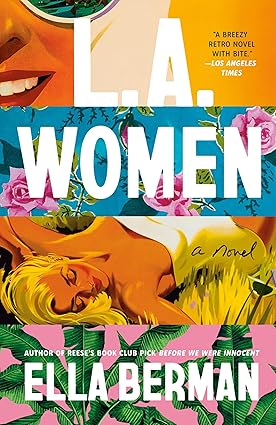
L.A. Women by Ella Berman
Two ambitious writers in 1960s LA face betrayal when one writes a novel based on the other's life.






Your guide toexceptional books
BookBrowse seeks out and recommends the best in contemporary fiction and nonfiction—books that not only engage and entertain but also deepen our understanding of ourselves and the world around us.


