
-
Your next favorite book
is waiting.
Summary | Excerpt | Reviews | Beyond the Book | Read-Alikes | Genres & Themes | Author Bio

A Memoir of Sorts
by Margaret Atwood Book Reviewed by:
This article relates to Book of Lives

Margaret Atwood (b. 1939) is probably best known for her novels, such as 1985's The Handmaid's Tale and its Booker Prize–winning sequel, The Testaments (2019). Her first published works, however, were volumes of poetry—five collections before her first novel, The Edible Woman, hit the shelves in 1969.
Atwood spent much of her childhood living in the Canadian wilderness—what we'd now call "off-grid." Her father, an entomologist, was employed doing fieldwork, and his family moved with him to remote locations each summer, sometimes living in tents, sometimes in rustic cabins without electricity or running water. Left largely to her own devices, Atwood developed a close connection with nature and came up with creative ways to keep herself occupied.
In 1945 her father began working at the University of Toronto, and Margaret was enrolled in school for the first time—a situation she found challenging after the freedom she'd enjoyed ("I found sitting still all day very tiring" she writes in her memoir). Around this time she started writing poetry and created her first book, Rhyming Cats. This collection, put together with folded sheets of paper and a construction paper cover, included 26 short, rhyming poems, such as "Fairies":
Fairies come at magic times,
and they make such magic chimes.
This rymes [sic]
According to Atwood in a 1995 University of Toronto lecture, she continued writing throughout her grade school years but "became a poet at the age of sixteen. I did not intend to do it. It was not my fault." She went on to say:
"The day I became a poet was a sunny day of no particular ominousness...I was scuttling along in my usual furtive way, suspecting no ill, when a large invisible thumb descended from the sky and pressed down on the top of my head. A poem formed. It was quite a gloomy poem: the poems of the young usually are. It was a gift, this poem...I suspect this is the way all poets begin writing poetry, only they don't want to admit it, so they make up more rational explanations. But this is the true explanation, and I defy anyone to disprove it."
In 1957 she enrolled in the University of Toronto as an English major (she decided if nothing else, she could teach to support her writing habit) and submitted her work to the school's literary journal, Acta Victoriana.
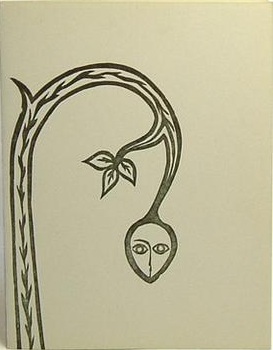 As graduation neared, Atwood collected seven of her poems into a volume she referred to as Double Persephone, since the content revolved around the mythological figure. Her boyfriend at the time, poet David Donnell, suggested publishing them as a chapbook. Atwood carved a block of linoleum into a simple design used for the cover, and she and Donnell hand-set the type on a friend's flatbed press. They produced 200–250 copies, which they distributed to local bookstores; the entire run sold out. Someone (Atwood doesn't remember if it was her or someone else) submitted the collection for consideration for the E.J. Pratt Medal—a prestigious award for poetry given by the University of Toronto—and the collection won. The first poem in the volume is "Formal Garden":
The girl with the gorgon touch
Stretches a glad hand to each
New piper peddling beds of roses
Hoping to find within her reach
At last, a living wrist and arm
Petals that will crush and fade
But always she meets a marbled flesh
A fixing eye, a stiffened form
Where leaves turn spears along the glade
Behind, a line of statues stands
All with the same white oval face
And attitude of outstretched hands
Curved in an all-too-perfect grace.
Atwood's poetic credentials were cemented by the release of her second collection, The Circle Game, in 1964. A 1966 revision won the highly prestigious Governor General's Award for poetry, instantly garnering her national and international recognition and establishing her as a significant new voice in Canadian literature.
Double Persephone and The Circle Game set the groundwork for the author's future poems and novels. Critics often note Atwood's focus on duality—art vs. real life, self vs. other, or nature vs. humanity. Her figures are often alienated or isolated, and her early works especially contained a certain gothic bleakness.
As of 2026, Atwood has published over 20 poetry collections. In addition, she's written 18 novels, 13 books of nonfiction, 11 short story collections, and seven children's books. She's written opera libretti, drawn comic strips, and worked on movie and television scripts. Her most recent book is Book of Lives: A Memoir of Sorts, but at 86 she shows no signs of limiting her activities or her creative output.
Cover of Double Persephone by Margaret Atwood, via Wikimedia Commons
Filed under Books and Authors
 This article relates to Book of Lives.
It first ran in the January 14, 2026
issue of BookBrowse Recommends.
This article relates to Book of Lives.
It first ran in the January 14, 2026
issue of BookBrowse Recommends.
L.A. Women by Ella Berman
Two ambitious writers in 1960s LA face betrayal when one writes a novel based on the other's life.




Your guide toexceptional books
BookBrowse seeks out and recommends the best in contemporary fiction and nonfiction—books that not only engage and entertain but also deepen our understanding of ourselves and the world around us.


