
-
Your next favorite book
is waiting.
My friend Lani's been busy today, sending me a droll 90 second video from Unbridled Books, and a quote that touched her....
Unbridled Books P.S.A. from Unbridled Books on Vimeo.
Update Feb 5: Scott Westerfeld's article in the Guardian (UK) summarizes the whole contretemps in one easy to digest article.
Update Feb 4: Truepenny's blog is a great starting point for an update on what's been happening. It includes commentary and links to a follow up letter from Macmillan CEO John Sargent; and an excellent post from Joseph E. Lake Jr. explaining all the people involved in getting one of his books to print and the stages it goes through - which in turn explains why ebooks don't have a much cheaper cost basis than printed books.
Steve Jobs today unveiled the all new iPad tablet which, to quote him, is a "mobile video-watching, book-reading, game-playing, photo-perusing, music-listening, web-surfing, and email-emailing device."
Perhaps the biggest surprise is that its base price starts at $499, which is much lower than the ~$1000 price point industry watchers predicted. At this price it is likely to give dedicated e-readers such as the Kindle and Nook serious competition, and also significantly impact the market for smaller computers known as netbooks.
You will find a thorough description of the new device, as described by Jobs himself here
And for more about the likely pricing and availability of e-books on the iPad click here
Lastly two particularly salient paragraphs lifted from Rik Myslewski's article in theregister.co.uk.....
"And speaking of Amazon's Kindle, Apple clearly is in a gauntlet-throwing mood when it comes to ebooks. But putting aside the epaper-versus-backlit display debate, it's difficult to compare the iPad and the Kindle. The Kindle, for example, can download books from (sorta) anywhere at anytime over Sprint's wireless Whispernet service. To accomplish the same degree of convenience, an iPad owner will not only have to pony up the extra $130 for 3G connectivity, but also pay AT&T $14.99 for 250MB a month or $29.99 for an unlimited data plan.
That said, however, the Kindle is merely a monochrome reader for ebooks (and enewspapers and emagazines and blogs), while the colorful, oleophobic, LED-backlit, 1024-by-768 iPad includes a range of entertainment, creative, and productivity software, plus access to those aforementioned 140,000 iPhone apps. If you're already an iPhone or iPod touch owner, by the way, the iPad will also run all the apps you've purchased for those two handhelds. Another bonus: when docked, the iPad can double as a full-color digital photo frame."
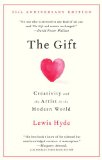 This holiday, in between shopping for presents, I began reading an amazing book, The Gift: Creativity and the Artist in the Modern World by Lewis Hyde. It is, in part, about the cultural meaning of gift exchange, and though my timing in reading it during Christmas was coincidental, the resonances were very welcome. By day, I would buy gifts and experience a familiar twinned pleasure and guilt at all the consumption. By night, I would read The Gift and find myself getting to the source of that dual emotion.
About a year ago, I wrote a blog about ebook readers and my
decision to purchase a Sony PRS-505. I have absolutely no regrets, and I still love my reader; I can no longer say, though, that I "wouldn't trade it for anything."
First, I'm thrilled, pleased and tickled to death that after decades of owning ebook readers I'm finally using a product that's likely to become part of the mainstream. I've got at least three obsolete devices sitting around for which I can no longer purchase books. I truly believe that ebooks are here to stay this time. You can't read an industry publication these days without seeing at least one article about the evolving ebook market. Ebooks are the only segment of the book industry whose sales have seen a dramatic increase during the recession, and I know at least half a dozen people who are asking for an e-reader for the holidays this year. (Not to mention the fact that I'm frequently seeing others with these devices on the bus; mine is no longer a novelty.)
OK, I confess, I joined Facebook. Now, you have to remember I'm a computer geek, and as such, I'm not really all that
good at dealing with people, face-to-face. I'm much happier working with machines; they're logical, they don't talk back, and generally do what you tell them to without argument. (Although I do have one server that I swear wants a blood sacrifice before it'll condescend to behave.) If I have to interact with people over the course of the day, I do everything possible to do it in writing (yes, e-mail is my friend). So, it only makes sense that a medium that allows me to interact with others, without actually having to talk
to them, would offer some appeal.
At first I thought it was kind of silly; I had four or five "friends" (distant cousins and co-workers) with whom I'd rarely communicated in the past and have little in common with now, and I just couldn't understand the attraction. (Sadly, I didn't really care that my cousin spent her evening watching Glee on Fox.) Then, one day, the oddest thing happened – I got contacted by a former high school boyfriend. From there, one thing led
to another, and now I'm in contact with all these people I have had nothing to do with for decades. (Still not entirely sure whether or not that's a good thing – and they probably feel the same way.)
