
-
Your next favorite book
is waiting.
Cathy Marie Buchanan, author of The Day The Falls Stood Still, offers an impassioned plea to preserve the environment and natural beauty of Niagara Falls and prevent the planned high-rise development at the brink of the Falls.....
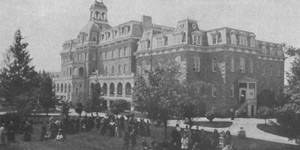 Lady Howard of Glossop, in her travel journals, published in 1897, describes Loretto Academy as "superbly situated on the highest ground, just above the Horseshoe Falls, commanding the whole bird's eye view of the Falls." Because of its choice setting, Loretto was host to a steady stream of visitors including literary luminaries, ecclesiastical dignitaries and even, in 1901, the King and Queen of England. Unfortunately, its choice setting has come into play once again, this time with a hotel developer planning three high-rises for the seven acres of treed green space surrounding the academy.
 Elif Shafak, the most widely read woman writer in Turkey whose books include The Bastard of Istanbul, explains how Sufism influenced her latest book, The Forty Rules of Love ...
 My interest in Sufism began when I was a college student. At the time I was a rebellious young woman who liked to wrap several shawls of "–isms" around her shoulders: I was a leftist, feminist, nihilist, environmentalist, anarcho-pacifist.... I wasn't interested in any religion and the difference between "religiosity" and "spirituality" was lost to me. Having spent some time of my childhood with a loving grandmother with many superstitions and beliefs, I had a sense the world was not composed of solely material things and there was more to life than I could see. But the truth is, I wasn't interested in understanding the world. I only wanted to change it.
 Shortly before my first novel was published, I walked through a bookstore with my son. "Once my book is published, I'm not going to be able to do this any more," I told him. Wander into a book store and pleasantly meander the aisles. It was hard to articulate, but suddenly I realized that the next time I walked into a bookstore -- and likely all the times thereafter -- I would be self-consciously focused on one thing: my own book. Did they have it? Where was it placed? Should I offer to sign it? (Was I presentable?)
And it was true ... Going in and out of bookstores became stressful, loaded with angst. I felt I'd been robbed.
 The dedication in Roses has inspired interest. It reads: For Janice Jenning Thomson . . . a friend for all seasons. Readers ask: "Who is she and why a friend for all seasons?"
Without Janice--her encouragement, faith, and belief in the book from its inception--Roses might not have been completed. Our friendship is going on thirty-two years. She is thirteen years my junior. We met when our husbands were serving as pilots in the US Air Force. Bonds were established immediately--I, a teacher, and she, an attorney. The years brought many changes in her life, but never was I one of them. She once said, "Friends come into your life for a reason, a season, or a lifetime."
It's been snowing here since before Christmas. Not much for some parts of the world, admittedly (I sent a picture of my kids sledging to a friend in Canada and she emailed back 'nice frost') but, for us on the south coast of England, it's a totally new experience.
Things I like about the snow:
When I worked in publishing just after college, my fellow peons in the editorial department used to play a game where they'd walk into a random bookstore and see who could pull the most books off the shelf that thanked them in their acknowledgments. I never played the game, and I always suspected I would have killed at it. Ever since then, I have always turned to the acknowledgments first when beginning a book, just to see who I can see. And in turn, I've become a huge appreciator of the genre.
My all-time favorite acknowledgments are in one of the best nonfiction books I've ever read, Timothy Tyson's Blood Done Sign My Name. In order to understand the acknowledgments, you've got to understand the book. Tyson, then a professor of Afro-American Studies at the University of Wisconsin-Madison, wrote about the civil rights movement with a muscular, hard-hitting argument: violence, or the threat of violence, played a far more central role in desegregation than we generally would like to admit. But this is no distanced academic treatise. The book opens with a sentence that Tyson's childhood friend uttered to him one spring day when he was ten: "Daddy and Roger and 'em shot 'em a nigger." Tyson grew up in Oxford, North Carolina, where his father was a white Methodist preacher, and his history is also a deeply personal memoir of his family's experience of a racially motivated shooting and the riots and activism it prompted. To understand everything that happened, Tyson would go on to study history at Duke. He would write his masters' thesis on the events in his hometown, and he would eventually rewrite it all from a personal perspective of anguish, outrage, and pride. The making of Blood Done Sign My Name literally drew on every aspect of Tyson's soul, as a child, as a student, as a teacher, writer, and scholar. The acknowledgments burst with heart and passion. They run to eleven pages.
