
-
Your next favorite book
is waiting.
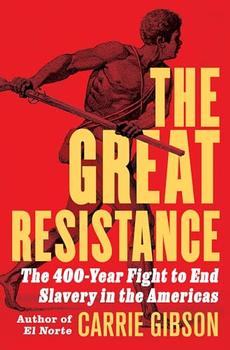
The 400-Year Fight to End Slavery in the Americas
by Carrie Gibson
For more than four centuries, enslaved people across the Americas, from the United States and the Caribbean to Brazil, fought any way they could to gain their freedom. For the first time, their dramatic stories are gathered in one sweeping narrative that offers a message of inspiration in our own time.
"Among the emancipators are the millions whose stories will never be known. They lived the struggle. They were the great resistance." Thus does acclaimed historian Carrie Gibson conclude her magisterial chronicle of four centuries of effort by enslaved people in the western hemisphere to gain their freedom. "Freedom is an idea," she writes, and the actions of the thousands who fought to escape slavery made clear that "freedom had to be for everyone, otherwise it was a lie."
The horrific enslavement by Europeans of twelve million Africans taken to the Americas has been widely written about, and important individual slave revolts have been recorded; but Gibson tells a larger story, portraying the multitude of freedom struggles across the entire hemisphere—from North America to the Caribbean to Brazil—as one long-running quest for freedom. From the first African revolt in 1521 on the island of Hispaniola, to the 18th-century Maroon Wars on Jamaica and the revolution that gave Haiti its independence, and thousands of smaller acts of defiance in between, Gibson vividly chronicles the continuum of resistance that eventually ended the slave trade and, with Brazil's decision in 1888, the institution of slavery itself.
This was the most diverse ongoing insurrection the world has ever known, and the way it was responded to shaped every nation in the Americas in meaningful ways. "If scholars were to emphasize the efforts of the enslaved more than the condition of slavery," historian Vincent Brown has written, "we might at least tell richer stories about how the endeavors of the weakest and most abject have at times reshaped the world." With its deep scholarship and rich narrative, The Great Resistance is a major contribution to the literature around slavery and freedom and, in our time, a tribute to the persistence of the human spirit to overcome even the darkest of circumstances.
"[A] magisterial account ... Gibson constructs a sweeping vision of resistance to slavery as a defining element of Western history that made 'abstract concepts of freedom concrete.' Expansive and elegant, this is a marvel." —Publishers Weekly (starred review)
"A solid contribution to the literature of the New World slave trade." —Kirkus Reviews (starred review)
This information about The Great Resistance was first featured
in "The BookBrowse Review" - BookBrowse's membership magazine, and in our weekly "Publishing This Week" newsletter. Publication information is for the USA, and (unless stated otherwise) represents the first print edition. The reviews are necessarily limited to those that were available to us ahead of publication. If you are the publisher or author and feel that they do not properly reflect the range of media opinion now available, send us a message with the mainstream reviews that you would like to see added.
Any "Author Information" displayed below reflects the author's biography at the time this particular book was published.
Carrie Gibson is the author of two acclaimed works of history, Empire's Crossroads: A History of the Caribbean from Columbus to the Present Day, and El Norte: The Epic and Forgotten Story of Hispanic North America. She received a PhD from Cambridge University focusing on the Spanish Caribbean in the era of the Haitian Revolution and has worked as a journalist for the Guardian and contributed to other publications, as well as the BBC. She has done research across Mexico, the Caribbean, South America, and the United States. She lives in Seoul, South Korea.

If you liked The Great Resistance, try these:

by Greg Grandin
Published 2026
From the Pulitzer Prize–winning historian, the first comprehensive history of the Western Hemisphere, a sweeping five-century narrative of North and South America that redefines our understanding of both.

by Scott Shane
Published 2024
A riveting account of the extraordinary abolitionist, liberator, and writer Thomas Smallwood, who bought his own freedom, led hundreds out of slavery, and named the underground railroad, from Pulitzer Prize-winning author and journalist, Scott Shane. Flee North tells the story for the first time of an American hero all but lost to history.

by Caroline Dodds. Pennock
Published 2024
A landmark work of narrative history that shatters our previous Eurocentric understanding of the Age of Discovery by telling the story of the Indigenous Americans who journeyed across the Atlantic to Europe after 1492


Tread softly because you tread on my dreams.
Click Here to find out who said this, as well as discovering other famous literary quotes!

Can you name the title?
Test your book knowledge with our daily trivia challenge!
Your guide toexceptional books
BookBrowse seeks out and recommends the best in contemporary fiction and nonfiction—books that not only engage and entertain but also deepen our understanding of ourselves and the world around us.
