
-
Your next favorite book
is waiting.
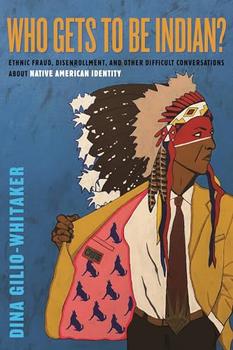
Ethnic Fraud, Disenrollment, and Other Difficult Conversations About Native American Identity
by Dina Gilio-Whitaker
An investigation into how Native American identity became a commodity, from cultural appropriation to ethnic fraud to disenrollment.
Settler capitalism has been so effective that the very identities of Indigenous people have been usurped, misconstrued, and weaponized. In Who Gets to Be Indian?, scholar and writer Dina Gilio-Whitaker (Colville Confederated Tribes) explores how ethnic fraud and the commodification of Indianness has resulted in mass confusion about what it means to be Indigenous in the United States.
As an entry point to the seemingly intractable problem of ethnic fraud, Gilio-Whitaker critically looks to the film industry, including a case study of Sacheen Littlefeather, who is most known as the Native American woman that rejected an Oscar on behalf of Marlon Brando in 1973—though later revealed, she was not who she said she was. Gilio-Whitaker argues that this pretendian phenomenon originated in Southern California when the United States was forcing assimilation of Indians into white America culturally, but also into its capitalist economic system. With Indianness becoming a marketized commodity in the Hollywood film business, the field became open to anyone who could convincingly adopt an Indian persona.
Deeply researched using socio-historical analysis, Gilio-Whitaker offers insights from her own experiences grappling with identity to provide clarity and help readers understand how the commodification of Indianness have ultimately left many people of legitimate American Indian heritage to be disconnected from their tribes. Personal and compelling, Gilio-Whitaker takes settler capitalism to task and helps us better understand how we got here in order to counteract the abuses of pretendianism and disenrollment.
"This incendiary j'accuse isn't afraid to name names." —Publishers Weekly (starred review)
"With clarity and conviction, Dina Gilio-Whitaker exposes what's at stake for Native people when Indianness becomes a commodity. A sharp, personal, and urgent look at the high cost for actual Native people in a system built to exploit them at every turn." —Kim TallBear, author of Native American DNA: Tribal Belonging and the False Promise of Genetic Science
"A fresh and unflinching look into the rise of pretendianism—when it became normalized for Hollywood to grant Native American identities to various grifters. Dina Gilio-Whitaker's courageous and original analysis will challenge readers, Indigenous or not, to think deeply about the nature of settler colonialism today." —Darryl Leroux, author of Distorted Descent: White Claims to Indigenous Identity
This information about Who Gets to Be Indian? was first featured
in "The BookBrowse Review" - BookBrowse's membership magazine, and in our weekly "Publishing This Week" newsletter. Publication information is for the USA, and (unless stated otherwise) represents the first print edition. The reviews are necessarily limited to those that were available to us ahead of publication. If you are the publisher or author and feel that they do not properly reflect the range of media opinion now available, send us a message with the mainstream reviews that you would like to see added.
Any "Author Information" displayed below reflects the author's biography at the time this particular book was published.
Dina Gilio-Whitaker (Colville Confederated Tribes) is a lecturer of American Indian Studies at California State University San Marcos, and an independent consultant and educator in environmental justice policy planning. At CSUSM she teaches courses on environmentalism and American Indians, traditional ecological knowledge, religion and philosophy, Native women's activism, American Indians and sports, and decolonization. As a public intellectual, Dina brings her scholarship into focus as an award-winning journalist as well, contributing to numerous online outlets including Indian Country Today, the Los Angeles Times, High Country News and many more. Dina is co-author with Roxanne Dunbar-Ortiz of "All the Real Indians Died Off": And 20 Other Myths About Native Americans, and As Long as Grass Grows: The Indigenous Fight for Environmental Justice from Colonization to Standing Rock.

If you liked Who Gets to Be Indian?, try these:

by Shilpi Somaya. Gowda
Published 2025
From the New York Times bestselling author, a novel in the tradition of Celeste Ng's Little Fires Everywhere, exploring the ties and fractures of a close-knit Indian-American family in the aftermath of a violent encounter with the police.

by Caroline Dodds. Pennock
Published 2024
A landmark work of narrative history that shatters our previous Eurocentric understanding of the Age of Discovery by telling the story of the Indigenous Americans who journeyed across the Atlantic to Europe after 1492

by Susanna Moore
Published 2024
From one of our most compelling and sensual writers comes a searing, immersive novel about a seminal and shameful moment in America's conquest of the West. Drawing partly from a true story, it brings to life a devastating Native American revolt and the woman caught in the middle of the conflict.
Theo of Golden by Allen Levi
One spring morning, a stranger arrives in the small southern city of Golden. No one knows where he has come from…or why…






Your guide toexceptional books
BookBrowse seeks out and recommends the best in contemporary fiction and nonfiction—books that not only engage and entertain but also deepen our understanding of ourselves and the world around us.

