Before You Knew My Name: A Novel
by Jacqueline Bublitz
Heartbreakingly Tragic, Yet Life-Affirming Featuring Characters Readers will Long Remember (12/9/2022)
Author Jacqueline Bublitz wrote Before You Knew My Name, her debut novel, after spending a summer in New York City where she "hung around morgues and the dark corners of city parks (and the human psyche) far too often." Her manuscript was rejected many times during a more than five-year journey to publication, but the book is now receiving stellar reviews and numerous awards.
Bublitz says she drafted the ending of the book first, and continued penning the narrative in reverse chronological order, which made sense because on the first page she reveals that " our narrator has not survived." She crafted the book's propulsive opening later -- it came to her "really strongly" when she had become "intimately acquainted with Alice Lee, one of our two storytellers in the book, so intimately connected to her voice." She kept hearing, "If I tell you my story . . . and it wouldn't leave me alone," so she sat down and wrote the opening in just two or three minutes.
The second narrator is Ruby Jones, who arrives in New York City from Melbourne on the same day as Alice arrives from the Midwest. Ruby is twice Alice's age -- 36. "She knows what she's getting away from but she doesn't know what she's going to." She chose New York from an "if I can make it there" unrealistic, from Bublitz's perspective, outlook. She's "a bit of a romantic and a hot mess as well." She's escaping a toxic romantic relationship -- her lover is engaged to marry another woman but continues his dalliance with her as she hopes against hope that he will finally choose her. Bublitz says "she's absolutely aimless and she knows it," and while jogging early one morning in New York, she discovers Alice's body.
Bublitz was inspired by an actual case in Melbourne. A young woman was chased into the Tenant Gardens around 5:00 a.m. and murdered in an area that was considered safe. "I could identify with this young woman," Bublitz says. Her body was discovered by a jogger. A jogger herself, Bublitz could not stop wondering, "What if that had been me? I could not get that trauma out of that mind." She researched the impact upon people who happen upon bodies under similar circumstances, but she could only locate one archived article discussing how a gentleman was so effected by the experience that he returned to the scene every year to commemorate the victim's death. That's when Bublitz knew she was "on to something" because no one had ever told the story of the connection between the person who found the body and the victim. She felt she could craft the “very human” tale.
She tells the story beautifully. From the very first page, when Alice begins relating her experiences, Bublitz endears readers to the dead girl who came to New York in search of a fresh start after enduring poverty, the death of her mother, being foisted on various relatives, and, eventually, an inappropriate relationship with one of her teachers. When he realizes how reckless and potentially destructive his behavior has been, Alice flees. She boards a bus from Milwaukee to New York City, taking with her a small amount of cash and his cherished antique camera. It is a Leica from the 1930s that belonged to his mother and she steals it from him because she knows losing it will cause him pain. “I am a survivor. I will turn eighteen years old tomorrow, and I am leaving on my own terms. Nothing – no one – can hold me back now,” she declares.
Alice finds a room for rent in the home of an older man named Noah. She has no job and her money won’t last long, but she works out an arrangement with Noah, who is clearly lonely. Is he a kind-hearted person who feels genuine fondness for Alice and wants to help and protect her by providing her a safe place to stay? Or is he a predator? Alice enjoys living in his beautiful apartment and working for him in exchange for room and board. Their arrangement ensures she can remain there. She walks and walks, learning her way around the city and snapping photographs, and begins to believe that perhaps dreams can come true. But her life ends abruptly and violently. Senselessly. Alice explains that a man murdered her in the park by the river. Is Noah her killer? Readers will find themselves hoping Noah is the kind-hearted man he initially appears to be, and not a cold-blooded murderer.
Simultaneously, Ruby, who is “approximately three years past pretty,” drinks heavily when she first arrives in New York. She stays in the dreary little room she has rented, staring at the ceiling, considering the choices she has made and her feelings for Ash, the man she loves more than she respects herself. She knew he was planning to marry another woman when she got involved with him, but believed that over time he would change his mind. He didn’t. So she escaped to New York for a sabbatical. After she wallows for a week, she finally decides to get up and moving, her anger inspiring her to go for a jog even though it is raining. She feels better, realizing “there is a whole world outside” the brick walls of the apartment building, and “she’s finally ready to crash her way through.”
But as Ruby approaches the marina, she steps on a plastic object – it is round and black, and now shattered. She notices something on the rocks, and quickly realizes she is looking at fingernails and blond hair. Comprehending that she has happened upon the body of a young woman, she summons help. Indeed, she has found Alice’s mangled body. “Ruby Jones is my only witness,” Alice explains. From the waterfront path, Ruby can’t get to Alice, but Alice is able to “make my way to her” but is dismayed to find that Ruby “can only see the husk of me, left down on the rocks.” But her spirit has aligned with and will remain with Ruby as the police search for Alice’s killer and a traumatized Ruby tries to understand the ways in which her life is forever changed that morning.
Before You Knew My Name is a unique and inventive tale, related from the perspective of a young woman whose life ends tragically and wants justice because she has been robbed of the future she was just beginning to envision and create for herself. “I really fought hard to stay in my body. I tried my best, but I just couldn’t hold on. I did not want to die.” At first, the police are unable to identify Alice because she had no wallet or form of identification with her, so she becomes yet another “Jane Doe” whose plight will fade from the headlines quickly. The media dubs her “Riverside Jane” but she wants to be identified so that she can be remembered and mourned by her best friend back at home, and her killer can be prevented from murdering again, even though she acknowledges that when the man who murdered her is identified, “he’ll be the one they want to now, the one who takes over the narrative.” When no one comes to the morgue to claim her body, she fears no one will care about her because she will be classified as “the wrong kind of victim.” Meaning, the kind who remain invisible. Alice looks to Ruby to ensure that she is not forgotten, whispering to Ruby, “I’m Alice,” again and again. But Ruby cannot hear her over the din of the city noises.
Ruby recognizes that she can never go back to being the woman she was before that morning. The media reports that Alice’s body was discovered by a jogger, but “why did they never say what happened to the jogger after that?” She wants to help. She wonders why only some victims’ stories are deemed worthy of being told. She can’t stop thinking about Alice; she feels connected to her. She seeks out other “finders of the dead” and discovers a small group who call themselves the Death Club. Led by a mortician, the members include Josh, who survived a near-death experience and suffers from survivor’s guilt, and a grieving mother. They are an eclectic and fascinating group of supporting characters who reveal their own tragic stories and the personal demons they are striving to overcome. Their ponderings about death are absorbing.
Fortunately, the detective assigned to Alice’s case is seasoned, and determined to solve it. As Alice remains beside Ruby, Bublitz takes readers on their journey of discovery. It is poignant, frequently heartbreaking, and powerful as a result of the achingly simple yet captivating way in which Bublitz describes Ruby’s encounters with the members of the Death Club, the relationships she forms with them, and the myriad ways in which she grows and matures, unwilling to be aimless any longer. At the center of the story is a cleverly-imagined mystery and the believable procedural tale about how Detective O’Bryne follows sometimes obscure clues that would be missed by a less diligent investigator.
But the real power of Before You Know My Name is the way in which Bublitz examines female empowerment from the perspectives of her two female protagonists. As noted, for Alice, it is about being valued. Even though her life was short, she wants to ensure that it was not without merit and meaning, and that she will be remembered as a person who mattered. The same things are important to Ruby, but from the perspective of her continuing life. Bublitz makes a strong statement about the importance of safety to women in New York City, in particular, but wherever they find themselves, and the vast power imbalance that still leaves women vulnerable and too often victimized.
Bublitz explores, from a decidedly feminist and fresh vantage point, the often surprising and frequently profound ways in which people’s lives intersect and become intertwined, and how those connections impact not just emotions, but decision-making, and shape the future. She also offers a sly indictment of the ways in which the media sensationalize crime, especially crimes against women. And the shamefully fleeting and superficial attention paid to cases that lack “legs,” meaning the ones the public grows tired of hearing about because they are not flashy or titillating enough to sustain interest from an industry focused on soundbites rather than substance. Bublitz makes clear that Alice’s killer should never overtake the narrative or overshadow the significance of the life he stole from her. Bublitz also challenges readers to consider their beliefs about the afterlife. Could those nudges and urgings we all feel emanate from spirits of the dead who remain with us and, as Alice struggles to communicate with Ruby, whisper to us?
Before You Knew My Name is a richly emotional, riveting, and thought-provoking debut from a talented and promising new thriller writer. It is a hauntingly tragic, yet life-affirming story of two women readers will not soon forget. And it is one of the best books of 2022.
Thanks to NetGalley for an Advance Reader's Copy of the book.
The Hero of This Book: A Novel
by Elizabeth McCracken
A Tender & Funny Homage to the Hero of a Grieving Daughter's Life (10/29/2022)
Is The Hero of This Book a work of fiction, a memoir, or a treatise on writing? It doesn't matter because it is an engaging, heartfelt tribute to a mother from the daughter who loved, admired, and was bemused by her. McCracken’s narrator considers various literary styles, insisting she is not a memoirist, and is not even sure about the difference between fiction and memoir. “Permission to lie; permission to cast aside worries about plausibility.” To her “emotionally autobiographical” fiction, the narrator has lent her secrets, but never her identity, out of fear of being found. Now she claims to have perhaps lost her inhibitions. Or not. (She equivocates about various topics throughout the narrative.) Her mother hated graves and therapy, and viewed memoirs with contempt, especially those replete with complaints about parents. But was fun-loving, adventurous, and “loved to tell stories about herself.”
The fictional narrator remains anonymous throughout the book, but acknowledges that the “actual me is the author.” She describes how she wandered the streets of London during a return visit in August 2019, "the summer before the world stopped," feeling every bit the motherless child she became ten months earlier when her mother died. Yet she neither grieved nor mourned the mother whose name she also conceals until late in the story. She rejects the words "grief" and "mourning," finding both terms "melodramatic. . . . I just missed her. I hated to see her go." Back in Boston, her parents' belongings had been sold during an estate sale, and their house was being readied to be put on the market. "In London, I found I wanted to hoard my little portion of her" -- perhaps in the same way that her parents hoarded objects, although the narrator never uses that word in relationship to their living conditions or the monumental task of hauling their amassed belongings out of the house. Those belongings were curated to serve as “a bulwark to keep people away and out.” Rather, the trip was a means of escaping those mundane details of finalizing her mother's affairs. The house -- and, more specifically, the squalor in which her parents needlessly lived -- had haunted her for years. “At first the house was untidy, then messy, then dirty, then a shame, a shanda, then squalid. Actual squalor. . . . It really was shameful, to be so educated, with such resources, and live in squalor.” She was happy to be away from it all and soon, hopefully, unburdened by it. "I was bereaved and haunted," she recalls.
As the narrator details walking around London, remembering her mother and the extraordinary life she lived, McCracken often employs a stream of consciousness style, permitting the narrator to veer off on tangents while relating a story. The technique makes the tale believable and authentic. Anyone who has experienced the grief of losing a loved one will recognize aspects of their own experience in the narrator’s recollections of family members and events, and her efforts to come to terms with who her parents were and their legacy. Ordinary objects, words, prictures or specific locations can trigger memories that flood one's consciousness in jagged, disjointed, seemingly random order, as they do the narrator's.
The narrator marvels at many aspects of her mother’s life and personality, as well as her physical characteristics. She remembers her mother saying she sustained a “birth injury” or “forceps injury,” but never a birth defect, and describes her mother’s refusal to let her body inhibit her lifestyle or accomplishments. She was formidable and personable, unique and memorable, and it is not until well into the story that the narrator names her mother’s condition – words she never heard her mother utter until she was fifty-eight years old and the narrator was twenty-six. Of course, to the narrator her “mother’s body was just her body,” and it surprised her when others noticed and/or commented about it, in part because of her mother’s personality. It was also just her body to her mother – never “something to overcome or accept any more than yours was.”
In some respects, her mother’s death came as a surprise. After all her mother had overcome and accomplished in her life, the narrator “was awaiting another resurrection.” When she had to accept that her mother would not survive, she and her brother had to make decisions about her mother’s last days and care. And they chose well, observing that both of her parents had “good deaths . . . from this angle especially, a quiet death in old age, people you love nearby: It feels like luck.” If the definition of being lucky includes being survived by a child who remembers the years spent with you lovingly, even in recognition of your flaws and missteps, the narrator's parents were indeed lucky. She “hated to see them go” and, through the process of losing and missing them, illustrates the various ways in which she knew and understood her parents, while acknowledging that there was much about them, their lives, and their relationship she did not know. And will likely never know. It's another aspect of the narrator’s feelings with which readers who have lost parents will identify. In her grief, the narrator realizes that she “only knew the stories my mother liked to tell, not the ones she’d prefer to forget,” which is, perhaps, a universal parental trait.
The Hero of This Book is an often hilarious and at times heartbreaking, beautifully crafted homage from an empathetic, bereaved daughter to her deceased mother (and, to a lesser degree, father, grandmother, and aunt). Thanks to McCracken's vivid and evocative prose, the narrator's parents and other family members spring back to life on the pages as McCracken details lives well-lived, along with personality quirks and eccentricities, and foibles. Her mother was ferociously private. The narrator wonders how her mother would react to the book, and ponders whether privacy outlives us. Ultimately, as with other weighty issues, she decides not to decide. Because concluding that the dead have no privacy might simply be a way to camouflage and justify her own self-centeredness. Besides, the narrator continues to keep many things secret and the book is her story -- a story she needs to tell -- even if her mother is the hero of it. And make no mistake: the narrator's brilliant, intellectual, stubborn, complicated, and unconventional mother is the undisputed hero of the book . . . and her daughter's life.
The narrator’s ruminations never hit a false or contrived note, revealing her particular worldview and sometimes cheeky philosophies about writing. “I hate novels with unnamed narrators. I didn’t mean to write one. Write enough books and these things will happen. I never meant to write a novel about a writer, either.” She believes that life is all about story: “Your family is the first novel that you know.” Adult readers who are, like the narrator, motherless or orphaned children, may find themselves fondly recalling and missing their own parents as they get to know McCracken's perhaps fictional ones. I certainly did.
Thenks to NetGalley for an Advance Reader's Copy of the book, and to Ecco Books & Bibliolifestyle for a paperback copy.

The Lies I Tell: A Novel
by Julie Clark
Another Absorbing Mystery from the Talented Julie Clark (7/19/2022)
Bestselling author Julie Clark was fascinated by a podcast about a con artist who "went to elaborate lengths to lure in his victims, gain their trust, and then steal everything they owned." She envisioned female con artists being even more effective because women are generally perceived as less threatening than men. She asked herself, "Would people be more inclined to trust them?"
From the outset, Clark makes Meg a richly sympathetic con artist. Early in the story, Meg reveals that her latest target, Ron Ashton, tricked her mother, robbed them of what was rightfully theirs, and is now a powerful politician. Meg's first-person narrative is highly effective and heightens her story's emotional impact. She explains that Ashton "tore my life apart, sending my mother into a downward spiral she never recovered from and leaving me to live alone in a car for my final year of high school and beyond." Meg describes how her mother longed for a true partner, believing women should stand on their own, but fell victim to the scheming, deceitful Ashton. Meg's dreams were crushed and she learned to take refuge in libraries, using the computers there to establish a dating profile that ensured at least three dinner dates per week in order to stay fed. Living in her car, she worked at the YMCA where she was able to shower before her shift and hide her true circumstances from her boss and coworkers. She was never quite able to save enough enough money to get a place to live due to car registration fees, rising gas prices, and parking tickets issued as a result of the ongoing search for a safe place to park and catch a few hours of sleep. She inadvertently fell into a life of grifting when she discovered the profile on a dating site of a math teacher, Cory Dempsey, at her high school. Crafting a fake identity and life story, Meg used her knowledge about the forty-eight-year-old, who had been promoted to high school principal, as a basis for her first scam. Initially, she was motivated by her need for a safe place to live. But as she learned more about him, she formulated a plan to extract revenge and found she enjoyed being someone else. Eventually, Meg reached the point that "harming someone who harmed someone she cared about felt right to her" and found a lucrative career as a con artist.
Meg explains how she creates elaborate, detailed backstories about herself, focuses on specific targets, and "plays the long game," taking time to study her prey. She methodically infiltrates her victims' lives, heavily using social media to establish connections with her victims' friends and business associates. That way, the mutual acquaintance can vouch for her when she finally meets the victim, corroborating details of the identity she has fabricated. And she reinvests in her business, using the money she makes from her cons to fund her future scams. She keeps meticulous records of her pursuits.
By the time Meg meets Kat, she has been spent ten years perfecting her techniques, all in preparation for and leading up to the one big con that will destroy Ashton, the man who ruined her life. As Meg compellingly explains, being a con artist is not just a role she never planned to play. It is a lonely existence and she has no intention of being a grifter indefinitely.
When Kat and Meg's lives intersected a decade ago, Kat's career as an investigative journalist was just beginning. Chasing the Cory Dempsey story, she saw a chance to score an interview with a reluctant witness. It could lead not only to the discovery of new and shocking information about the story, but also, perhaps, to details about Meg herself that would enable her to successfully pitch a story about her and allow Kat to advance in a highly competitive industry. Her risk did not pay off. Instead, her life quickly derailed. She was "collateral damage" as a result of a series of events set in motion by Meg. She has blamed Meg ever since, determined to expose Meg as the fraud that she is and put her life back in order. Clark also employs a first-person narrative to convey Kat's story, pulling readers into her innermost thoughts and motivations in chapters that alternate with Meg's account. Kat reveals that she knows blaming Meg for what happened to her is not entirely rational, but she embarks, like Meg, on a mission to "balance the scales."
Kat is living with her fiancé, Scott, a police detective with a gambling problem, when she learns that Meg has returned. Meg is posing as a real estate broker, and Kat secures a job as Meg's assistant. She plans to infiltrate Meg's life, ingratiating herself in much the way that Meg does with her victims, in order to gather enough evidence to finally write the exposé that will unmask Meg and establish Kat as a credible, respected journalist. She believes that Meg has no idea who she really is, but before long, Kat finds herself being reeled in by Meg, and doubting everything she thought she knew as she strives to keep her life from unraveling yet again. Trust is a theme Clark deftly explores through Kat's experiences. She made the mistake of trusting years ago and the consequences devastated her. But did she learn from the experience? Is her trust in Scott misplaced? Has she learned to trust her own instincts? And could her growing fondness for Meg, despite her knowledge of Meg's actions, undermine her efforts to get her life and career back on track?
The Lies I Tell is a smart, absorbing story about two women who craft false identities and attempt to con each other. Both are motivated by deep wounds inflicted by others who wronged them. In Meg's case, she lost her beloved mother as a result of Ashton's callous wrongdoing. Both women are intent on retribution, believing that they can exact justice and, in the process, free themselves from past hurts and forge for themselves the kind of futures they have long dreamed about. Clark cleverly keeps readers guessing "who is the cat and who is the mouse" in a tale that is simultaneously full of surprises and heart-wrenching. Clark has made Meg a relatable anti-hero for whom readers will find themselves rooting.
And The Lies I Tell is yet another cautionary tale about the dangers of social media. The methods Meg employs to gather insight into her victims and enable her to believably ingratiate herself in their lives illustrate the inherent dangers of posting personal details online. Posts detailing life experiences, birthplaces, current and past residences, jobs held, names of relatives, etc. can easily provide a con artist the entrée he/she seeks.
For Clark, The Lies I Tell is "about justice; it's about taking back what you think belongs to you.” And that theme is particularly poignant, resonant, and timely given that Clark's two protagonists are female and this is still "a world where women often get the short end of the stick."
Thanks to NetGalley for an Advance Reader's Copy of the book.
The House Across the Lake: A Novel
by Riley Sager
The Less You Know in Advance, The Better! (6/21/2022)
Bestselling author Riley Sager firmly believes he is a thriller writer who injects some horror elements into his books. He says he began watching the movies of Alfred Hitchcock movies at an early, very impressionable age and loves the artful way Hitchcock blended suspense, secrets, and character studies. And inspiration for The House Across the Lake struck in October 2020 when Sager spent a week in a Vermont lake house to which he escaped following the pandemic lockdown. "The first night there, I poured myself a bourbon, sat on the back porch that overlooked the water, and stared at the lights of the houses on the other side of the lake," he recalls. "It got me thinking about who lived there, what their lives were like, and, since I write about such things, what dark secrets they were hiding." Although Sager was supposed to be on vacation, he found his thoughts returning to the story and plotting the book, and acknowledges that The House Across the Lake "is totally Rear Window on a lake," paying homage to Hitchcock's classic film. But he promises "there is a lot more going on" in the tale than it initially appears.
From a show business family, Casey Fletcher has enjoyed her own successful career as an actress . . . until recently, when a very public meltdown made her fodder for paparazzi and cost her a role she loved in a Broadway play. At her mother's insistence, she has retreated to the family's charming house on the shore of Lake Greene in Vermont, built by her great-grandfather in 1878. Only five houses sit beside the dark waters of the lake and, as the book opens, it is mid-October and Casey is being questioned by Detective Wilma Anson. It seems that Tom Royce, a tech innovator who, along with his wife, Katherine, a former supermodel, owns the house directly across the lake from Casey's, is missing. He appears to have vanished, leaving his car, keys, and wallet behind, and his house unlocked. Katherine is also missing, and Wilma knows that Casey has been spending time watching the Royce home, as well as its occupants, from her porch. But Casey insists she has no idea where either of them are, and has not observed anything unusual that evening . . . . . . even though she has the prime tied up in her bedroom.
The action immediately shifts to a few days earlier. In Casey's first-person narrative, she describes her exile to the lake house, and her mother's daily calls to check in and see if Casey is drinking. She is. A lot. Her days revolve around her rigidly scheduled consumption of bourbon and vodka, ducking her mother's calls, and thoughts of the career she destroyed, as well as memories of her late husband, Len, a screenwriter, who died in the lake. Casey loved him deeply and they had a happy marriage for several years. Her drinking problem developed after Len's death. Alcohol is her coping mechanism -- it makes it possible for her to avoid confronting and dealing with her emotions.
One evening, despite having had several drinks, Casey is convinced she sees someone struggling in the water, so she clumsily navigates her boat out to the middle of the lake where she discovers Katherine's motionless body bobbing on the surface. There is no one to help her since Eli, the lake's only full-time resident, is out for the night. Casey manages to dive into the icy cold water and guide the woman's body toward the boat, convinced she is dead. But she surprises Casey by regaining consciousness and a budding friendship is born from gratitude, on Katherine's part, as well as an immediate camaraderie punctuated by crisp, humorous dialogue. Casey is witty, with a sharply self-deprecating sense of humor that Katherine does not understand at first. Casey explains, "I make jokes because it's easier to pretend I'm not feeling what I'm feeling than to actually feel it." Casey recognizes that she and Katherine have much in common. "Ridiculously privileged, but self-aware enough to realize it. Yearning to be seen as more than what people project onto us." But their relationship is short-lived.
Soon, Katherine mysteriously disappears and Casey becomes obsessed with finding her. After all, because the Royce home is a modern glass, steel, and stone structure with massive windows fronting the lake, Casey was able to peer directly inside the Royce home and, using binoculars, observe interactions between Tom and Katherine that Casey found troubling, including one physical altercation. The night before she went missing, Katherine and Tom joined Casey and Eli for drinks, and the tension between them was palpable. The couple is "so at odds that it sucks all energy from the area, making the porch seem stuffy and crowded." Katherine confides in Casey about the problems in their marriage, revealing that she pays for everything with her substantial earnings from her former modeling career. "Tom needs me too much to agree to a divorce," she tells Casey half-jokingly. "He'd kill me before letting me leave." Katherine also confides to Casey that she has not felt well for several days. "I feel weird. Weak." Exhaustion caused her to collapse while swimming and had Casey not discovered her, she would surely have drowned. The next day, there is no trace of Katherine.
Tom claims that Katherine returned to their New York City apartment, unnerved at the prospective of the forecasted storm passing through the area, Casey simply does not believe his explanation. Undaunted, Casey launches her own investigation, enthusiastically joined by handsome Boone Conrad, who is staying in the house next door while he completes renovations for the owners. Casey finds herself drawn to the former police officer and recovering alcoholic whose wife died under mysterious circumstances. Sager reveals that creating the character was motivated by his own struggle during the pandemic. "Everything was scary and uncertain and we were all stuck at home, so why not drink up?" But after a few months, he recognized that drinking every day could become a problem for him, so he "wanted Boone to be that voice of reason," he says. "He represents the part of me that realized my actions were close to getting out of hand." When Casey voices her suspicions, Detective Anson insists that Boone is a sincere voice of reason, and he is honorable and intent on putting his life back together. But could Boone be playing Detective Anson, along with Casey? Sager slyly brings his character and motivations into question, along with those of Tom and Eli, as the story proceeds and Katherine's whereabouts and fate remain unknown.
Casey is a deeply sympathetic and likable character. She is self-aware: she knows exactly why she is drinking too much and consciously chooses to continue doing so, even as she acknowledges that it does not solve any of her problems or resolve the past she is not yet ready to face. Her concern for Katherine and her well-being is genuine -- she is a loyal and supportive friend. As the story proceeds and Casey relates details about the past, explaining how she came to be a drunken voyeur, it becomes clear that she has experienced loss and profound disappointment, including the loss of the husband she loved under tragic circumstances, and has a strong sense of right and wrong. She is stubborn and resilient.
The House Across the Lake is replete with shocking revelations and surprising plot developments that keep the story moving forward at a relentless pace. And yes, Sager eventually demonstrates there is indeed "a lot more going on," with an inventive, mind-bending, and cohesive twist that readers will not anticipate. He acknowledges that anyone can dream up a plot twist, but the "hard part is making it work in a way that feels organic to the story that’s being told while also playing fair with the reader. The best twists are something you don’t see coming, even though the book has been secretly guiding you to that point the entire time." Sager seamlessly weaves the surprising twist into the story such that, once revealed, it is apparent that he injected clues throughout the narrative, but readers never saw it coming until he unveiled the truth at an expertly-timed juncture calculated to yield maximum impact. No hints can be revealed, but readers are reminded that Sager is devoted to writing thrillers that contain "some horror elements." And his observation "that you think you’ve read this story before. Trust me, you haven’t," is apt.
The House Across the Lake is an engrossing and entertaining thriller, at the center of which is an emotionally complex woman that readers will find themselves cheering on as she searches for her new friend, but the truth eludes her until Sager dramatically unveils a twist that feels completely organic and satisfying. But take Sager's advice and go "in blind, . . . The less you know, the better."
Thanks to NetGalley for an Advance Reader's Copy of the book
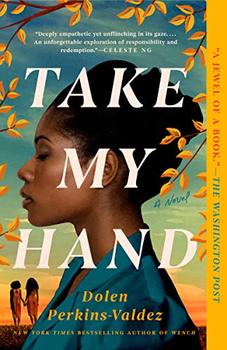
Take My Hand
by Dolen Perkins-Valdez
An Eerily Time, Heart-Wrenching Must-Read (6/11/2022)
Take My Hand is a fictional work based on actual events. In 1973, Mary Alice Relf, age fourteen, and her sister, twelve-year-old Minnie Lee, both mentally disabled, were surgically sterilized after their illiterate mother signed with an "X," mistakenly believing she was authorizing the provision to her daughters of birth control shots. It was not an isolated incident. In the 1970's, many poor women who received government assistance, particularly women of color, were coerced into agreeing to sterilization when threatened with a loss of benefits. The U.S. Congress established the Community Action Programs (CAPs) in 1964 to assist low-income households become self-sufficient. It was Alabama officials affiliated with that federal program who took the impoverished Relf girls to a doctor for Depo-Provera injections. But the drug had been banned, pending FDA approval. Nurses told the girls' mother they would be given "some shots" and convinced her to sign a consent form that she could neither read nor understand. When the truth came to light, a social worker took the girls to the Southern Poverty Law Center, which filed a complaint on their behalf. The ensuing litigation brought to national prominence the issue of involuntary sterilization and Senator Ted Kennedy held hearings that led to guidelines being promulgated. Ultimately, those guidelines were ruled insufficient to prevent involuntary sterilization and the federal court condemned the practice, holding that federal funds cannot be used for involuntary sterilizations and enjoining the practice of threatening women with the loss of benefits if they refused to accede. Eventually, the Department of Health and Welfare issued acceptable regulations outlining when sterilization in federally funded programs is medically appropriate and authorized. "The case is considered a pivotal moment in the history of reproductive injustice, as it brought to light the thousands of poor women of color across the country who had been sterilized under federally funded programs." In the wake of Relf v. Weinberger, the concept of reproductive freedom expanded to encompass both the right to have children and the right to be free from unwanted pregnancy.
Perkins-Valdez says that when she first heard the Relf girls' story and became aware of the case, her reaction was "outrage. I couldn't believe it and wondered why more people don't know the story." Her inspiration for Take My Hand was envisioning and wondering how the spirits of the Relf girls might want her to frame their story. She commenced three years of research and "everything" that she learned surprised her. The Relf girls were sterilized just one year after the shameful, four decades-long experimentation on Black Tuskegee men with syphilis came to light and marked the culmination of decades of eugenic policy -- egregious and racist -- including a push by Margaret Sanger to control the reproductive lives of Black women. She also discovered that reproductive justice has not been achieved in post-Roe v. Wade America. For example, in 2013, it was revealed that between 2006 and 2010, approximately 150 women were involuntarily sterilized in California prisons. In Tennessee, it came to light in 2014 that prosecutors were incorporating stipulated agreements for permanent birth control into plea bargains, and a whistleblower reported in 2020 that immigrant women in Immigrations and Customs Enforcement facilities were sterilized without consent.
Despite her extensive research, Perkins-Valdez could not find any accounts from the nurses who worked at the clinic in Montgomery, Alabama, where the Relf girls were sterilized. So she created Civil Townsend, a nurse, to serve as the lead character and narrator of the book. Perkins-Valdez wanted to understand what it would be like to be a nurse working at a clinic where such atrocities were taking place -- how they could make sense of what was happening there and would react to such an incident occurring "on their watch." The book opens in Memphis in 2016, with a sixty-six-year-old Civil addressing her daughter, Anne, who has just graduated from college. She says she must tell the story of India and Erica as a "reminder to never forget" and to lay "ghosts to rest." Civil has learned that India is very ill and she is going to go visit her, but first wants Anne to understand how her "story is tied up with those sisters."
The action then moves back to March 1973. Civil is only twenty-two years old, and has just graduated from nursing school and begun working at the Montgomery Family Planning Clinic along with two other young, new nurses, supervised by Linda Seager, a stern "white woman working in a clinic serving poor Black women." Civil is the daughter of a local doctor who wanted her to go to medical school and join his practice. But Civil is idealistic and chose to be a nurse because in the medical hierarchy they "were closer to the ground. I was going to help uplift the race, and this clinic job would be the perfect platform for it."
Early in the book, Civil reveals that she had an abortion in the spring of 1972 -- before Roe v. Wade legalized abortion. Perkins-Valdez says including that event in Civil's history frightened her because she had never included such a story in any of her prior work and she was scared about readers' reactions. She had to research how Civil would locate an abortionist, where she would have the procedure, whether she would be provided with after-care, including pain medication, etc. The location she uses in the book is the site where abortions were provided illegally. But she concluded that Civil takes the job at the clinic in order to give women more reproductive freedom than she herself enjoyed. "It made sense that she would have been through that, because that part of the motivation for working at that clinic is so important to her," Perkins-Valdez notes. "She doesn't want the women to go through what she went through." The decision to include that aspect of Civil's history was the correct one because it enhances Civil's motivations. It also provides context, dimension, and emotional depth to Civil's story and, regardless of the reader's stance on abortion, makes Civil more sympathetic because she thinks about her choice, the procedure, and what might have been. She is not yet at peace with her decision or her relationship with the father, even though she tells her daughter, "There is no greater right for a woman than having a choice, Anne. I exercised that right. Fully and consciously."
Civil quickly discovers that birth control is an instrument of oppression of Black women. Clinic staff aggressively pressure them to use birth control and Depo-Provera, then an experimental drug, is being routinely given to clinic patients. At first, Civil assumes it is safe but is troubled to find out that it has not received FDA approval.
There is an outreach component to Civil's duties and early in her tenure at the clinic she is assigned an off-site case. She dreads the journey out into the country the Williams' home. "Now when I say the country, I'm talking the country country. No running water. Outhouses. Unpaved roads," she recalls. "Up close the structure was more of a wooden shanty than a cabin" with no telephone so Civil isn't sure her patients are expecting her visit. But she meets Erica, age thirteen, and her sister, India, who is mute. They live in unimaginable squalor with their widowed father, Mace, who is just thirty-three years old, and his mother, Patricia, age sixty-two. "Walking into that house changed my life," Civil relates. "And yes, it changed theirs, too. I walked right up in there with my file and bag of medicine, ready to save somebody. Little old me. Five foot five inches of know-it-all." She discovers that India is being given birth control even though she is a mere eleven years old, is not sexually active, and has not even begun menstruating. And Erica, just two years older, insists that she has never even kissed a boy and admits that she bleeds all the time, a side effect of Depo-Provera. Civil is enraged. And resolved.
From that first meeting, Take My Hand focuses on Civil's efforts to help the Williams family. She is young, naive, and ignores the medical protocols she was taught in nursing school, her involvement and relationship with the family members growing increasingly personal. She is determined to help them find better housing, unabashedly using resources available to her to do so, even as she recognizes that she is jeopardizing her career by not maintaining the requisite professional distance from the family. Her clinical practices are also risky. And she feels that her efforts are making a difference, but Ms. Seager will not be deterred, making the Williams sisters pawns in a dangerous game of power in which Seager asserts her will. What happens to the Williams sisters becomes "the greatest hurt of" Civil's life -- a watershed moment that impacts her, as well as the entire Williams family, and alters the trajectory of their lives and relationships.
Perkins-Valdez knew that Civil and the girls had to hail from different socio-economic classes. Indeed, college-educated Civil explains that she and her family "managed to live dignified in undignified times," and she had advantages that the Williams girls did not, even though they still fought to survive "the humiliations of the Jim Crow life." Perkins-Valdez recognized early on that she was writing a book about Black class dynamics and wanted to explore what it would be like for the two families to encounter each other. She does so skillfully, describing in detail the day-to-day details about the families' lives and letting the images of their disparate living conditions illustrate how different their experiences of living in the same small area of Alabama has been. She also expertly allows their voices to effectively make the point that the two families are living in two different Americas, neither of which is a land of freedom or equality for persons of color or the poor.
Perkins-Valdez's extensive research lends validity and depth to the powerful story, and her characters are fully developed. Perkin-Valdez relates their engrossing story with compassion and insight. Erica and India are clever, believable young women, as well as heartbreakingly sympathetic, and Mace, their father, is fascinating. He's a man searching for a way to create a better life for himself and his family who has been beaten down by a system rigged against him, the death of his beloved wife, and his own flaws. Patricia, the girls' grandmother, is wise and appropriately skeptical, but also loving and appreciative.
Civil is a woman looking back over a period of forty-four years, evaluating her life and her choices as she stands on the cusp of retirement. She has enjoyed a successful career and flourished as a mother, but news of India's illness, along with contemplating the next phase of her life, compels her into something of an "apology tour" during which she meets with her baby's father for the first time in many years and is reunited with the Williams sisters. Civil is as objective as anyone can be about her decisions and actions all those years ago, admitting her own faults and acknowledging that her life can be divided into two parts -- before she met and after her involvement with the Williams sisters. "Now I know why I came on this trip. I needed to make my peace. Ain't nothing like peace of mind, Anne." Indeed. Perkins-Valdez's treatment of the story is evenly paced, vividly credible, and utterly heart-wrenching, inviting readers to become deeply invested in Civil's richly emotional narrative to see whether she is finally able to reconcile the past.
Valdez-Perkins says she hopes that Take My Hand "will provoke discussions about culpability in a society that still deems poor, Black, and disabled as categories unfit for motherhood." The book is both timeless and eerily timely given that the right to reproductive freedom is far from assured in the United States with the U.S. Supreme Court on the brink of overturning Roe v. Wade and many states are enacting laws that restrict or completely annihilate reproductive choice. Thus, in addition to being a beautifully crafted, absorbing, and thought-provoking tale that will surely be on lists of the best historical fiction published in 2022, it is also an important book that belongs in every history classroom. Because Perkins-Valdez correctly believes that "the power of the novel (and its readers!) to raise the alarm, influence hearts, and impact lives" is tangible.
Thanks to NetGalley for an Advance Reader's Copy of the book.

The Lioness: A Novel
by Chris Bohjalian
A Masterfully Crafted Mystery Set in an Exotic Locale (6/9/2022)
Bestselling author Chris Bohjalian says his inspiration for The Lioness was movies. He loves them. One day in 2019 he found himself wondering why he had never written a Hollywood novel or a book set in the era in which he grew up, the 1960's and 70's. He had to think of a locale to which he could transport Hollywood people and put them in jeopardy. In the 1960's, the Simba rebellion was unfolding as East Africa sought to escape from colonialism, so he decided on the Serengeti with a simple premise: "The biggest star in Hollywood finally gets married and decides to bring her entire entourage with her on a honeymoon safari" which quickly goes horribly wrong.
Bohjalian and his wife were lucky to go on safari in the Serengeti to conduct research in October 2019, a trip he describes as "life-changing for me as a human being and as a novelist." Far from civilization, he watched the wildebeest cross the Mara River, and observed instances of natural predators conquering their prey. He also had the opportunity to pose numerous, frequently macabre, questions to his knowledgeable guides, who assured him that the key to remaining safe on safari is following the directions provided. The guides explained that exiting a vehicle or leaving a tent at night can prove deadly because "there are so many animals (including snakes) and trees that will kill you." Bohjalian deftly incorporates those tangible dangers into The Lioness, making it terrifyingly suspenseful. Some of his characters fail to heed the guides' warnings, while others find themselves in the wild without their guides by their side through no fault of their own. Regardless, many of Bohjalian's characters are forced to use what knowledge they possess about nature in an effort to stay alive. Not all of them succeed.
The Lioness is a masterfully crafted, engrossing story of a thirty-year-old actress, Katie Barstow, who is a major Hollywood star. She and her older brother, Billy, are the children of acclaimed stage actors who were abusive. They grew up on Central Park West in a sprawling apartment and Billy bore the brunt of their mother's toxicity as their father mostly just went along with her actions. Katie has just married Billy's lifetime best friend, David Hill, whose family resided in the same New York City apartment building. David owns a struggling art gallery in Beverly Hills, and insists that his father works for the CIA but is a 'paper-pusher" laboring in the agency's personnel department. Billy is married for the second time to Margie and they are expecting their first child.
Accompanying them on the safari are Felix Demeter, a screenwriter, and his wife, Carmen Tedesco, an actress who has appeared in films with Katie in supporting roles; actor Terrence Dutton, Katie's co-star and good friend; Reggie Stout, Katie's publicist; and Katie's agent, Peter Merrick. Charlie Patton, renowned for leading hunting safaris with Ernest Hemingway, among others, leads the expedition.
Four days into the safari, the group is kidnapped by evil Russian mercenaries and Bohjalian takes readers along with his characters on a harrowing journey. They are transported in two groups by armed captors led by an intriguing and intermittently charming leader "with ice-blue eyes and a nose that a casting director would kill for if he ever needed a boxer." As the characters attempt to discern the motive for their abduction, they witness and are subjected to appalling violence. Individually and collectively, they assess whether they can outsmart and overpower their kidnappers, and make their way to freedom. But, of course, they are far from civilization with no idea how far they might have to travel to enlist help. And they are in the Serengeti, surrounded by wildlife including leopards, hyenas, and venomous snakes, so they are forced to weight the risks, including the very real possibility that they might evade their abductors only to perish in the wild. The setting is inarguably one of Bohjalian's characters, and he vividly describes the landscape, making readers feel the remoteness and isolation, and looming presence of those things that will kill you. He unsparingly details the dangers his characters encounter. "Character and geography intersect in all of my books," he notes, but they are inextricably and palpably intertwined in The Lioness.
The narrative structure of The Lioness is creative and highly effective. The Prologue, related via a first-person narrative from, presumably, the Lioness, declares, "We went there and (most of us, anyway) died there in 1964." Each successive chapter focuses on a specific character. Bohjalian reveals both the character's history and relationship with the other characters, as well as his/her expectations for the trip and what they are experiencing in Africa. Readers learn about the characters' Hollywood careers and alliances. Bohjalian propels the story forward at a steady pace, but his deftly-timed respites from his characters' fraught circumstances allow readers to understand, relate to (or not), and develop emotional attachments to the characters so that they become invested in the characters' fates. Some of the characters are innocent victims who find themselves in the wrong place at the wrong time. And for some of them, the horror they are experiencing dredges up painful memories. For instance, Katie and Billy's mother used to lock him in a large closet in their home for hours at a time. So when, with his hands and feet bound, he is tossed into a dark hut where all manner of creepy, crawly things might attack, the abuse he sustained as a child intensifies his fears and anxiety. Bohjalian acquaints readers with Benjamin Kikwete, a porter and guest liaison, who proclaims that he'd "rather die charging like a rhino than bleating like a goat." His story is nothing less than heartbreaking, if inspiring. Some of the characters harbor dark secrets and scandalous pasts that, if brought to light, would cause relationships to fracture and derail careers. Some are betrayers . . . some have been betrayed, but may not know it.
The Lioness is a cautionary tale about fame. Like the Serengeti, Hollywood is a critically important character in the book. At the beginning of each chapter, Bohjalian includes blurbs -- some actual, some invented -- from a magazine or newspaper that was published in 1964, among them The Hollywood Reporter and Movie Confidential. To do so, he researched the popular movie magazines of the era, dubbing them "Twitter's ancestor." Much the way social media does today, those magazines influenced the public's beliefs and perceptions about actors and actresses, often exploiting but sometimes keeping performers' secrets, and spreading fake news. Bohjalian also weaves pop culture history into the story, including references to stars of the day. For example, famed Caucasian film director Otto Preminger dated Dorothy Dandridge, a Black actress, but their relationship was "only alluded to" in the magazines and trade publications. As the story progresses, Bohjalian cleverly unveils how fame plays into his characters' predicament, paving the way for the horrors they experience.
And Bohjalian also explores racial tensions. Terrence Dutton, a successful Black actor, recently co-starred in a film with Katie. They have been great friends for some time, but their relationship has remained platonic, in part, because if a romance became public, Katies observes, Terrence would never again work in Hollywood. The movie they made was controversial and one particular scene stopped short of their characters kissing. Bohjalian examines how Terrence's experiences and complex emotions as a Black American visiting Africa differ from those of the other members of the group. He interacts not only with his traveling companions, but also with the African guides and porters who work for Charlie Patton. For example, Benjamin is thrilled to be serving the group and notes how down-to-earth Terrence is. He can't wait to tell his father that Terrence, who is only the third Black man from America Benjamin has ever met, told Benjamin to address him by his first name. Will he get the chance?
Reminiscent of Agatha Christie's And Then There Were None and, more recently, Peter Swanson's Nine Lives, characters are eliminated, one by one, in various dramatic and horrific ways. Simultaneously, Bohjalian reveals who organized the kidnapping and why, pulling together various story threads and clues dropped along the way, and again demonstrating what an adept and creative storyteller he is.
The Lioness is an engrossing, entertaining, and wildly inventive mystery populated with fully developed, compelling characters. It's a page-turner -- an adventure set in the most exotic location imaginable -- filled with plenty of themes to keep readers both guessing and thinking about the price of fame and glamor, and how well anyone can really ever know those closest to them. What might they do if faced with similar threats? And what about the title character? Who is The Lioness? Does she survive? Once again, Bohjalian has created a strong female character who exhibits bravery, determination, and resolve she did not even know she possessed until faced with unimaginable danger. By the end of the story, she confesses, "I really do see myself in my mind as a lioness . . ."
Thanks to NetGalley for an Advance Reader's Copy of the book.

The Personal Librarian
by Marie Benedict, Victoria Christopher Murray
A Timely & Timeless Story That Has At Last Been Told (5/18/2022)
The Personal Librarian is a seamlessly related and meticulously crafted fictionalized account of the life of a woman who presented one identity to the world while hiding her true self because she "didn't want the color of her skin to be used as a weapon against her, an excuse to keep her relegated to the lowest jobs, the worst neighborhoods, with little possibility for a better life." It is a poignant, engrossing, timely and timeless story about the lengths to which one woman would go in order to rise above the constraints society placed on her and her family.
Belle's story is told via a first-person narrative, making it powerful and impactful. Authors Marie Benedict and Victoria Christopher Murray meticulously researched their subject but Belle was, of necessity and purposefully, intensely private. Based on the information available to them, Benedict and Murray have believably imagined and crafted conversations, as well as Belle's inner dialogue as she navigates the world. Belle was determined to succeed in a world designed to hold her back. Clever, calculating, witty, and beautiful, Belle was adept at using all of her assets to her advantage. She had to be. Because everything was at stake. And not just for her, but for her entire family because she supported them financially, enabling them to move to increasingly more comfortable apartments as Morgan generously increased her salary when she successfully procured the pieces he desired and elevated the library's stature.
Belle's father was not only the first Black graduate of Harvard University. He was also an activist, a contemporary of Frederick Douglass, Charles Sumner, and Booker T. Washington, known for his oration. But Belle's mother "saw the writing on the wall." When politicians began dismantling Reconstruction, her father lost his job as the first Black professor at the integrated University of South Carolina and the school was converted to a whites-only private men's college. She explains to Belle, "Your father and I lived through a brief, fleeting time in history when equality might have been possible." But the "lofty postwar ideal of integration" evaporated, the world comprised only of "black and white, two races separated, but certainly not equally." She recognized what Belle's father refused to: "Our only hope would be to live as white." And so they did.
But when Belle's mother reported to a 1905 census worker that the family was white, her father was infuriated to the breaking point and left. "Once she made the decision that they were going to live as white, she changed their names, she told them how they had to behave and, from the age of sixteen on, Belle was walking the footsteps her mother laid out for her," explains Murray. Indeed, throughout the book, Belle is "walking a tightrope" and struggling to reconcile her guilt with her ambition. She "felt that she was betraying her father but also helping black people." Belle secretly knew that her achievements were, in fact, the achievements of a a woman but, more particularly, a Black woman. Even if the world did not. Yet.
Belle was a woman compiling a vast and priceless collection of rare books, manuscripts, and art, an unparalleled accomplishment. She traveled abroad and skillfully negotiated to purchase artifacts she deemed necessary to elevate the library to unmatched esteem. But she did so in the employ of J. P. Morgan (1837-1913), a man of vast wealth and power who financed railroads and helped organize U.S. Steel, General Electric, and other major corporations. He was demanding and unforgiving, an anti-Semite who reminded Belle that she was emhis/em personal librarian, sometimes treating her like she was yet another of his possessions. Or worse, in Belle's mind, a slave. They disagreed and quarreled, but she strove to avoid angering or embarrassing him, aware that he would fire her instantly were her secret revealed, bringing ruin upon her entire family. Belle revered him and he was drawn to her -- based on their research, Benedict and Murray suggest a sexual tension between them. He came to consider her the most important person in his life, providing generously for her in his will.
Benedict and Murray effectively portray the evolution of their complex relationship, as well as Belle's interactions with Morgan's mistresses and children, especially his daughter Anne. Unmarried, Anne was rumored to be in a "Boston marriage," a euphemism for wealthy women who chose to eschew marriage to live independently and, perhaps, enjoy an intimate relationship. Their fractious encounters cause Belle concern, especially when Anne makes references to her "people," and questions her background, snidely telling Belle, "I though I heard something about your family having tropical roots." Belle shrewdly leverages the rumors about Anne to her advantage and relates the story that Belle's mother devised about Belle's grandmother hailing from Portugal to explain Belle's olive skin tone. It appeases Anne for a time, as it does others who inquires.
Belle never married, but she did have a decades-long relationship with Bernard Berenson, an expert on Renaissance-era art, which is explored in depth. It is both a heartbreaking and empowering aspect of Belle's life, as depicted by the authors. As a young woman, Belle was forced to accept that marriage and motherhood would not be in her future. She says, "I've always known that, because of my heritage, a traditional relationship would not be possible for me ... because a marriage means children, and that is something I cannot hazard. Without the fairer skin of my siblings, I could never risk bearing a child whose skin color might reveal my deception." But Belle wanted to experience love and romance, and in Benedict and Murray's telling of the story, although she had other lovers, she gets the opportunity to feel loved through Berenson, a man in an unconventional marriage with other secrets of his own. Like her relationship with Morgan, Belle's affair with Berenson changes her profoundly.
How did Belle manage to pass for so many years, her secret never revealed? Murray believes that she would certainly never be able to pull it off today. But in the Gilded Age "to white people she looked white, but to black people, she looked black because of their features." As part of her deception, Belle was taught by her mother never to make eye contact with African Americans employed in service positions. There are times in the story, however, when Belle knows she has been seen by waiters and others, although they do not give her away. After one such encounter, Belle wonders, "Why does she serve while I am served? Why is it that the relative whiteness of my skin has given me this chance at privilege? It seems incomprehensible, but it is thus." Such details included in the narrative illustrate the complicated life Belle led -- always calculating, looking over her shoulder, and devising plausible explanations, constantly afraid that someone who knew the truth about her and her family would reveal it.
Of all of her accomplishments, the one that mattered most to Belle was making two men proud of her -- Morgan and her father -- for very different reasons. Her father's departure from the family impacted Belle deeply because of their close relationship and his tutelage about art and other subjects. Eventually, because of her notoriety, Belle dares not be seen with him in New York, so she is not able to personally show him her life's work. She knows his words are true: "Changing your name is easy. Changing your soul is impossible." She dreams of reinventing herself yet again and ponders coming forward with the truth in order to serve as an example to other Black people. But she never did.
The Personal Librarian is Belle's story, told in a compelling, engrossing, and richly moving manner that provides insight into and appreciation for Belle's triumphs, as well as sacrifices, as she strove to achieve her goals in the only way possible to her at the time. As he father tells her in a conversation imagined by Benedict and Murray, "One day, Belle, we will be able to reach back through the decades and claim you as one of our own. Your accomplishments will be part of history, they'll show doubtful white people what colored can do. Until that time, live your life proudly."
Benedict and Murray hope that readers, especially book club members, will reach out to each other and use the book to launch conversations about race in a way that feels safe.
Thanks to NetGalley for an Advance Reader's Copy of the book.
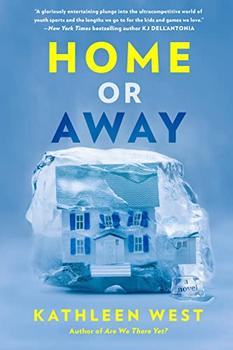
Home or Away
by Kathleen West
A Story About Abuse of Power Set Against the Backdrop of Competitive Sport (5/13/2022)
Author Kathleen West is a lifelong Minnesotan with more than twenty years' experience as a schoolteacher. She continues teaching English while focusing her writing on motherhood, ambition, competitive parenting, and work-life balance.
West describes Minneapolis as "the perfect place to write a hockey book. . . . Minnesota is the state of hockey." It is an integral part of the school and youth culture, and West herself is a hockey mom. Her children fell in love with the sport and she has spent a decade in hockey rinks. Even so, to pen Home or Away she had to conduct significant research to educate herself about coaching and playing hockey. In addition to the fact that "Minnesota and hocky go together," she chose to focus the story around it because children begin playing at a very young age in order to excel at it. And hockey requires players to master several different skillsets, including skating and stick handling, in addition to game strategy. West found the intensity inherent in the sport important for her characters' traits, life choices, and reactions to what they experience.
The story is told from four characters' perspectives. At the center of the tale is Leigh, who grew up in Minneapolis playing competitive hockey and, along with her good friend and teammate, Suzy, goes to Lake Placid to train and, hopefully, secure a place on the 2002 Olympic team. For Leigh, competing in the Olympics will be the culmination of years of preparation, and she is singularly focused on her goal. By the time she leaves for the summer, she is in a relationship with Charlie. When she arrives in Lake Placid, she realizes that competition for the team is even more intense than she imagined it would be, but she has attracted the attention of an assistant coach, Jeff Carlson. She believes him when he assures her that, although he does not have final decision-making power, he can definitely influence the selection of Olympic team members. Leigh is young, ambitious, and determined to achieve her goal at any cost. Still, her compromise is not enough and she listens in stunned disbelief as the team members are announced but her name is not called. She returns home to Minnesota dejected and bitter, and gives up hockey. She persuades Charlie to marry her shortly thereafter and launches her career in investment banking.
Worse, Leigh carries a terrible secret that, if revealed, could destroy the life she builds with Charlie in Florida where he works as the assistant manager of a bookstore and toils sporadically on his first novel which, unbeknownst to Leigh uncomfortably parallels her experience. In their marriage, Leigh is the primary breadwinner, and Charlie bears prime responsibility for their household and rearing their nine-year-old son, Gus. Like his mother and Leigh's brother, who coaches hockey in Minnesota, Gus loves the sport and is excited to move to a place with a more robust youth program.
West also relates the story from Gus's perspective as he maintains a "Hockey Bible" in which he chronicles his practice times, milestones, and advice received from his coaches. His consternation about competition, fitting in, and his mother's role in his placement on the team in a division for which he is not sure he is qualified, is endearing and, at times, heartbreaking. West credibly depicts his emotional struggles and voice. He enjoys hockey and knows that his mother, more than anyone, wants him to excel. But is he playing the sport because he is passionately devoted to it and fueled by the same kind of ambition his mother had? Or is he just trying to please his parents by living up to their expectations?
The story is also related from the vantage points of Charlie and Susy. Charlie is affable, devoted to his family, and a bit overwhelmed as he attempts to assimilate into the the world of hockey parents. He wants only the best for Charlie, and looks to Leigh, her brother and his fellow coaches, and the other parents for guidance since he did not play hockey. His passivity and gentle nature both attract and repel Leigh, who finds herself at a crossroads soon after relocating. She is reunited with Susy, who knows the truth about what happened in Lake Placid. She could see that Leigh's focus was not where it should be and she was not working hard enough. Suzy has remained active in the sport as a coach and mother of a talented daughter who is competing. Susy's growing friendship with Charlie alarms Leigh, who fears that she will reveal to Charlie what she knows about Leigh's past. Divorced, Susy finds herself increasingly drawn to Charlie ("the nicest guy in the universe" who looks "like a literal movie star") and frustrated by Leigh's actions and the way Susy believes she takes Charlie for granted.
Leigh learns that Jeff has been accused of abusing young, vulnerable female athletes that he coached after that lifechanging summer in Lake Placid, and she is asked to provide information about her experiences. Jeff's fundamental character traits remain the same as two decades earlier. He is still overbearing and manipulative, and convinces Leigh that he holds the power to influence her son's success as a competitive player. The secret she has kept for so many years weighs heavily on her, as does her guilt, as she debates whether to accede to Jeff's demands or risk everything and everyone that she loves by telling the truth.
The most compelling and emotionally resonant aspect of Home or Away is West's exploration of the power dynamics between male coaches and female athletes. West places Leigh and Susy in the midst of the emergence of women's hockey in the mid to late 1990's, culminating in Susy earning a place on the U.S. Olympic team when Leigh did not. Seeing Susy again -- an Olympic medalist -- churns up feelings that Leigh has refused to confront for twenty years. Coupled with pressure from both Jeff and other women who want her to speak her truth in order to ensure that Jeff is held accountable for his behavior, Leigh must finally reconcile her past at the risk of the life she has built. She is not just wracked with guilt and afraid of the fallout from having the truth exposed. She is also proud and determined not to let her parents and brother down again. After all, her father created a place in her parents' home where her Olympic medal was going to be displayed and that place has remained empty for twenty years. It represents an empty space deep within Leigh where she has been unable to forgive herself. As West notes, "She refuses to let people in or admit weakness" and her stoicism blinds her to the truth about her behavior in Lake Placid. But at her core, Leigh wants to do the right thing, which forces her to grapple with a stark reality: she has the unique power to aid the young women who have lodged complaints about Jeff's abuse of power. West deftly examines the nuances of the #MeToo storyline from the viewpoints of Leigh and Susy, as well as the voice of Leigh's new friend, Nicole, a savvy and assertive attorney. She also compassionately depicts Charlie's emotional turmoil as pieces of the puzzling truth about his wife and her decisions begin falling into place. Charlie and Leigh eventually grapple with whether their marriage can withstand betrayals and lies through understanding, forgiveness, and abiding love and respect.
Home or Away is at once a charming look at family life in America's heartland and a searing study of the pressures budding athletes feel to succeed, with internal and external stressors weighing upon them. Between chapters, West inserts emails from the officious team manager to the "Listen Heights Hockey Fam" which are darkly hilarious and frighteningly realistic, demonstrating the extent to which some parents become obsessed with their children's athletic pursuits. And although West successfully centers the tale around hockey, she could have fleshed out her universal themes within the context of any competitive sport.
West's characters are multi-layered and believable, and Leigh's conundrum is both timely and, sadly, timeless. Her dilemmas are relatable, and West skillfully makes every character both flawed and sympathetic so that readers will find themselves taking Leigh, Charlie, Susy and, in particular, little Gus into their hearts and hoping that they can successfully navigate the crisis into which they are thrust.
Home or Away is entertaining, engrossing, and, best of all, thought-provoking.
Thanks to NetGalley for an Advance Reader's Copy of the book.
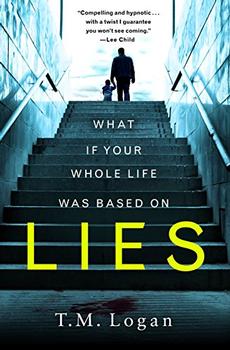
Lies
by T. M. Logan
An Impressive Debut Psychological Thriller (5/9/2022)
How well can one ever really know another person? Is faith always blind? How much trust can be confidently placed in the person with whom one shares a life, home, children?
Those are the overriding questions that haunt Joe Lynch as he unwittingly becomes embroiled in the mysterious disappearance of Ben Delaney, a man with whom he is merely acquainted when his four-year-old son, William, spots Mel’s car on the highway. Observant William insists that it indeed is his mother’s car, so Joe gives in to the little boy’s pleas to see her, telling William, “Let’s go and surprise Mummy.” Instead, it is Joe who is surprised to find his wife in a hotel restaurant with Ben, the husband of Beth, Mel’s best friend. Ben is animated and plainly angry, pointing his finger at Mel, “his voice a barely controlled growl.” Matters only worsen when Joe, in an effort to protect William, returns to the parking garage. Mel drives off before he can get her attention. However, he does start a conversation with Ben, who denies having seen Mel in the restaurant. The discussion quickly escalates into violence as Ben yells at Joe that he is a “classic underachiever” and so “dense that you haven’t seen it, have you?” Confused by Ben’s commentary, Joe defends himself against Ben’s assault. When Joe drives out of the garage, Ben is lying on the ground, unconscious and bleeding. By the time Joe returns to the garage, Ben has vanished.
Thus, Joe’s innocent desire to make their young son happy by paying Mel a surprise visit ensnares him in a frantic quest for answers. Joe quickly realizes that everything he has believed about his wife and their relationship has been a lie. It appears that not only is Ben obsessed with Mel, he is determined to destroy Joe in order to get what he wants. Ben is a charming, highly successful, and wealthy businessman known for his ruthless competitiveness. He simply does not lose. And because he is in the tech industry, his knowledge of computers and other devices is far superior to Joe’s and allows him to embroil Joe is a dangerous cat-and-mouse game. Ben’s wife, Beth, claims that he returned home after the altercation with Joe but quickly left the house, taking a shotgun with him. She also reveals dark secrets about their marriage that lead Joe to believe that Ben poses a threat to all of them. Joe is convinced that Ben is alive, but taunting him as he makes it appear that Joe has murdered him. Thus, Joe sets out to prove that Ben is not only alive, but the mastermind behind a series of events that jeopardize Joe’s reputation and career, including an altered photograph that is posted on Facebook. Logan’s inclusion of plot twists involving and illustrating the inherent danger of social media provide an opportunity for Joe’s observations about the “compulsion to share every event, every emotion, every success, every random thought, every half-funny conversation.” Joe opines that “it’s not the photographing and sharing and broadcasting that makes something what it is. It’s the doing. The being. The experience of it. . . . That’s the truth. That’s what’s real.”
Lies is the debut psychological thriller from author T.M. Logan, who admits to telling “quite a few fibs” during his years as a writer. Until he inked the publishing deal for Lies, he kept his writing aspirations from everyone except his family and close friends, noting, “Like a lot of people, I was a secret writer.”
Logan’s talent is no longer a secret. Lies is a tautly imagined and plotted thriller with a jaw-dropping ending, featuring an empathetic and sympathetic main character in Joe Lynch. Joe is truly a good man, devoted to his wife and son, committed to his profession (teaching), and honest. Through Joe’s first-person account of the nightmarish circumstances in which he finds himself, readers understand and can relate to his frustration, anger, and sheer terror at the prospect of being wrongly accused of committing a heinous crime. Assuming, that is, that Joe Lynch is a reliable narrator.
Once Mel is revealed to have deceived her husband, she is also a suspect, although her possible motive for wanting to further hurt Joe is far from apparent. Ben’s inspiration is clear. But Logan keeps readers guessing as to exactly what happened to Ben, who is responsible for his fate, and exactly why Joe finds himself at the center of the mystery until the very end of the story. The pace never slows, accelerating to a shocking conclusion that will take most readers completely by surprise and cause them to ask themselves, “What if your whole life was based on a lie?” Lies is an impressive and engrossing first novel, and bodes well for the prospect of more intriguing thrillers to come from Logan.
Thanks to NetGalley for an Advance Reader's Copy of the book.

The Island
by Elin Hilderbrand
An Enjoyable Beach Read (4/13/2022)
The four women’s time on Tuckernuck is supposed to bring them respite from their troubles. Chess is by far the most troubled, a fact her mother has recognized, and about which she is deeply and understandably alarmed. Prior to leaving for the island, Chess has seen a therapist every day who has recommended that she write her thoughts and feelings in a journal. As she does so, readers gradually learn out the real story behind her breakdown.
Chess is easily the most compelling of the four characters, as well, simply because her mental condition seems genuinely fragile. Sure, the others have problems, but they pale in comparison to the fact that Chess is experiencing the first real crisis of her life . . . and it’s a doozie. Although she is portrayed as a bit of a whiner at the outset, Chess is reminiscent of Robert Redford’s “Hubbell” in The Way We Were: Everything has always come too easy to her. She is bright, beautiful, outgoing, competitive. She has attained every goal she ever set for herself and gotten everything she ever wanted. Until, that is, she met Michael and his brother, Nick, and realized for the first time that love can be complicated, hurtful, and impossible to disregard. As her secret is slowly revealed, it becomes clear that Chess is weighed down by guilt and that weight is fueling her retreat from life. But should she feel guilty? Did she do anything wrong? Was she — along with Nick — responsible for Michael’s unhappiness? Or his fate? And where does she go from here? After all, life on Tucknernuck is nothing more than a temporary retreat, not a permanent solution.
India is tough, having survived a tumultuous, if loving, marriage to artist Bill, as well as his suicide and its aftermath. She is looking forward to being a grandmother soon, but her recent experience with Lula has proven deeply unsettling for a variety of reasons. She is attempting to maintain a professional and appropriate distance from Lula, who is plainly interested in much more than a business relationship with India. She is concerned not just about the actual implications of launching a relationship while Lula is a student, but, rightfully, the potential perception of impropriety. More importantly, Lula has stirred feelings in India that she has never experienced before and, although she wants to pursue them — if she can clear the professional hurdles — she is fearful of what her family and friends will think.
Tate has been in love with Barrett since she was a teenager. But back then, he only had eyes for Chess. He was smitten with her older sister as, it seemed, all the boys were, even though Chess had no interest in him. Their father even arranged a date for Chess and Barrett which turned out quite badly. In the thirteen years since Tate has seen Barrett, they have both matured. Tate is a successful businesswoman, while Barrett has taken over his father’s maintenance business. He is a widower with two young sons to raise. Will Barrett finally notice and appreciate Tate? Or will his old feelings for Chess be rekindled when he sees her again, especially now when she is so vulnerable and in need of support?
Lastly, there is Birdie, who divorced Grant because he was more married to his career than to her. She knows that her feelings for Hank are not right — he is, after all, still married, even if his wife is incapacitated with no hope of recovery. Hank has wined and dined her, showering her with the kind of attention she longed for from Grant. But with Grant she has the comfort and familiarity that comes with having been together for over three decades, during which they raised two beautiful daughters. Their time has passed . . . hasn’t it? Grant will never change. He’ll always be obsessed with his career . . . won’t he?
Author Elin Hildenbrand has created four female characters and placed them in an entrancing setting. Her descriptions of Tuckernuck are rich with detail and imbued with loving vignettes about the island, its traditions and inhabitants. It is a place any reader would want to visit, sheltered from society and accessible only by boat, even though the house is somewhat crude, lacking hot water and only generating enough electricity for a few small appliances. No cell phone reception? No problem. A brisk walk to the end of the island where there is reception is good exercise on a warm summer day, and a wonderful opportunity to further explore the island.
After a month at their island hideaway, it is no wonder that by the time the book concludes, all four women are feeling better about themselves and their lives, rested and rejuvenated after lying on the beach, eating light meals, taking walks, and sleeping as much as they want while contemplating their problems, and pondering solutions. With the possible exception of Chess, none of the four women are facing very serious issues, and all are fortunate in that they have complete financial stability. Still, each character is well-developed, her history fleshed out in sufficient detail to place her current concerns in context. And each is at a crossroads — none of their lives will be the same after they leave the island and return to their “real” lives and responsibilities. By the end of their vacation on Tuckernuck, has each woman learned something about herself? Yes, and that makes the read worthwhile.
The Island is enjoyable, the action moving along swiftly with a few surprises and plot twists thrown in to keep things interesting. It is the perfect book to pack in your tote bag and read on the beach or by the pool. The theme, tone, characters, and pace all combine to make it a delightful “beach read.”
What Happened to the Bennetts
by Lisa Scottoline
Nail-Bitingly Suspenseful and Deeply Moving (3/28/2022)
"What Happened to the Bennetts" gets off to an explosive and tense start on the very first page. Bestselling author Lisa Scottoline's inspiration for the story came from being tailgated, an experience that caused her to wonder what could happen should being followed serve as the prelude to a carjacking. She opted not to speed up because she was enjoying the drive in a wooded area of Pennsylvania, near her home. So as the story opens, the Bennetts, an unremarkable American family living in southeastern Pennsylvania. Jason operates his own court reporting business and his wife, Lucinda, is a photographer. They are en route home from daughter Allison's soccer game in Jason's recently purchased Mercedes. Allison is in the back seat with her younger brother, Ethan, and the family dog, Moonie, when Jason notices a pickup following their vehicle too closely on the single-lane road that winds uphill through the woods. Like Scottoline, Jason has no room to maneuver his vehicle over in order to permit the pickup to pass. Also like Scottoline, Jason does not want to accelerate, because he feels he has a right to drive as he sees fit. He resists his family's urging to speed up and "smoke" the pickup with his powerful new car. Eventually, though, he relents and as he accelerates, so does the pickup, passing the Bennetts' car, pulling in front of it, and then stopping, blocking the road. Two men jump out of the pickup, brandishing weapons, and inform Jason, "We're taking the car." The carjacking ends tragically.
Reeling, the Bennetts return to their home after meeting with local authorities, who theorize that the carjackers were looking for a getaway vehicle after committing a double homicide. And the Bennetts were simply in the wrong place at the wrong time. They are shocked to find FBI agents on their doorstep at 3:15 a.m. Agents Dom Kingston and Michael Hallman explain that the two assailants were members of GVO, a crime syndicate that distributes and sells opiates, and had just killed two retail-level drug dealers in the organization. The Bennetts are now in the cross-hairs of GVO. Because their lives are in danger, they need to enter the witness protection program for their safety and well-being. Immediately.
Scottoline effectively relates the story from Jason's point of view, utilizing a first-person narrative. The FBI explains to the family that they will be under the watchful eyes of the FBI twenty-four hours per day in a safe location, but "there can be no communication" with their family, friends, employees, neighbors or friends. Lucinda's inability to continue caring for her mother, who suffers from Alzheimer's disease and resides in a care facility, is particularly distressing. They will not even be permitted to attend a close family member's funeral. They must simply vanish. After a family meeting, they reluctantly come to the conclusion that, although the FBI cannot force them to enter the program, they do not really have any other option. Jason explains, "We left our lives in silence. . . . We'd had fifteen minutes to pack, . . . Deep inside me was the most profound sorrow I had ever known, one that had settled in, unpacked, and took up residence."
Scottoline was surprised to learn that the FBI would probably hide the Bennetts somewhere in Delaware. Jason shares Scottoline's shocked reaction when he learns he and his family are being transported to the Delaware coast, just outside a beach town that is largely deserted during the off-season. The safe house is adjacent to a saltwater tidal marsh and the surrounding houses are mostly vacation homes, closed until the summer season begins. Agents Kingston and Hallman (affectionately known as Wiki, because of his encyclopedic knowledge about many topics) reside in a smaller home on the same lot that houses their command center. Jason quickly learns there are cameras mounted everywhere, including in the trees, and the agents will maintain round-the-clock surveillance as part of their "Babysitter's Club" assignment. Jason soon bonds with Dom (Agent Kingston) as they jog together and Dom explains the circumstances that prompted him to transfer out of an undercover assignment. Most importantly for purposes of Scottoline's tautly-crafted story, Jason gradually comes to trust Dom, believing that the agent's only priority is keeping him and his family safe.
The marshlands surrounding the safe house are dark, slippery, and mysterious, and Jason relates how any solid ground he once felt beneath his feet has been ripped away from him. But he is determined to keep his family safe, no matter the cost.
In the absence of facts, the Bennetts' friends, neighbors, and business associates begin speculating about what has become of them. They take to social media to commiserate and seek answers, and Lucinda's best friend lodges a missing persons report with the police. Rumors and theories swirl, and Jason discovers a website maintained by an amateur sleuth who bills himself as "America's premier citizen detective." He is convinced that Jason murdered his family and went on the run, which only adds to Jason's misery . . . and determination.
Scottoline compassionately describes the emotional devastation that Jason and his family feel about the prospect of leaving their lives behind and starting over in every conceivable way. It is especially difficult for young Ethan, who keeps asking about his friends and when they will be going home. Lucinda came from a well-off family, but Jason had a modest upbringing on a farm near Hershey, Pennsylvania. Jason completed one year of law school before dropping out for financial reasons. In combination with what he has learned during his years as a court reporter, he knows more about legal procedure than most non-lawyers. But the one topic that has never come up during all of the depositions he has transcribed is the witness protection program. He quickly discovers that it was not really designed to shelter innocent witnesses to crimes. Rather, most of the "applicants" are criminals who have entered into plea agreements under the terms of which they provide evidence against other perpetrators in exchange for the opportunity to slip into the kind of new lives Jason and his family want no part of.
So even though they have been warned about engaging in any online behavior that might reveal their whereabouts and jeopardize their security, Jason utilizes his legal prowess to begin researching the carjackers and their connections to other criminals, especially GVO. And decides that he and his family are not going to simply give up their lives and relationships. Jason is bent on unraveling the mystery so that his family's attackers and anyone with whom they conspired can be brought to justice . . . and the Bennetts can reclaim their lives.
At that point, Scottoline takes readers along as Jason undertakes a rogue, action-packed search for the truth and to ensure that justice is served. His dangerous journey is filled with shocking revelations -- some heartbreaking -- along with surprising plot twists, and numerous near-misses. Scottoline introduces a cast of intriguing supporting characters along the way, both friend and foe, as she gradually reveals that what initially appeared to be a random carjacking was anything but.
At its core, What Happened to the Bennetts is a richly emotional rumination on marriage, parenting, betrayal, and forgiveness. Scottoline illustrates that Dylan Thomas was, to a certain extent, right. If you are able to go home again, you will find that home has most changed during your absence. But more importantly, you will definitely have changed. So after all that they have lost, and everything they have endured, the Bennetts cannot simply return to their home and pick up where they left off.
The Bennetts are fully developed and relatable characters who are yanked by tragedy out of the sameness and complacency of their very ordinary day-to-day existence. Circumstances force them to address their assumptions, the things they have taken for granted, and evaluate whether their marriage can and should survive the mistakes they have made. Ultimately, Scottoline says the book is about both "the triumph of an individual and also the triumph of a family when they work together to deal with the most horrible thing they can imagine happening to them."
And what is better than a relentlessly fast-paced, nail-biting, and deeply moving story about family, love, and justice? If told by the incomparable Scottoline, absolutely nothing. What Happened to the Bennetts is Scottoline at her best and that is very good indeed. It is thoroughly engrossing, entertaining, and thought-provoking.
Thanks to NetGalley for an Advance Reader's Copy of the book.

Big Summer
by Jennifer Weiner
A Beach Read with Surprising Suspense & Depth (3/23/2022)
Big Summer, by bestselling author Jennifer Weiner, opens with a foreboding prologue set in 1994 involving a young woman named Christina who is happy raising her son on her own at her family's cabin on Cape Cod. "Her story was almost at its end, but that night, she had no idea" as she sang to her four-year-old son. The story then advances to 2018 and the focus shifts to Weiner's protagonist, Daphne, an up-and-coming plus-size Instagram influencer who has been offered a chance to showcase the clothing of Leela Thakoon. Daphne is thrilled when the attractive garments fit perfectly and make her look and feel "like the vest version of" herself. A collaboration is born.
In her first-person narrative, Daphne relates how she came to be a young woman who has eschewed dieting and is determined to simply be true self. As the only child of doting parents, she had no idea she was overweight until a fateful weekend with her body size-obsessed grandmother. That was the point at which her psyche was irrevocably altered, and from which she gradually "learned every trick for taking up as little space as possible and not asking for much." She describes her first day at the exclusive new school where her father taught, but a scholarship was required in order for her tuition to be paid, and meeting the other students. Two in particular play prominent roles in Daphne's story. Darshi, who, as the story opens, has been her faithful friend for many years and her roommate for the past four. And Drue Cavanaugh.
Weiner describes Drue as a "thinly veiled Ivana Trump-like" character -- the wealthy and glamorous girl who is the most popular in the school. The other girls emulate her, craving her attention and approval. Shockingly, Drue embraces Daphne on her very first day at school, even inviting her to eat lunch with her and her friends. But Drue is manipulative and calculating, and Daphne details specific instances of Daphne using and abusing her. Still, Daphne remained her loyal friend throughout school, writing papers for her, keeping her secrets, covering for her when she cut class or was too hungover to function. The friendship, such as it was, endured because even though Drue repeatedly abused Daphne's generous spirit and her trust, Daphne still wanted to be like her: beautiful, funny, self-assured, and decidedly cool.
At long last, however, Drue goes too far and a particularly cruel machination causes Daphne to stand up for herself and declare she has had enough. The incident is videotaped and goes viral, transforming Daphne's attitude and life. She changes the name of her blog from "Daphne's Craft Corner" to "Big Time," vows to focus on her health and well-being, rather than her weight, and six years pass during which she has no contact with Drue.
But Drue reemerges, appearing in person when Daphne ignores her emails and texts. And she has a surprising request. She wants Daphne to be her maid-of-honor when she marries in a lavish ceremony on Cape Cod. She pitifully insists that she has no close female friends, has missed Daphne, and acknowledges that her past behavior was horrible. She blames, in part, her parents' dysfunctional marriage and her lack of a relationship with her dismissive father, who has had multiple affairs over the years. She even offers to pay Daphne. Daphne is torn -- resolved not to get reeled back into Daphne's life and the drama their friendship inures, but ultimately swayed by happy memories of time spent together as young girls.
Daphne also recognizes that she can parlay the event into Instagram posts featuring photos taken in a stylish setting at one of the biggest social events of the summer. She relents, despite her misgivings and a strong hunch that she is being used by Drue. Daphne's number of Instagram followers grows as soon as Drue begins posting about the wedding and Daphne's role in it, and Daphne struggles to escape her uneasiness. But Darshi is direct, warning Daphne that Drue will hurt her again and when she does, she will not be there to comfort Daphne, aptly calling Drue her "Kryptonite."
The story veers in a direction most readers won't see coming. The party at the estate the night before the wedding proves to be a magical one for Daphne when she meets a handsome and charming man who wants only to spend time with her. But the party is disrupted by a loud argument between Drue's parents that sends the bride-to-be retreating to her room. The book shifts from women's fiction to a murder mystery, with Daphne searching for two mystery men: the one she caught lurking outside Drue's door the previous night, as well as the one with whom she spent the night who disappears before she wakes up. Worse, Daphne, like all of the other guests, is questioned by the police, and becomes convinced that she could be viewed by the authorities as a suspect. The police are motivated to find the killer quickly, after being embarrassed by their incompetent handling of a murder that occurred in the area years ago. Darshi, being the loyal friend that she has always been, rushes to Daphne's side and they begin sleuthing, determined to unmask the murderer.
Weiner pulls off the genre-switch seamlessly, her cleverly-constructed, intricate plot unfolding during the latter half of the story. She examines the dark side of social media in a credible manner, revealing the ways in which some of her characters connive to use their status as influencers -- and other characters -- to attain fame and wealth. She deftly pulls all the loose threads into a cohesive story in which every character's significance becomes apparent -- including Christina and her son, Aidan, the subjects of the prologue that most readers will have forgotten all about by that juncture.
Daphne and Drue are fully developed characters, and as the story progresses, Weiner highlights the traits that differentiate them, as well as their common humanity. Weiner makes Drue a sympathetic character by exposing the truth about her family and upbringing, illustrating that outward appearances are, of course, deceiving. Readers come to understand the environment and lessons that made Drue who she is. Daphne's narration hits all the right notes as she describes her own familial relationships and home life, as well as her internal struggle to accept and love herself. Daphne is intelligent, self-deprecating, insecure, tenacious, and, most importantly, highly self-aware. She is likable, and has a strong moral center and commitment to justice. Female readers will recognize aspects of themselves in Daphne, whose emotional battles are almost universally relatable. The complicated, sometimes hilarious and frequently heartbreaking relationship between Daphne and Drue is believably and compassionately portrayed by Weiner as is her depiction of the love, envy, exasperation, and, finally, understanding and empathy Daphne feels for the woman who is so consequential in her life.
Weiner has succeeded at making Big Summer a witty and enjoyable beach read, as well as an engrossing exploration of the contradictions between real and virtual life. The book is also a surprisingly thought-provoking examination of friendship and how profoundly the friends we choose can impact our lives.
Thanks to NetGalley for an Advance Reader's Copy of the book.

The Heights
by Louise Candlish
A Riveting Examination of Parenting, Grief, Betrayal, & Revenge (3/22/2022)
Bestselling author Louise Candlish's latest novel, The Heights, is a book within a book, as well as a family drama. The protagonist, Ellen Saint, is a participant in a writing seminar, drafting a memoir. As the chapters of Ellen's story unfold, they are interspersed with excerpts about it from a feature in the Sunday Times, the reporter's commentary adding interesting color to the tale.
Ellen suffers from "high place phenomenon," a common form of vertigo that causes people to experience an irrational urge to jump from high places such as bridges, rooftops or balconies. It does not mean that the individual is suicidal, but is, rather an intrusive thought and form of mild anxiety, as well as autonomy. As the story opens, Ellen is meeting with a client when she looks out a window and recognizes Kieran Watts standing on the roof of an adjacent tall building called The Heights. She is convinced she is looking at Kieran and equally convinced that the man cannot be Kieran. She knows Kieran is dead because she killed him. He was a monster who ruined her life.
In her first-person narrative, Ellen takes readers back to 2012, relating how she gave birth to her son, Lucas, when she was quite young. She and his father, Vic, broke up when she later fell in love with Justin, her husband, with whom she shares fourteen-year-old daughter Freya. Theirs is a modern family, with Vic living a fifteen-minute walk away. He has dreamed for years of starting a craft beer company, and continues making pitches in hopes of finally inking a deal.
Lucas is sixteen years old -- a strong student with good enough grades to attend a university of his choice, handsome, and well-liked. Ellen loves him boundlessly and is a fiercely protective mother. Foxwell Academy assigns him to serve as a buddy to a "vulnerable new classmate," the aforementioned Kieran, who resides with his foster mother in a different neighborhood but scored well enough on placement examinations to be enrolled in the exclusive school. Ellen describes having heard tales with "a daredevil theme" about Kieran before she met him, which evoked images of a handsome, athletic boy. Instead, upon meeting him, she sums him up as "short and fleshy, with deep red hair that he had a habit of tugging at and skin bumpy with acne." Her immediate reaction to him is visceral, noting that he looks at her with a "death glare . . . so deadly, so chilling, I actually shivered . . . " Ellen is taken aback by her own response to meeting the boy. She knows that Kieran, who lacks any social graces, has had a difficult childhood and she should be gracious in her assessment of him, but despite her self-awareness, she cannot control herself. She is convinced that he is trouble. Will her instr instinctual reaction be accurate? And how reliable is Ellen's recitation of the facts?
Indeed, Lucas falls under Kieran's influence, despite his parents' attempts to prevent it. Kieran has no interest in college or the future at all, for that matter. He is interested only in taking drugs and partying, and Ellen experiences a mother's worst nightmare. She loses all power of persuasion over Lucas who begins using drugs, lets his grades slip, and jeopardizes his admission to college.
Ellen's fixation on Kieran becomes increasingly pronounced as Lucas grows distant and defiant. Both Vic and Justin love Ellen in their own ways and have, over the years, developed mechanisms to copy with Ellen's anxieties and neuroses. They have found that confronting her with facts and logic is counterproductive so, rather, they appear to be supportive of her machinations. In Vic's sardonic first-person narrative, he details the ways in which he manages Ellen, noting that he probably should have drafted a "how to" guide for Justin. Although they are also concerned about Lucas, neither of them are as alarmed by his friendship with Kieran as Ellen is, which she finds utterly exasperating. Justin chastises her for characterizing Kieran as "evil," put off by what he deems to be histrionic behavior on Ellen's part. He believes that Kieran makes Lucas and his friends laugh and poses no real danger to any of them. "What is it going to take for you to start believing me? When something really bad happens, will you believe me then?" Ellen demands.
And, of course, something really bad happens. When the worst kind of tragedy befalls Ellen and her family, Ellen neither believes that Kieran's version of events is truthful or that justice is served. She wants vengeance, which propels her obsession with Kieran to a reckless new level and she convinces Vic that they must take matters into their own hands. He agrees and they devise a plan that she believes -- but never independently verifies -- is executed successfully, which empowers her to carry on with life, focused on Freya, Justin, and her career as an interior lighting designer. Until, that is, until her fateful sighting of Kieran on that rooftop that launches her on a manic search for the truth. It's a lonely journey, because no one believes her when she insists that he is, in fact, alive.
Candlish's plot is intricately-crafted, inventive and suspenseful. Ellen demonstrates just how far she will go to hold Kieran accountable for his misdeeds, but is she willing to put everything on the line a second time if, in fact, she is right about him being the man on the rooftop? And what is he doing there? Does he actually live in that tony building? How can he afford to do so? Who is the mysterious man who warns her to stop seeking answers and what is his interest in the matter? And how do Vic's actions figure into the mystery?
As always, Candlish's characters are intriguingly multi-layered and fully developed. Vic and Justin are believable as the men who have loved Ellen for years, accepting her as a high-strung, protective, but unquestionably devoted mother. They have always tolerated what they perceive as her quirks. They fail to share Ellen's extreme concern about Kieran's potential impact upon Lucas and their family until it is too late.
Maternal instinct is a powerful, driving, and often unerring force in a mother's life. Candlish deftly portrays the dichotomy between the men's reactions to Kieran's influence over Lucas . . . and Ellen's. She also credibly depicts Ellen's outrage at having her feelings dismissed and being viewed as bordering on hysteria. She believes her instinctual responses justify her actions, and she will not be pacified until she knows the full truth, no matter the cost. Ellen's story will resonate with readers. Through it, Candlish examines grief, neurotic over-parenting, and the ways in which her obsession with Kieran and the aftermath of the tragedy impact young Freya and her relationship with her mother.
Candlish's deviously clever plot is full of unexpected betrayals and revelations, and shocking twists that propel the story forward at an accelerating pace until the very last page. Candlish inspires readers to contemplate what they would do if they found themselves in a situation like Ellen's -- how they would protect their child from harm if they were absolutely convinced that the child was making self-destructive choices and, should the unthinkable occur, the lengths to which they would go to extract retribution. The Heights is another riveting thriller from a master storyteller.
Thanks to Atria Publishing for a paperback and NetGalley for an electronic Advanced Reader's Copy of the book.
Girl in Ice
by Erica Ferencik
A Gripping Adventure Imbued with Science Fiction & Mystery (3/14/2022)
Girl In Ice is set at the extremely remote Tarrarmiut Arctic Science Station, a research facility off the coast of Greenland. At that very venue, linguist and professor Val Chesterfield's twin brother, Andy, allegedly committed suicide five months earlier by walking outside in the dead of night wearing only his boxer shorts and freezing to death. What would cause Andy to take his life in that manner? Val and her brother have been deeply troubled not about Andy's death, and skeptical of the reported circumstances surrounding his demise.
Val receives an email from Wyatt Speek, Andy's mentor and fellow researcher, to which he attaches a brief recording, asking her to come to the research station. The recording is just a snippet of a young girl speaking in an unknown language and Wyatt insists that he needs Val's expertise to decipher it. Val suffers from anxiety: "the crippling kind. I'm tethered to the familiar, the safe, or what I perceive as safe," she explains in the first-person narrative Ferencik employs to tell the story. She pays a visit to her ninety-one-year-old father at the nursing home where he is cared for. He was once a climate scientist "with a fierce intellect and fiercer temper," and Val has always known that Andy was his favorite child. Because their father has never believed that Andy killed himself, he convinces Val to go to Greenland not only to solve the mystery about the language the young girl is speaking but also to find the truth about Andy's death. He persuades Val, in part because Andy and Val made a pact to never hurt themselves and Val can't accept that Andy broke his promise.
With her anxiety medication in hand, Val travels to the research station for a seven-week mission. There, in addition to Wyatt, are married polar marine scientists Nora and Rajeev Chandra-Revard who will be working in a dome over the ice, diving into the icy water to retrieve samples and specimens to be studied. Like Val, they have signed a contract prohibiting them from discussing the girl anywhere except at the site. Jeanne, the station's mechanic and cook who lost her husband and daughter to a drunk driver, decided to leave Minnesota to work with Wyatt at the research facility.
Wyatt explains how he found the girl encased in ice, frozen as though running, and with a battery-powered saw cut a huge block loose and transported it to camp. He adamantly claims that she thawed out alive. Since then she has only screamed and thrashed about, breaking lamps and dumping everything out of the kitchen drawers. "She's freaked-out and confused. Inconsolable." Indeed, when Val first comes face to face with her, she screams and runs away. She refuses to bathe and wears a far-too-large, filthy Christmas sweater that once belonged to either Wyatt or Jeanne. Wyatt demands that whatever progress Val makes be reported solely to him.
Ferencik relates a fascinating tale about how Val, a woman who must suddenly confront her demons, bonds with the little girl. Eventually her named is revealed to be Sigrid. Val works to gain the child's trust even as emshe/em becomes increasingly distrustful of Wyatt, the stories he tells, and his motives. Gradually, Val and Sigrid form a tenuous bond, as Sigrid repeats words that Val struggles to understand -- they appear to contain only fragments of the languages about which she is knowledgeable. (The language Sigrid speaks was actually created by Ferencik to tell the tale.) Sigrid draws the same picture over and over, with increasing vehemence that convinces Val she is attempting to communicate something vitally important. But what is she trying to convey? At the same time, Val's suspicions about Wyatt are heightened by her discoveries of evidence related to his ongoing research and experiments. Val forms an alliance with Nora and Raj, who are also growing extremely wary of Wyatt, and keeps her progress with Sigrid a secret from him, fearful of what he may be capable of doing with the information.
Ferencik's evocative prose sweeps readers off to Greenland, along with Val. Her descriptions of Val's trip there, as well as the terrain and harsh conditions, are stunning, providing an immersive backdrop against which her story plays out. Her characters are well-defined, especially Val, a highly intelligent and empathic linguist who has recently divorced a "rageaholic." She battles anxiety that limits her ability to fully experience life, and her trip to Greenland -- the exact place where her twin brother recently died -- exacerbates her fears and misgivings. But she is committed to her work and, once she meets little Sigrid, feels a deep commitment to helping the child communicate what she has endured and, hopefully, be returned her to her home and family.
When Val first arrives, Sigrid does not, according to Ferencik, see the value in communicating. She appears to be about seven or eight years old, but if Wyatt's story can be believed, she was frozen in the ice for hundreds of years. She has awakened in a strange place, surrounded by people who dress and speak in ways she could never have imagined, and as time goes on, she begins to sense who among the adults are her friends and who cannot be trusted. She becomes ill and her desperation to make Val understand what is happening to her and what she needs intensifies. As Val begins piecing together the clues that Sigrid is providing, it is clear that there is no time to waste, and Val emmust/em secret her progress from Wyatt, whose behavior becomes increasingly erratic and frightening. She grows defiantly protective of Sigrid.
Ferencik says, "A big part of being human is a deep desire to be understood. Really understood, because if we don't feel seen, there is no bigger loneliness." Communication is the centerpiece of Ferencik's story, but it is not limited to the burgeoning transmission of information and feelings between Val and Sigrid. Val must look at Sigrid's movements and gestures, listen to her, pay attention to her inflection, and study her drawings (that she hides from Wyatt) in an effort to understand what Sigrid is trying to tell her. Ferencik also showcases the various ways that Val and the other characters communicate, and how their communication style impacts their relationships, especially in the case of Val's troubled relationship with the father she always believed viewed her as second best to Andy.
Grief is another theme explored in the story. Every character is grieving in some way. Val is mourning Andy, Sigrid misses her family, and Jeanne has escaped to Greenland after tragically losing her husband and daughter. Wyatt is "grieving himself and his lack of success," while Nora and Raj have lost a child, which is one of the reasons why they form a strong attachment to Sigrid.
Grief is intricately intertwined with fear, and Val's anxiety causes her to fear many things. Can she overcome her fears in time to prevent tragedy? "I've always loved thrillers that take place in challenging settings," Ferencik relates. And a more challenging setting is difficult to imagine. The "great polar Enormity" -- as Val calls it -- enhances the risks associated with simply existing (the dangers include subzero temperatures, blinding snows, and polar bears, just for starters). That, coupled with the circumstances in which Val finds herself, and Ferencik's deft acceleration of the story's pace toward an explosive conclusion, make the dramatic tension palpable and compelling.
Girl In Ice is an engrossing adventure imbued with elements of science fiction and mystery, at the heart of which is an insightful and thought-provoking examination of the way in which people communicate with each other and overcome fear, as well as a commentary on climate change and what we can let science teach us. Readers will find themselves taking both Vale and little Sigrid into their hearts, cheering Val on as she strives to overcome her fears and provide Sigrid with what she needs to survive . . . before time runs out.
Thanks to NetGalley for a paperback copy of the book to review.
Before She Disappeared
by Lisa Gardner
Fabulous Beginning of a Compelling New Series (3/3/2022)
Bestselling author Lisa Gardner has penned the first volume in another series at the heart of which is a strong female protagonist. But Frankie Elkins, unlike Detective D.D. Warren, is not a trained professional. Rather, she's an ordinary woman with a troubled past . . . and a mission.
The fictional D.D. Warren is a Detective with the Boston Police Department, a city in which Gardner formerly resided. Frankie once "had a house, a car, a white picket fence . . . " Gardner does not explain what happened, but Frankie has no home now. Rather, she goes wherever the cases lead her and volunteers her time. She has no interest in payment or recognition, and has so far solved fourteen cases without finding a single missing person still alive. Most recently, she located the body of a twenty-two-year old woman locked in a her vehicle at the bottom of a lake. She had been missing for eighteen months. Usually, Frankie finds her next case online, frequenting chat rooms and forums where family members and friends join "crazy people like" her to discuss the investigations conducted by local authorities, and share theories and information. Frankie doesn't own a computer. Instead, she visited the library in the town where her last case concluded.
That has led her to Boston, a city she has never previously visited, in search of Angelique Lovelie Badeau, who was fifteen years old when she disappeared eleven months ago. She walked out of school on Friday afternoon, but never arrived at home. "No sightings. No leads. No breaks in the case." Her friends call her Angel, but she is LiLi to her family.
Mattapan is a Boston neighborhood with the largest Haitian population in the United States, aside from Florida. It is also a rough area populated by poor working people, replete with gang activity and violent crime. That doesn't deter Frankie who arrives determined to find a job and apartment, and commence working the case. She is particularly interested in cases involving minorities.
Frankie is an alcoholic who needs to attend Alcoholics Anonymous meetings regularly in order to safeguard the sobriety she has maintained for more than nine years. She explains, in the first-person narrative Gardner employs, that she "gave up drinking and took up always being on the move instead." She grew up in a small Northern California town. Her father also drank and her mother worked two jobs in order to support the family. And a man named Paul saved her until she grew strong enough to save herself. She thinks about Paul frequently, but Gardner does not reveal the nature of their relationship or precisely what happened to him. Gardner describes Frankie as "haunted," and "living outside the norms of society — and yet in doing so, finding herself. She is not who the world expects her to be, but she is exactly who she needs to be." She is an endlessly fascinating character, in part because Gardner only offers periodic clues to what motivates her to lead the life she does.
The mystery at the core of this first volume is intricately crafted and populated by intriguing supporting characters. Gardner's story implicates societal issues including immigration, racism, and human trafficking, and is propelled forward at an unrelenting pace as she adds layers of complications, motives, and characters with reasons to keep Frankie from locating the missing girl. Frankie narrowly escapes danger more than once, as she seeks to understand how exactly LiLi went missing, given all of the ways that people's whereabouts are tracked in urban areas. A fifteen-year-old leaves clues through social media, a cellular telephone, friends, and camera feeds located throughout the neighborhood, yet LiLi vanished.
Frankie indeed takes a job in a bar that includes a small, furnished upstairs apartment. An aggressive cat named Piper is included in the deal. Stoney, the owner, is "a man who's seen it all and lived to tell the tale" and can "communicate volumes with a single eyebrow," and he seems to appreciate Frankie and her demons. Frankie's efforts are at first met with skepticism by LiLi's family and, initially, derision by Dan Lotham, the lead detective on the case. But Frankie works to ear the trust of LiLi's family and Lotham recognizes that Frankie gets results -- she has a knack for getting information from people who refuse to cooperate with the authorities -- and if the two of them work together, they might make progress. Because Frankie has no special skills or training, is not a licensed private investigator or affiliated with the local police department, she is not bound by procedures designed to ensure that the rights of subjects or witnesses are not trampled. She can and will submit requests for information in conformity with the Freedom of Information Act or ask the families of the missing to authorize the release of specific documents if law enforcement officials refuse to share information with her. She is committed and determined, and has "a gift for asking the right questions" that Lotham respects and decides to capitalize on. And their attraction is immediate and palpable, but Frankie clearly enunciates her circumstances to ensure that their expectations are manageable and realistic. "Good guys like him have a weakness for train wrecks like me. Just ask Paul," she wryly notes.
Frankie is determined that LiLi's case will be her first real success -- she will find the missing girl alive and return her to her family. But she has to stay alive herself in order to do so. With Before She Disappeared, Gardner lives up to her well-earned reputation as "the master of the psychological thriller." Frankie is a uniquely intriguing, credible character to whom readers will find themselves immediately drawn and invested in her well-being as they strive to understand her. And transfixed to see if she succeeds and, perhaps, decides to remain in Boston with a handsome detective.
Before She Disappeared is Gardner at her very best, which means it is a page-turner that leaves readers clamoring for the next installment.
Thanks to NetGalley for an Advance Reader's Copy of the book.
How to Find Your Way Home
by Katy Regan
Reconciliation, Forgiveness & New Beginnings Are Possible (3/3/2022)
How to Find Your Way Home, author Katy Regan's sixth novel, is a beautifully crafted and deeply moving examination of a family torn apart by betrayals, lies, and alliances, and the impact they have upon the individual members' lives.
In a third-person narrative, Regan details events beginning in 1987 when newborn Emily Adele Nelson was introduced to her older brother, Stephen. Those chapters alternate with a first-person account from Emily, commencing in March 2018, as well as another third-person narrative focused on Stephen that correlates with what Emily is experiencing. The siblings grew up exploring the English marshes and the birds that inhabited them. Stephen was a typical energetic boy, but also sensitive and thoughtful. And totally enamored with all kinds of birds. Tagging after and wanting to emulate him, Emily shared his devotion and, with their father, birdwatching and studying about birds were integral to their lives.
But Regan establishes at the outset that Emily, living in London, is preparing to celebrate her thirty-first birthday, a day that will bring her "another year further from the day in '99 Stephen was taken from me." She searches the internet in vain for him or a mention of him, a clue to his whereabouts. She is in the latest in a long string of short-lived relationships and, by all outward appearances, seems to be a happy woman with friends and a stable career. But she reveals that she "can't do life, you see, everything feels wrong; I can't make plans or commit to anything, I can't love or be loved. Not while there's this piece of me missing, this giant hole in my heart."
Stephen has spent the past fifteen years living on and off the streets, his latest homeless stint having spanned six weeks. Now thirty-five years old, he has served time in prison and battled substance abuse, but is currently sober. He has learned how to navigate an unwelcoming world and survive harsh conditions, always taking solace from the birds he still loves. He sells a few sketches of them to earn money. Two things have kept him alive: hope and his beloved birds. "I had my birds. They've saved me," Stephen says. He has been estranged from their mother for a long time, and her life took an unhappy turn at some point. She has been caring for their profoundly disabled stepfather, Mitch, for years, even though Emily has consistently urged her to place Mitch in a care facility. Emily dares not mention Stephen to their mother, although Regan does not initially reveal what caused the rift between them. Their father has remarried and is preoccupied with his stepchildren, his relationships with both Emily and Stephen strained.
Stephen arrives in Emily's head each morning before she leaves for work, her thoughts "laced with anxiety: Where was he today? How was he? What was he doing right now? Occasionally I'd just be treated to a memory, a lovely one," often associated with excursions to the marshes to see their cherished birds. Emily works as a housing officer at a social services agency tasked with placing suitable applicants in public housing accommodations. Of course, there is a housing shortage -- 1.15 million names are on the waiting list -- and stringent requirements that too many applicants cannot meet. She notes that "life begins with a roof over your hear, doesn't it? Without that, nothing can take off." Ironically, she has a lovely apartment filled with things she loves, yet "it doesn't feel like I live here. Sometimes, when I open the front door, I feel like a visitor." Every day, she hopes that Stephen, her homeless brother, will be among the countless people who come to the agency seeking assistance.
And then one day, she becomes aware of a familiar voice. It jolts her back to a day when she was about ten years old and Stephen was fourteen or fifteen. In her memory, Mitch is "bellowing" at Stephen as Emily tries to show their mother a shoe box inside of which is a tiny injured bird. Stephen is trying to explain that he wanted to save the bird, repeating, "You don't understand . . ." exactly as he is currently expressing his frustration at not being eligible for housing to Emily's colleague in the next room. Emily realizes that she is not dreaming. She is really hearing her brother's voice for the first time in years. But he leaves the agency before Emily can get to him. At least she knows he is alive and begins searching the area for him.
Regan instantly draws readers into the psyches of Emily, Stephen, and their parents, establishing their fraught relationships with each other and current circumstances. Cleverly, she does not reveal at the outset what caused the family to fracture or how a sweet young boy like Stephen has become a homeless thirty-five-year-old man with a criminal record.
Regan illustrates with tenderness and compassion that finding Stephen is just the beginning of a new journey for the family. When Emily locates him, he initially denies that he has a sister. However, after thinking about it, he reaches out to her and accepts her invitation to stay with him. She is determined to help Stephen get his life back on track, and he is delighted to be reunited with her, but interacting with her and her friends proves challenging for a man who hasn't enjoyed "normal" social interactions for nearly two decades. And he wants Emily to inform their mother that he is staying with her because he wants to be reunited his Mum, as well. Stephen has missed their mother -- perhaps most of all -- but Emily admits that while Stephen stays with her, "Every day I resolved to tell Mum that Stephen was here, and every day I failed." That failure initiates a series of events that cause all four family members to reevaluate their choices and feelings.
Regan makes expert use of the alternating chapters, gradually disclosing the betrayal that set in motion the disintegration of their family. Stephen and Emily were youngsters unequipped to deal with their parents' issues. Worse, Mitch was very different from their father -- a decorated veteran who bullied Stephen, mocking his love of birds, verbally abusing him about his refusal to consume meat, and complaining that he brought "revolting half-dead creatures into the house." Mitch threatened to kill the birds Stephen valiantly sought to save, and little Emily witnessed their horrifying interactions while their mother wrung her hands helplessly. Mitch was never smart enough to understand what Stephen knew from a very early age. That "birdwatching was all about being still and it was where life was for him, where the thrills were, if you were patient enough to wait for them."
Emily and Stephen work to mend their relationship so that they can move forward, but they must first reconcile the past. Their recollections about a traumatic event and its repercussions are different, but getting to the truth is essential to their ability to forge a new, lasting alliance. Regan skillfully depicts their exchanges through believable inner struggles and resonant dialogue. They embark on the adventure they promised themselves as children they would one day enjoy together -- experiencing the events on the Top Five list Stephen compiled so many years ago that includes spotting two rare birds in twenty-four hours and watching the swifts' migration from the Spurn Peninsula. They argue about how to navigate to the various locations, vehicle maintenance, and other matters in ways that readers with siblings will find completely relatable. And in the process they work through what tore them apart.
But can they reconcile the past? And when the full truth is at last revealed, will their bond remain unbreakable? Will the revelation of the truth facilitate understanding and forgiveness by their mother? Will Stephen at last find a permanent home where he can be content? Can Emily finally feel whole and at ease in her own life?
Regan answers each of those questions in a dramatic, but emotionally satisfying manner. In the process, she examines the ways that childhood trauma impacts her characters and shapes the course of their lives. She also explores how mistaken beliefs, faulty memory, a mother's failure to protect her children, and an older sibling's determination to shield his sister from pain cause fissures in a once close-knit family. Ultimately, Regan demonstrates that forgiveness is possible and can facilitate the restoration of familial bonds if the family members are willing to acknowledge their own role in the disintegration of their relationships and accept each others' truths. Indeed, sometimes those truths were apparent all along, but never voiced or validated.
How to Find Your Way Home is a must-read selection for readers who enjoy stories about families and, more particularly, siblings who overcome turmoil in their relationships and deal with its impact upon their lives. Regan's compelling characters and insightful story are both memorable, impactful, and uplifting. And affirm it is possible to feel as if everything you've ever lost is coming back to you -- all of it coming home.
Thanks to NetGalley for an Advance Reader's Copy of the book.
The Last Woman in the Forest
by Diane Les Becquets
A gripping and terrifying story about misplaced trust (3/31/2019)
Marian Engström has found her true calling as a field technician. It doesn't pay much, and she must ravel from assignment to assignment, but she loves training rescue dogs to help track endangered or threatened wildlife. It's a profession not for the faint-hearted or out of shape. The conditions are brutal, the physical demands extreme.
Marian joins a conservation study in northern Alberta where she is trained to be a dog handler by the handsome and ruggedly charming Tate Mathias. He professes love, talks about their future together, and even gives her a ring. Marian soon realizes that she has fallen for Tate and envisions the two of them forging a life together than combines their commitment to each other with their love of the wilderness and the dogs they train and handle.
Tragically, after Tate leaves on another assignment, Marian is advised that he has been killed by a bear.
Brokenhearted and grieving, Marian finds herself questioning what she thought she knew about Tate in light of inconsistencies between what Tate told her about his background and life experiences, and some of the information Marian learns from Tate's sister.
Four young women have been brutally murdered over the course of six years. When Marian begins to suspect that Tate could have been the killer, she reaches out to a retired forensic profiler, Nick Shepard, providing him with information Tate provided her. She also launches her own investigation into Tate's whereabouts on the dates of the killings and other details, including the real nature of Tate's relationship with coworker Jenness who has a connection to one of the murdered women.
As Marian inches closer to the truth, she is naively unaware that she is being stalked, her every move and thought known to the killer. Can she solve the mystery in time to save herself?
The Last Woman in the Forest is a unique, creative tale that for author Diane Les Becquets proved to be "absorbing, at times personal, and immensely rewarding . . . " It was inspired by the murders of six women along the Connecticut River Valley in the 1980's. The killer was never found. She was assisted in her research by and dedicated the book to John Philpin, a renowned independent criminal profiler. Both Les Becquets and her mother have been assaulted by men, and those experiences informed her writing, as well. She describes the book as her "attempt to address the fear and vulnerability too many women live with every day, and to encourage women to pay attention when something doesn't feel right, to heed that small voice inside themselves."
The result is an absolutely chilling tale of a young woman who falls for a man she does not really know anything about under circumstances that leave her highly vulnerable. After all, Marian and Tate are in the wilderness, Marian is attempting to make a good impression in order to advance in her career, and the very nature of their work takes them on a daily basis into remote regions where they are isolated and must depend upon each other and the dogs that accompany them for their very survival.
Les Becquets weaves the stories of the four victims into the narrative, describing in detail how they met their killer and made the fatal mistake of trusting him. The Last Woman in the Forest is a complexly layered mystery in which Les Becquets takes readers along with Marian as she uncovers, detail by detail, the truth about Tate Mathias and his actions. Marian and Nick are each, in their own right, sympathetic and endearing characters, which adds to the story's tension as the pace escalates to a terrifying level.
With The Last Woman in the Forest, Les Becquets succeeds spectacularly at telling a gripping, contemporary story of a woman who fails to heed that small voice inside, and may have blindly but willingly placed her trust in the wrong man. Will she pay for that mistake with her life? That is the question compelling the story forward to its jaw-dropping conclusion.
Thanks to NetGalley for an Advance Reader's Copy of the book.

Moloka'i
by Alan Brennert
starsA beautiful story -- haunting, compelling, and emotionally rich (3/3/2019)
Molokai is simply a beautiful story in which Alan Brennert features unforgettable characters. Brennert's love of Hawaii and meticulous research are fully on display throughout the rich tale of Rachel who, at the age of 7, is diagnosed with leprosy and torn from her family and happy life in Honolulu. Exiled to a leper colony on Molokai, Rachel is raised by the Catholic nuns who run the girls' home there. Rachel develops deep friendships with the other girls, as well as with, in particular, Sister Catherine. Rachel longs for her family back on Oahu and the prospect of returning to a normal life there, but as the years pass, and the disease remains active, thereby prohibiting her release, she draws upon the strength of those around her and the beautiful island of Molokai, as well as her Hawaiian heritage. Eventually, Rachel finds love and has a beautiful daughter with whom she is only allowed to spend a few hours before the child is cruelly taken from her lest she or her husband infect the child.
Rachel's story spans nearly 7 decades and is told with great compassion. Brennert educates readers on the beliefs and culture of the Hawaiian people, the sadly true history of Kalaupapa, the leper colony that is today a national park on Molokai, and the suffering of real Hawaiians who, like the fictional Rachel, were ripped from their homes and families when they displayed symptoms of the disease. But Brennert's focus is on his characters' strengths and resilience, not their suffering.
The result is a deeply moving story that will resonate with and haunt readers long after they finish reading the book. For readers who have never been to Hawaii or experienced its beauty, spirituality, and traditions, Molokai will permit them to understand the true meaning of "aloha" and precisely why Hawaii is commonly referred to simply as "paradise." Molokai gets my highest recommendation.