Page 1 of 1
There is 1 reader review for 1873
Write your own review!
 Janine_S
The gilded age wasn't so gilded
Janine_S
The gilded age wasn't so gilded
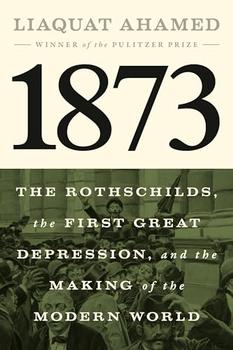
An examination of a global financial crisis and how it connects the inequality of the Gilded Age to the end of Reconstruction to the decline of the Ottoman Empire and to the rise of global antisemitism.
The crash of 1873 came out of boom years produced by events that included the discovery of gold in California in 1848, the rapid building of railroads in the 1850s-1860s, the accumulated debt from the Civil War, the reparations France had to pay Germany after the end of the Franco-Prussian War. People had more money to invest in risky things like projects in Egypt and Turkey for example. Fake projects and shady promoters appeared and as money went out and people used margins to gain wealth the banking bubbles eventually burst. At the same time instead of sticking with silver as the money standard, countries moved to gold which contributed to destabilization. When Grant vetoed a stimulus bill along with a series of scandals in his cabinet the way was paved for the shady election of Rutherford B. Hayes that resulted in the premature end of Reconstruction.
The book’s main focus though are the Rothschilds, the wealthy European Jewish banker family, who financed much of Europe’s growth and expansion during its Gilded Age. They did much to stabilize economies. Yet these efforts lead to the conspiracy theories of the day that it was the Jewish bankers who had shafted the counties of Austria and Germany. The term antisemitism arises in 1880. Such were the Rothschilds so reviled that in 1890 when a loan from them would have helped America, William Jennings Bryan had a clerk read from The Merchant of Venice.
While our current government crooks wax eloquently about returning to the Gilded Age (which had its fair share of corrupt politicians and millionaires), this book dispels its mystique. Money is a corrupter and greed is its willing ally. The look into the lead up of 1873 has some eerie correlations to today.
I gave this book five stars because it was well researched and written. It also presented information that shows how economies are global and provided interesting historical information many of us are not aware of. As with all history, and most importantly, it must strive to tell the truth and not what we want to hear because it fits our way of thinking - this book meets that important test.