
-
Your next favorite book
is waiting.
Summary | Excerpt | Reviews | Readalikes | Genres & Themes | Author Bio
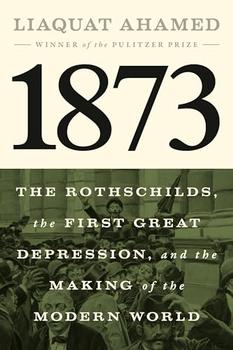
The Rothschilds, the First Great Depression, and the Making of the Modern World
by Liaquat Ahamed
1.
In Bonds We Trust
As the 1860s ended, the world's economy had never appeared in better shape. Few events were more emblematic of its health than the successful completion, within a few months of one an-other, of three monumental and iconic infrastructure projects that promised to remake global commerce.
On May 10, 1869, several hundred luminaries and railroad workers gathered on the windswept plateau of Utah's Promontory Summit, north of the Great Salt Lake. They were there to witness the linking of the Central Pacific and Union Pacific Railroads, marked by the ceremonial driving of an eighteen karat gold spike into the tracks. The moment signaled the realization of the first transcontinental railroad across the United States, collapsing the New York–San Francisco journey from six months to a mere six days. It had taken seven years to build at an estimated cost of $70 million.
Scarcely six months later, in November 1869, a more extravagant ceremony unfolded halfway around the world to mark the opening of the Suez Canal. It had cost $100 million. The celebration was a much grander affair. Three thousand European guests, including Empress Eugénie of France, Emperor Franz Joseph of Austria, Crown Prince Friedrich Wil-helm of Prussia, Prince Henry of the Netherlands, and Prince Louis of Hesse, were invited for the festivities, which lasted four days and came with a hefty price tag, said to have been $10 million. On the morning of November 17, 1869, a flotilla of forty eight ships, festooned with bunting and escorted by half a dozen Egyptian men of war, entered the canal at Port Said. At sunset, a northbound flotilla from Suez met them at Ismailia, the halfway point along the canal, where a new town featuring a palace, a hotel, and numerous villas had been built on the banks of Lake Timsah. There the guests enjoyed a sumptuous banquet—five hundred cooks had reportedly been imported from Trieste, Genoa, and Marseilles—followed by an elaborate fancy dress ball.
Four months later, on March 7, 1870, a more modest function took place at Jubbulpore (now Jabalpur), in central India, to mark the junction of the Great Indian Peninsula Railway with the East Indian Railway, thus linking Bombay on the west coast of India with Calcutta, fourteen hundred miles away on the east coast. Attendees included Prince Alfred, Queen Victoria's second son; Lord Mayo, the British viceroy; Sir William Vesey FitzGerald, the governor of Bombay; and a collection of Indian royalty, including the maharajas of the houses of Holkar, Rewa, Nagod, and Maihar. The prince opened the line by ceremonially hammering a simple silver spike into the tracks with a silver mallet, both specially cast for the occasion.
The near simultaneous completion of these three grand projects prompted much commentary in newspapers across Europe, saluting the transformative impact they would have on international trade and travel. One French paper even hazarded a guess that these three critical links in the global transportation chain would now enable a traveler to go around the world in fewer than eighty days—it even went so far as to provide a detailed itinerary for the imagined journey. The French adventure novelist Jules Verne chanced upon one such article, which seeded the idea for his classic book about a wager to circumnavigate the globe. Around the World in Eighty Days would eventually be published in early 1873.
All three projects had been built with substantial financial support from governments—tens of millions in land grants and government guarantees for the transcontinental railroads, $40 million poured into the Suez Canal by the Egyptian government, and a British government guarantee on the Indian railway bonds. Yet all three had been primarily financed through private capital, raised by issuing bonds on the stock exchanges of London, Paris, and New York, a testament to the remarkable financial machinery, constructed over the previous twenty years, for harnessing middle class European savings and channeling them into investments around the world.

Excerpted from 1873 by Liaquat Ahamed. Copyright © 2026 by Liaquat Ahamed. Excerpted by permission of Penguin Press. All rights reserved. No part of this excerpt may be reproduced or reprinted without permission in writing from the publisher.

Theo of Golden by Allen Levi
One spring morning, a stranger arrives in the small southern city of Golden. No one knows where he has come from…or why…




Your guide toexceptional books
BookBrowse seeks out and recommends the best in contemporary fiction and nonfiction—books that not only engage and entertain but also deepen our understanding of ourselves and the world around us.

