
-
Your next favorite book
is waiting.
Summary | Excerpt | Reviews | Readalikes | Genres & Themes | Author Bio
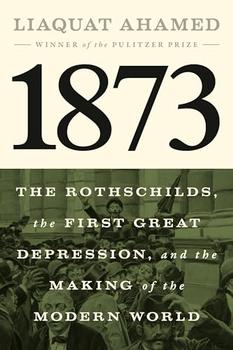
The Rothschilds, the First Great Depression, and the Making of the Modern World
by Liaquat Ahamed
As the new decade began, the machinery seemed to be humming along very smoothly. The world had just gone through a two decade long period of economic growth—the first truly global boom in Western eco-nomic history. The combined GDP of the four major economies had almost doubled, and the volume of world trade had expanded fivefold. Powering this surge was a jump in capital investment, which rose almost two and a half times (increasing as a percentage of their combined GDP from below 10 percent to above 15 percent), led by railroad construction. The growth was fueled by a massive increase in credit, both domestic and international: Between 1850 and 1873, the global bond market quintupled in size. Economic prosperity, previously concentrated in a small group of countries, spread across the globe. And as the demand for labor soared, for the first time since the start of the Industrial Revolution in the early nineteenth century, unskilled workers began experiencing steady improvements in their standard of living.
Two factors made the jump in investment possible. First was the rise in savings in the major countries. As a burgeoning middle class—doctors and lawyers, solicitors and insurance men, civil servants and clergymen, teachers and headmasters, writers and scientists—began to emerge across Europe and the United States, every country saw a boost in its savings rate. In Britain, then home to the world's largest economy, the savings rate went from 8.5 percent of the GDP to 13.5 percent; in Germany, from 9 to 14 percent; in France, historically a highly thrifty nation, from below 17.5 to 19 percent; and in the United States, from around 15 percent in the 1840s to above 20 percent.
Equally important was a revolution in finance that channeled these savings from the wider public to those who could invest them most productively. The spike in savings and the improvements in financial markets led to a major decrease in the cost of borrowing around the world—after inflation was taken into account, long term interest rates in London, the world's preeminent financial center, fell by half, from around the typical 6 percent that had prevailed before the 1840s to 3 percent in the 1850s and '60s. As a result financial markets swelled in size. Across the world, the amount of investment in projects like railroads and other infrastructure undertakings rose from $1 billion a year in the early 1850s to nearly $4 billion a year by the late 1860s. Much of this money was routed through banks and exchanges in the form of bonds and stocks. Over those two decades, the quantity of capital funneled through the financial markets of London, Paris, and New York skyrocketed. The total value of in-vestments in all their myriad forms—company shares, government bonds, bank loans, trade credits, and real estate mortgages—shot up from under $20 billion to over $50 billion.

Excerpted from 1873 by Liaquat Ahamed. Copyright © 2026 by Liaquat Ahamed. Excerpted by permission of Penguin Press. All rights reserved. No part of this excerpt may be reproduced or reprinted without permission in writing from the publisher.

Theo of Golden by Allen Levi
One spring morning, a stranger arrives in the small southern city of Golden. No one knows where he has come from…or why…





Your guide toexceptional books
BookBrowse seeks out and recommends the best in contemporary fiction and nonfiction—books that not only engage and entertain but also deepen our understanding of ourselves and the world around us.

