Write your own review!
John_B1
An engaging story taking the reader deep into life in a rural, west of Ireland village and its people
This Is Happiness – Niall Williams
At seventeen, Noel Crowe, often known as Noe, is on the cusp of adulthood when he returns to his hometown of Faha to live with his grandparents, known as Ganga and Doady. Christy, a man in his sixties employed by the Irish electric utility company, arrives to arrange property easements for the sighting of utility poles and cables, which will at last bring the long-promised ‘electric’ to the small, remote village of Faha in the west of Ireland, becoming a lodger with Ganga and Doady, and Noe’s roommate.
Noe, in whose voice the story is told, seeks escape from a Dublin seminary and a prior commitment he now regrets, to join the priesthood; while Christy seeks forgiveness from a lover he wronged many years before.
Set in an unexpected, prolonged period of blue skies and sunshine over the usually rain-soaked Faha, Niall Williams' lucid, eloquent prose draws the reader deep into Faha’s community, its people, and their many quirks and foibles. Noe and Christy undergo changes in their respective outlooks towards their lives and the lives of others. While Christy seeks to repair a jilted love, Noe begins to experience for the first time an irrational, often unbounded love. Noe’s emerging penchant for playing the fiddle is encouraged by Christy, and they search for the legendary blind fiddle player, Junior Crahearn, taking the reader into the world of traditional Irish music in the pubs and bars of Faha, where such music could be heard, and brought so vividly to life by Williams' moving and all-encompassing descriptive scenes.
techeditor
Another great Irish writer
Ireland seems to have a disproportionate share of great writers. I joke that they must have superior English and writing classes over there because several of my favorite authors are Irish. And now I just found another.
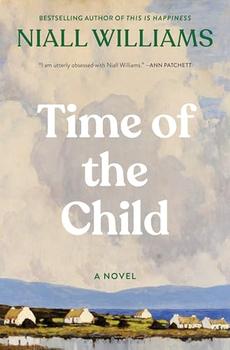
Niall Williams has written other books before, but Time of the Child, his latest, is my first. The story is about the people who live in a small town in Ireland during the 1960s. Apparently, Williams wrote an earlier book about this same town, so this is a return.
In Time of the Child, the town's doctor, a widower, lives with his oldest daughter, Ronnie. When they take in a baby that someone finds, Ronnie ends up falling in love with the child. But neither Ireland nor the Catholic Church there will allow a single mother to adopt a child. So what to do?
Normally, I dislike writing style that goes on and on about details that do not seem to push the story forward. Yet Williams does that, and I love it. And his sentences are long, too. But none of this feels unnecessary.
So you may want to read an excerpt before you buy Time of the Child. But, truly, this is a five-star read.
 Cathryn_Conroy
A Literary Treasure: Exquisite Writing and a Heart-Wrenching Plot
Cathryn_Conroy
A Literary Treasure: Exquisite Writing and a Heart-Wrenching Plot
Oh, the writing. Oh, the language. The words alone will transport you to December 1962 in rainy, windy, and cold Faha in the far west of Ireland. Read a few pages, and you'll want to snuggle under a blanket just to warm up. To heck with the story, the book should win an award just for the exquisite, hauntingly lyrical prose by author Niall Williams.
But the story is excellent, too—with one important caveat (see the paragraph below). The plot: An abandoned newborn is discovered in a cemetery on the night of the busy Faha Christmas fair, and she is so cold she must be dead. Without anyone else knowing, three people—two men and a boy—take the baby to the town doctor, who lives and works in a house with his eldest daughter, a 29-year-old who has never married. The baby isn't dead. The widowed doctor sees the joy this little girl brings to his own child and must concoct a way for them to keep the baby—something the Roman Catholic church and the Irish authorities would never allow of a spinster. Meanwhile, the infant's presence in their home must be an absolute secret so the baby isn't taken from them, but secrets are not kept long in tiny, gossipy Faha.
To get to this point in the book, one has to read the set-up, which places the reader into the center of Faha where we get to know its charming ways, eccentric people, and myriad mysteries. And it's a very long set-up at approximately 150 pages. Even with the extraordinary writing, I imagine some readers will be tempted to give up on the novel for the simple reason that nothing happens. This is one of those times that I urge you not to give in to that temptation. Keep reading because the payoff is remarkable.
Beginning on the first Sunday in Advent, this is an ideal book to read in December with allusions throughout the story to this liturgical season of waiting and expectation. There are themes of regrets for the past, but these are balanced with themes of hope and second chances for the future. Most of all, this is a book about family love.
This is a novel that I will think about long after I finish the last page. "Time of the Child" is a literary treasure.
Anthony_Conty
Literary Fiction for the Uninitiated
“Time of the Child” by Niall Williams has a very slow start, establishing its universe in the fictional Irish town of Faha. The plot remains secondary to the quirky people. The story from the flap begins around page 60, so we learn a lot about the importance of a town doctor and a local priest in Ireland.
Faha is a congested town, both metaphorically and literally. They are struggling through their day-to-day and cannot handle much more, or so they think, until a baby randomly arrives and alters their routine. The importance of daily monotony in literary fiction lies in making the unexpected event have a greater effect on the fully developed characters the author has created.
I broke my own rule and asked AI a question when part of the plot confused me, and our imaginary friend had a lot of extra facts to share about symbolism for melancholy. Apparently, Williams wrote several metaphors about the birth of Christ and creationism that I missed at first glance, but they reminded me why I enjoyed Comparative Literature in college with guidance.
Goodreads categorized the novel as “literary fiction,” which the casual reader cannot differentiate from “fiction.” Williams greatly prioritizes a message over plot and events, which requires some patience in reading. The last act, the contents of which I will not reveal, covers many themes, including single motherhood, societal norms, and nature vs. nurture in families.
Full disclosure: I went for long periods without knowing what was going on and feared that the author would lose me. If you love children and recognize that bond between parent and child, however, the ending will move you. Daughter Ronnie is a well-developed character, and you will root for her, as you do all the great protagonists in literature,, and it will make sense.

 Book Reviewed by: