Time Travel for Beginners
by Jaclyn Moriarty
What Would You Go Back and Change? (7/3/2026)
For the first 40 or so, I wasn't sure this book was for me. The rapid narrator shifts kept any one character from taking hold, and I found it hard to get into the story. Then, almost all at once, it clicked. Around the halfway point I realized I was eager to keep reading, and from there the momentum only grew. By the final chapters, I was impressed by how cleverly the author brought all the different perspectives together and tied up the many story threads. The ending made the slow start worthwhile — and then some.

The Secret Lives of Murderers' Wives
by Elizabeth Arnott
cozy-adjacent murder mystery sleuthed by 3 women who refuse to be silenced (5/1/2026)
Delivers on its premise: three women, each unknowingly married to a convicted killer, find each other in the wreckage and decide to put their hard-won expertise to use. Beverley, Elsie, and Margot are distinct enough to avoid feeling like variations on the same archetype, and their friendship has an earned, slightly barbed warmth. What unites them runs deeper than shared circumstance — each carries a sense of obligation to victims already lost and those who might still be saved.
Arnott keeps the focus where it belongs: not on the killers, but on the lives permanently altered in their wake, and the 1966 California setting grounds the mystery in a world that already treats these women as suspects. While the details of the murders are too graphic to qualify the novel as cozy murder mystery, I'd call it cozy-adjacent.
There are some slow points, and readers like me who guess the culprit early may find the ending deflating. But the journey holds. A compelling, twisty, imperfect read. 3.5 stars
Thanks to Berkley Publishing Group and NetGalley for an opportunity to read and share my opinion of this book.

Yesteryear: A Novel
by Caro Claire Burke
Satire That Unsettles More Than It Amuses (4/20/2026)
I'll be honest: I almost bounced off Natalie Heller Mills in the first thirty pages. She is not designed to be liked, and Burke doesn't soften that. But Yesteryear earns its unlikable protagonist by doing something more interesting than a simple tradwife takedown — it uses the time-travel conceit to literalize the gap between performance and reality until that gap becomes genuinely frightening. I've seen marketing that calls it "darkly hilarious," which undersells how specifically uncomfortable the comedy is. Burke's humor is a cringe-laugh: it lives in Natalie's near-pathological inability to read another person correctly, the way her sharp edges keep missing what's actually in the room. The dual-timeline structure takes a chapter or two to find its footing, and the ending is a stronger idea than it is a felt experience. Still, the novel's central question — what happens when a woman who has only ever curated herself is forced to be herself — stayed with me. A formally ambitious debut, and one worth the conversation it's already generating.

Dear Monica Lewinsky: A Novel
by Julia Langbein
a reckoning at the hands of the patron saint of women publicly sacrificed for powerful men's mistakes (4/13/2026)
Jean Dornan is forty-five and still can't account for who she was at nineteen, when a study-abroad program in rural France and a charismatic professor derailed her in ways she's only beginning to understand. In Julia Langbein's audacious and laugh-out-loud funny second novel, Jean's reckoning takes the form of a supernatural guide: Monica Lewinsky, patron saint of women publicly sacrificed for powerful men's mistakes, who escorts Jean back through that lost summer like the flinty, snarky Ghost of Christmas Past. In fact, Monica is the novel's narrator, opening with "The day that Jean Dornan first prayed to me began like any other…" — a genius tactic that makes the time transitions feel inevitable rather than managed.
Something about the pace at which we arrive at the final coupling reminded me of Call Me by Your Name — a sun-soaked coming-of-age, a doomed relationship allowed to unspool slowly. But where Aciman leaves us aching for Elio (Elio Elio Elio...), Langbein makes us ache at Jean — frustrated by her blind spots, frustrated for her, and aware that Monica, for all her saintly radiance, shares that frustration. At its core, this is a sharp examination of female desire and the price women pay for acting on their appetites — while the men involved build churches on the very ground where it all happened. That's not just metaphor: Langbein weaves in the lives of real female martyrs whose suffering was literally consecrated into stone, and the parallel is damning.
I highly recommend this to those who trust a novel that plays it completely straight while the world it describes is completely strange. And given Langbein's doctorate in art history and background in sketch and stand-up comedy, it's no surprise that the book's comedy is load-bearing. Did I mention that it made me laugh? A lot. PS: Her food writing is chef's kiss, too.
Thank you to Doubleday Books and NetGalley for the advance copy. All opinions are my own.
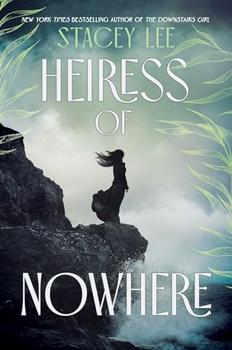
Heiress of Nowhere
by Stacey Lee
Atmospheric island mystery with whales and a love triangle (4/6/2026)
Set on Washington's Orcas Island in 1918, this YA historical gothic mystery opens with orphan Lucy Nowhere — a maid on a wealthy shipbuilder's estate — on the brink of leaving for the University of Washington. That is, until she discovers her employer's decapitated head on a beach and finds herself named his heir. Author Stacey Lee anchors the gothic atmosphere in the natural world: fog, orcas, folklore, and class tension layered with narrative economy. A whale-shaped birthmark that allows Lucy to feel the orcas' emotions tows the line between magic realism and myth without overexplaining itself, which is one of the novel's quieter pleasures. Themes of colonization, gender discrimination, science vs myth, and environmental collapse surface organically, while a tropey love triangle leans hard into familiar YA territory. Which dreamy boy competing for Lucy's affection should she choose? Come on. In any case, the island setting is the real achievement: immersive, ecologically grounded, and genuinely strange. Those who enjoy historical fiction with gothic atmosphere and a YA protagonist who refuses easy rescue will find this atmospheric, propulsive, and worth the read.
Thanks to Simon & Schuster and NetGalley for an opportunity to read and share my opinion of this book.

The Jellyfish Problem
by Tessa Yang
A novel about jellyfish, connection, and the cost of insularity (4/3/2026)
Jo has been captivated by jellyfish since she was a kid. But when she answers a distress call from her former best friend and lover to help with a jellyfish problem on a small island in Maine, she is not just captivated. She becomes an actual captive. She and all the other folks who've laid eyes on Clementine, the island's resident humongous jellyfish. This is a book about the power of community and the cost of insularity. It is chock full of fun facts about jellyfish, but it also deals with grief and survival, love, guilt, demons (both personal and spectral), the risks of connection, growth and regrowth, and the thing that breaks you open when you've been sealed shut.

Thistlemarsh
by Moorea Corrigan
Fae folklore with gothic coziness and a slow-burn romance (3/1/2026)
Thistlemarsh by Moorea Corrigan is a cozy historical fantasy that braids post-WWI grief with fae folklore and a slow-burn romance. When Mouse Dunne inherits a crumbling, faerie-blessed estate, she must restore it in a month or lose everything -- including her chance to care for her traumatized brother. Enter Thornwood, a dangerous and compelling fae lord offering magical help at a price.
Corrigan excels at atmosphere: moss-damp halls, breathing walls, and a house that feels alive with memory and magic. Mouse is a quietly stubborn, deeply human heroine, and the banter and wary trust between her and Thornwood give the story emotional pull.
Thanks to Berkley Publishing Group and BookBrowse for an opportunity to read an advanced reader copy and share my opinion of this book.

The Bookbinder's Secret: A Novel
by A. D. Bell
a puzzle-box of a novel, for books-about-books fans (1/14/2026)
Set in Edwardian Oxford, The Bookbinder’s Secret is steeped in ink, paper, and quiet defiance. Lily Delaney, a gifted young bookbinder, discovers that a set of six distinctly crafted volumes hides a dangerous secret. A.D. Bell layers historical detail with an elegant mystery, letting the scent of glue and leather mingle with coded letters and buried grief. The pacing takes its time, but that suits a story about patience, craft, and the way books hold more than words. This is for you if you're a book-about-books fan and/or you seek literary intrigue with a romantic, slightly gothic glow.

The Irish Goodbye: Micro-Memoirs
by Beth Ann Fennelly
A collection of micro-essays that perform "tremendous acts of perception" (12/16/2025)
The Irish Goodbye is a collection of micro-essays wherein author Beth Ann Fennelly performs high-wire acts of perception. These brief pieces move nimbly through marriage, motherhood, grief, and faith, never overstaying their moment yet leaving a distinct emotional imprint. Fennelly's prose is lucid and generous, intimate without exhibitionism, reflective without blur. She trusts compression, allowing ordinary scenes to carry their own resonance. Some of my favorites are "Tree Pose," "My Mother-in-Law in the Mirror," and the final piece, "Dear Viewer of My Naked Body." In that essay, she mentions liking someone for their "tremendous act of perception," and Shwabam! I realized. This is what I like about Fennelly, … bunions and all. These micro-essays remind us that empathy often resides in noticing, and that noticing, done well, is its own form of art.

Memorial Days: A Memoir
by Geraldine Brooks
the ideal form to frame a memoir (12/11/2025)
People of the Book is an all-time favorite novel, and I love Horse as well. But now Australian author Geraldine Brooks has written the most compelling memoir about grief I've yet read. Yes, of course it's sad, achingly so at times. But for the most part, I found myself feeling hope and appreciation for her departed husband, the writer Tony Horwitz. Brooks found the ideal form with which to frame her memoir, and to give space to her grief. The memoir is told in dual book-of-days timelines, one that excavates from the moment she learns of Horwitz's death on Memorial Day 2019. This alternates with her day-by-day account of the time she spent three years later holed-up in a shack on Australia's remote Flinder's Island. This is the space and time she devoted to mourning. It's beautifully intimate and candid and also informative about various cultural grief rituals. It's also a call for the US medical-forensic establishment to rethink their shitty practices. It's well done, and I hope writing it helped Brooks. I imagine it will help others.

Hole in the Sky: A Novel
by Daniel H. Wilson
Set in Oklahoma's Cherokee Nation, a first contact situation ignites a convergence of worlds (10/23/2025)
In Hole in the Sky, Daniel H. Wilson drops an alien mystery into the red dirt of Oklahoma's Cherokee Nation. Humanity faces first contact when a strange object plummets to Earth, setting off a convergence of characters—a collision of worlds—between a widowed father and his estranged daughter, a haunted NASA astrophysicist, and a shadowy government "Man Downstairs." The author, himself a Cherokee citizen, fuses Indigenous wisdom with cosmic wonder, crafting a "new weird" speculative fiction novel both intimate and vast—a meditation on belonging, inheritance, and what it means to face the unknown. I was rapt reading it even though one character made me feel stressed and overstimulated every time her POV took its turn. Interesting since she was likely but not explicitly on the spectrum.

The Slip: A Novel
by Lucas Schaefer
(7/13/2025)
And what a bold twist Lucas Schaefer deftly pulls off in his debut novel. Set in Austin, TX, in a gritty boxing gym, the novel's unifying theme is transformation, while the vehicle that delivers so many of the wondrous characters to that state is boxing. But I don't think you have to love or even know much about boxing to fall for this book, in which there are wild coincidences, rude jokes, a jumble of time frames, a gaggle of compelling personalities in varying states of flux, a mixture of third-, first-, and even second-person narrations, and sly commentary on race in America. All tossed in a splash of raunch. It worked, and I loved it.

The Original: A Novel
by Nell Stevens
The Original lives up to its name (7/3/2025)
"There was a painting my family set on fire. It burned to ashes, and then it came back." The novel's opening line took my breath away, and that was before I had read any further and could be dazzled by how much of the novel is contained in that first sentence. This book reads like a classic, yet it is brand-new and lives up to its title, with a plot that is a twisty puzzle, revolving around the themes of forgery and identity, art, madness, and truth.
The characters are complicated and compelling, with the protagonist Grace brilliantly named. And the atmosphere reminds me of my favorite Daphne Du Maurier novels, which is to say, all of them. I'll repeat what I said about The Original in the BookBrowse community forum: The language and overall craft are staggering. I want to use certain passages as writing prompts. In other words, I want to copy the book about copying. 4.5 stars, worthy of rounding up

Run for the Hills: A Novel
by Kevin Wilson
Kooky family road trip in a PT Cruiser (6/20/2025)
The gist, a foursome of half-siblings pile into a PT Cruiser on a road trip to find the father that abandoned each of them sequentially. They all thought they were only children until oldest brother Rueben pulls up to oldest sister Madeline's organic farm in Coalfield, Tennessee (the setting for Wilson's last novel, Now Is Not the Time to Panic).
Mad's mother convinces Mad to join Rube on his quest and they pick up their hoops-playing, college-aged sister Pep at OU (Boomer Sooners!) and their 10-year-old brother Tom in Salt Lake City before beelining to California, which Rube's PI has identified as the current home of their father, Charles Hill. Run for the Hills, get it? It's fun and clever like all of Wilson's novels, but this one feels a little safer, a little less weird. I love Ron Charles's take in the Washington Post: "Wilson writes that a quest 'is by nature fraught with peril,' but this antiseptic quest feels more fraught with Purell." Snap.
It's still a great read, especially if you are a Kevin Wilson fan. Thanks to Ecco and NetGalley for an opportunity to read and share my opinion of this book.

The Names: A Novel
by Florence Knapp
One family, three alternate versions of their lives (6/10/2025)
One family, three alternate versions of what 35 years in their lives might be like. Cora's newborn needs a name, and her husband expects (commands) her to stroller downtown to the registrar and register the baby as Gordon, which is his name and his father's name. But Cora likes the name Julien. And their 9-year-old daughter Maia prefers Bear.
So the novel narrates between the three possible timelines that result from the consequences of Cora's three different choices of name. And since Cora's husband is a respected local physician by day and a controlling, violent monster by night, the three choices have very different consequences.
Domestic abuse and other rough emotional terrain gave me pause, but the novel's sliding-doors structure and its rich, layered prose had me page-turning with few stops. Highly recommend.
Thanks to Pamela Dorman Books/Viking and NetGalley for an opportunity to read an advanced reader copy and share my opinion of this book.
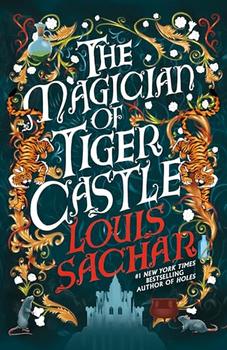
The Magician of Tiger Castle
by Louis Sachar
A captivating and whimsical fairytale for grownups (4/25/2025)
Louis Sachar's Holes introduced us to yellow-spotted lizards, a symbol of the dangers of Camp Green Lake. In The Magician of Tiger Castle, there's a captive tiger, symbol of royalty and power. In the decaying kingdom of Escaveta, where our narrator, the magician Anatole, plies his craft, it is fitting that those noble cats are confined in the castle moat. Because all the characters in this adult fairytale are captives in one sense or another.
Whether or not you've read any of Sachar's other books, you will likely be charmed by his distinct voice. This, his first adult novel, delves into themes of love, loyalty, and personal choice. His characters are funny, their drives and motives complex yet relatable. Blessed/cursed with magical longevity, Anatole the magician is a delightfully reflective narrator -- admittedly flawed, but impossible not to care for deeply as he relates his tale from the Renaissance era to present-day. Magicians, potions, princesses, court intrigue, tigers, moats, monks, mice, and cappuccino. This has so many expected ingredients of a classic fairytale. But it's the unexpected wit and wisdom of this tale that make it such a compulsively readable novel.
Thanks to Berkley Publishing Group and BookBrowse for an opportunity to read an advanced reader copy and share my opinion of this book.

Bright Objects
by Ruby Todd
a literary thriller about a comet, obsession, and a small Australian town (4/14/2025)
Set in a small town in Australia, and loosely inspired by the Heaven’s Gate cult and Comet Hale-Bopp in 1997, this debut novel is about a young woman still reeling from the hit-and-run death of her beloved husband. Written as a literary thriller, with a slower pace and more reflection, it’s about obsession in many facets, including how it can overtake a psyche in the wake of searing grief. Main character Sylvia Knight does a lot of mind- and soul-searching via astronomy, art, music, literature, tarot, geometry.
“My hope was that, if nothing else, the comet, like the celestial equivalent of a Rorschach inkblot, might cause me to face proof of a truth I had on some level long known, but been unable to see.”
The question, according to author Ruby Todd, becomes how to recover personal power, faith in life, and one’s place in the world.
I would recommend this to those who like slow-burn literary thrillers featuring astronomy, mystery, romance, and reflections on grief, humanity, and mortality.

Strangers in Time: A World War 2 Novel
by David Baldacci
WWII-set, character-driven historical fiction about found family (4/13/2025)
"This was their story. Three people standing together against all the world could hurl at them."
Set in London in 1944, this historical fiction novel tells the story of a bereaved bookshop owner and two teenagers from very different backgrounds who have lost everything to the second world war.
"But if I hadn't happened upon Charlie, and we both hadn't found you, I'm not sure what would have become of us."
A character-driven story about found family and the spirit of family, it brims with historical detail seamlessly woven into the narrative. I was not at first convinced I'd like this book. It took 68 pages for Molly and Charlie to finally meet each other, but from there the connections gripped me.

Good Dirt: A Novel
by Charmaine Wilkerson
a multigenerational, historical epic told from multiple POVs (3/17/2025)
Set in New England, and briefly France, Wilkerson's second novel explores more family secrets, trauma, and identity. With a timeline ranging from 1803 to 2021, Good Dirt is a multigenerational, historical epic told from multiple points of view. Because, "History is a collective phenomenon. It can only be told through a chorus of voices."
The novel's keystone is Old Mo, a 20-gallon stoneware jar crafted by an enslaved man in a South Carolina pottery. For six generations, Old Mo has been part of the Freeman family, an affluent Black family living in a well-to-do New England enclave. Wilkerson deftly ties together the family's and the novel's multiple threads. I'd argue that the threads set in France could have been nixed, but overall, I was drawn in by the characters, plot devices, and history lessons. An engrossing book -- emotional, reflective, medium-paced, informative, poignant, and hopeful -- it would make for excellent book club discussions.
Thanks to Penguin Random House and NetGalley for an opportunity to read and share my opinion of this book.
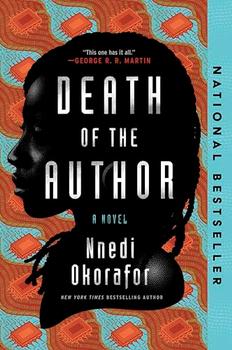
Death of the Author: A Novel
by Nnedi Okorafor
A book within a book that is both timely and timeless (1/28/2025)
Zelu has always been a storyteller and she has always felt like an outsider in her Nigerian American family. A paraplegic since falling from a tree as a child, Zelu used to dream of flying among the stars, yet now she feels as if she's ever falling. When the novel she's been writing for 10 years gets its umpteenth rejection and she loses her adjunct professor job, she moves back in with her parents and lets herself fall under the thrall of a new inspiration.
A novel set in the future, wherein humanity is extinct and metal robots war with disembodied AI beings, Rusted Robots becomes a stratospheric success. Yet even as Zelu gains wealth and popularity, finally hitting her stride, she begins to lose control of the narrative. "I've been deleted from my own story," she thought. "They've just erased me."
Author Nnedi Okorafor has masterfully crafted a book within a book, interspersing chapters of Zelu's story with chapters of the postapocalyptic Rusted Robots. Both books explore what it means to be human, and together they revel in the power of storytelling. Death of the Author manages to be both timely and timeless, with themes that include family, living in the margins, the writer's life, race, culture, change, fame, shame, forgiveness, self-acceptance, and that "creation flows both ways." The book's title is genius.
Thanks to William Morrow and NetGalley for an opportunity to read an advanced reader copy and share my opinion of this book.









 Power Reviewer
