
-
Your next favorite book
is waiting.
Summary | Excerpt | Reading Guide | Reviews | Beyond the book | Read-Alikes | Genres & Themes | Author Bio
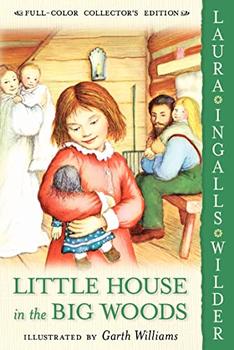
Little House on the Prairie #1
by Laura Ingalls Wilder Book Reviewed by:
Laura Ingalls is a four-year-old girl living in a little log cabin with her family in the Big Woods of Wisconsin. Her Ma and Pa work hard to keep the family safe and cared for in the wilderness, and Laura and her older sister, Mary, do their best to help while learning about pioneer survival. When they're not helping, they find fun wherever they can: playing balloon toss with a pig bladder, telling stories with their corncob dolls among the squashes and pumpkins stored in the attic, joining in the dancing at a get-together after a sugar snow (a late spring snowfall that prompts the maple trees to produce more sap that can then be turned into maple syrup). It's a simple but busy life, and Laura is filled with wonder as she discovers the world around her. A fictionalized account of author Laura Ingalls Wilder's childhood, Little House in the Big Woods is a children's classic that demonstrates the self-reliance, hard work, and familial support necessary to survive in the Big Woods in pioneer days.
Written for children, Big Woods isn't a particularly complex book. Rather than having a true plot, it features a slice-of-life story revolving around the chores and pleasures of Laura and her family over the course of a year. Through the eyes of a child, much of the work seems like fun and games, and Laura's recollections are consequently both instructive and entertaining. The novelty of these chores and the amount of work the girls are expected to do will likely astound children today, yet the enjoyable nature with which Laura describes it all may lead young readers to want to try their hand at churning butter or making snow candy!
To an adult reader, the simple nature of the story may be a drawback. However, the work done by Laura's family shows the tenacity required to survive life in the wild, and the qualities of hope and resilience, as well as dependence on family and friends, are themes anyone can relate to. And although the characters are not expansively developed—a four-year-old isn't truly aware of the deep thoughts of the adults around them—there's a perfect childlike simplicity to their depictions: Pa is kind and hardworking, Ma is reliable and pretty, and Laura herself is curious and loving.
When there is time to relax, there's a sense that the rest is well earned and all the more appreciated for its rarity, especially with regard to the elaborate nature of the family's celebrations. Modern readers can certainly relate to the pioneer philosophy of "work hard, play hard," as evidenced by the dance after a sugar snow: everyone in the area converges on Grandma and Grandpa's cabin to help prepare maple syrup, but also to dance and visit. It's a loud, joyous occasion made all the more glamorous through the descriptions of a young child who has little experience of such things. The primping, dancing, and enjoyment remind today's readers that although pioneers lived a very different life, we're united in our love of a good time with those we care about.
The festive feeling of the dance as well as the emotions of other scenes are further displayed in the simple yet detailed illustrations by Garth Williams. Although not the original illustrator, Williams's interpretations of the Little House books are the most well-known, and the dynamic images bring to life scenes and characters in Big Woods.
It's important to note that the book is diminished by its casual racism. Although Big Woods is considered less problematic than subsequent books in the series regarding the treatment of Black and Indigenous people (see Beyond the Book), there is one blatant instance of racism in this story. One evening, Pa plays his fiddle for Laura and Mary and sings a minstrel song called "Uncle Ned," written in 1848, which contains a slur. The offensive content should be taken into account before sharing the book with children.
Little House in the Big Woods may be a simple story, but it depicts pioneer life in a way that is both educational and interesting. Laura's perspective provides a sense of childlike wonder that will appeal to young readers; while adult readers may find the story's lack of plot less riveting, they may relate to or admire the family's strong work ethic. However, readers of all ages must consider the context. The books in this series contain blatant racism and reference to genocidal violence, which at the very least will require careful discussion with young readers. Nonetheless, this classic children's tale is a short but ultimately entertaining story about the pioneering days and the life of a young girl experiencing them.
 This review
first ran in the January 28, 2026
issue of BookBrowse Recommends.
This review
first ran in the January 28, 2026
issue of BookBrowse Recommends.

If you liked Little House in the Big Woods, try these:

L.A. Women by Ella Berman
Two ambitious writers in 1960s LA face betrayal when one writes a novel based on the other's life.






Your guide toexceptional books
BookBrowse seeks out and recommends the best in contemporary fiction and nonfiction—books that not only engage and entertain but also deepen our understanding of ourselves and the world around us.

