
-
Your next favorite book
is waiting.
Summary | Excerpt | Reviews | Beyond the book | Read-Alikes | Genres & Themes | Author Bio
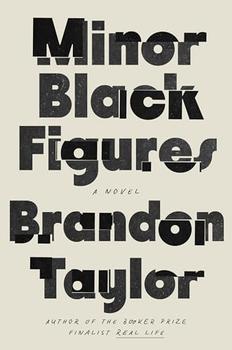
A Novel
by Brandon Taylor Book Reviewed by:
Romare Bearden's The Block, an impressive mural about Harlem lives, was the first painting that stirred my emotions. The richness of the colors immobilized me. But as the years passed, the vividness of Bearden's six-panel legendary watercolor was lost to time. Until I was reading Brandon Taylor's third novel Minor Black Figures, where Bearden's masterpiece appears out of the blue from a lush memory. It intertwines abstractly with Taylor's protagonist Wyeth, who is struggling to overcome a creative block and paint black people and feel good about it.
Wyeth's white mother raised him in an all-white Virginia trailer park. His father was black but dead. Because of the generosity of his father's family, specifically his aunt, he attended a black school with a decent reputation. Was he aware of the racial paradox, that by day he was surrounded by brown-skinned classmates and at night he ate hot dogs in a double-wide trailer park specifically for Caucasians, and without his daddy to give his racialization context, or to make life easier?
After high school Wyeth's mother ditched him and moved across the country to California and never acknowledged him once she began her perfect white life with a husband and blonde-haired children, as if Wyeth's existence was a dream. Wyeth, however, adjusted, moving in the world like he was an orphan, confused at how to appropriately illustrate black suffering, black trauma, black joy, black culture on canvas. It is the summer of Black Lives Matter protests and the Supreme Court's shocking Dobbs decision and anti-fascism slogans that invigorates him, even as he struggles to understand why.
He begins documenting the protests with his camera. Once he develops the frames, he is going to paint what he saw. At least that is the intention. But nothing about the photographs resonates with him. He complains about their flatness, as if the protestors were objects. "I don't know them. I took their pictures but I don't know anything about them. So if I painted them, I'd be making shit up." His stunning lack of empathy lands both awkwardly and selfishly, similar to his reaction when he was in graduate school and Tamir Rice was shot by the police.
All the black artists in his program used Rice as a template and began illustrating dead black boys as their subject. They felt deeply about Rice's killing. (Twelve-year-old Rice was gunned down by the Cleveland police, who mistook his toy gun for a real one.) But Wyeth was dismissive of the event in his artwork, instead painting scenes from arthouse movies. His classmates were grieving Rice and looked upon Wyeth as intentionally marginalizing black-boy death while uplifting French entertainment. Did Wyeth have a soul?
Regardless of what side of the debate you land on, black solidarity or black freedom, there is a philosophical question. Should creatives have to conform to expectations? Are black creatives asked to deliver on standards white creatives can choose to ignore? By the time the pandemic hit, Wyeth stopped painting altogether, until the summer of the protests. He feels invigorated, but it is short lived. Studying the protestors in his photographs returns the feeling of emotional numbness. His loneliness is overwhelming him.
And then one night, purely by chance, Wyeth meets a man in a bar. He likes his vibe, knowing basically nothing about him other than that his name is Keating. A Jesuit priest in training taking a break, Keating appears to be like any other single gay New Yorker who Wyeth finds intellectually stimulating, attractive, and an easy antidote to his loneliness. After preliminary flirting, kissing, and texting, Keating ventures to Wyeth's apartment during a storm from hell, described by Taylor as Armageddon.
"The East River thundered at the FDR, leaping high overhead as water on the road ran to meet the water in the river itself, formed in one continual sheet. There were accidents now. Downed power lines. Residents were being told to shelter in place…the risk of drowning was too high."
Metaphorically, I think it works, conflating water death with a couple's first sexual experience, or as Taylor represents that night for Wyeth, "to get head from a guy he barely knows." Both situations involve vulnerable people being plunged into a deep abyss of suffering or pleasure, erasure or intimacy. Either way, you lose your voice.
For Wyeth that rainy night, there is also a moral dilemma. Has he made a mistake inviting Keating to his home during the mother of all storms? Wyeth doesn't want to be responsible if something happens to Keating. Magically, when Keating arrives the rain ceases to be, and Taylor's description of Wyeth and Keating on the sofa luxuriating in each other's bodies has a soulful vibe, like a Norah Jones track. A less talented writer might have thought the point was sexuality, lust, and conquest but Taylor has crafted his protagonist as a man who thinks first, then feels, brain then heart; and so the sensual experience takes several pages to unpack. Wyeth has his mind blown. "This was beyond taste. This was somehow smell and touch and sensation and heat and cold and rushing, pounding sound. It was a totally encompassing sensation."
The heart of Brandon Taylor's novel is the city of New York. The fruit vendors and the homeless sleepers and the rush hour subway riders. And the solitary gay men who disappear inside the boisterous neighborhoods. The characters of Keating and Wyeth are anecdotal. They are both lost in what should have been perfect careers and their anxieties are shockingly compatible. As I lingered in their relationship I began to consider something. Millennial men in urban centers, their crises occur when the life they imagined doesn't quite resemble the life they are living.
This isn't a story for everyone. It's not one of those take it on vacation and read it on the plane books. The writing is dense and literary and the plotting quite narrow. The prose is what gives the story wings even with its thin plot and examination of black loneliness and creative struggle.
As a literary work, Minor Black Figures doesn't wrap around you like a second skin, nor did I expect it to. It's not a confessional about a black painter who can't relate to black struggle or black people. It's not a read at 2 am because you are desperate to find out the ending book. But its loveliness is Brandon Taylor's elite talent. He's the painter that Wyeth is not. He paints black lives and religion and ambitious gay men. He's a cultural anthropologist with a class to teach about art and New York and gallery shows and ugly paintings and gay sex and estranged families. I find forgivable what is missing: A hard truth about black identity when you're raised biracial and continually facing exile. Wyeth is written to be nuanced and evolving and unfamiliar for a reason, to uplift the narrative with likability. It works. Minor Black Figures is special, and if it isn't shortlisted for a literary prize for best fiction of 2025, that will be an injustice.
 This review
first ran in the October 22, 2025
issue of BookBrowse Recommends.
This review
first ran in the October 22, 2025
issue of BookBrowse Recommends.

If you liked Minor Black Figures, try these:

by Denne Michele Norris
Published 2026
In this heart-wrenching debut novel, a young Black gay man reckoning with the death of his father must confront his painful past—and his deepest desires around gender, love, and sex.
by Allen Bratton
Published 2025
Crackling with intelligence and wit, Henry Henry is a brilliant recasting of the Henriad in which Hal Lancaster is a queer protagonist for a new era.
by Nicole Cuffy
Published 2024
A provocative and lyrical debut novel follows a trailblazing Black ballerina who must reconcile the ever-rising stakes of her grueling career with difficult questions of love, loss, and her journey to self-liberation, from a sensuous new voice in fiction.
L.A. Women by Ella Berman
Two ambitious writers in 1960s LA face betrayal when one writes a novel based on the other's life.






Your guide toexceptional books
BookBrowse seeks out and recommends the best in contemporary fiction and nonfiction—books that not only engage and entertain but also deepen our understanding of ourselves and the world around us.

