
-
Your next favorite book
is waiting.
Summary | Excerpt | Reviews | Beyond the Book | Read-Alikes | Genres & Themes | Author Bio

A Novel
by Brandon Taylor Book Reviewed by:
This article relates to Minor Black Figures

 The half-century-old painting of a young child is owned by a Houston family who wants it restored to its original beauty. It is the job of Olin-Noah Venderhaven and his crew of assistants, Chloé and Wyeth, to manage the project. After the painting is de-aged, once the old varnish, debris, and residual dirt and dust are erased, what fills the room is a noxious nicotine scent. Over the years, cigarette smoke has seeped into the canvas and the smell that remains is suffocating. Wyeth, the lowest in grade of the assistants and a struggling painter, wonders why Venderhaven would take on such a marginal painting. He can't understand wasting time on something so average. In his mind, art restoration should be reserved for elite paintings, well-known works from great artists that have worth and value.
Wyeth says to Venderhaven, "It's not very good."
Venderhaven agrees and yet is incredulous. "Do you think we should conserve only what is good…or should we do our best on every piece that comes to us…Someone's someone made it. And they asked us to bring it back. Should we do substandard work because we don't judge the piece to be significant?"
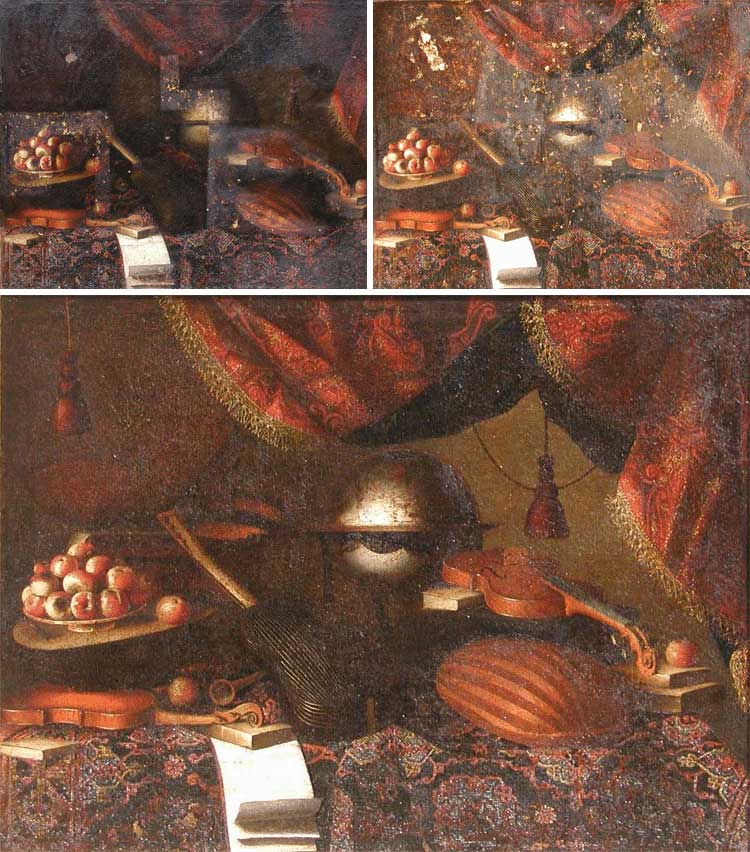
The Brandon Taylor novel Minor Black Figures illustrates through Wyeth the painstakingly precise job of restoring art, and that art restoration is both science and art. Modern restoration often involves a series of highly technical X-rays and infrared imaging to determine the source of the paint. The goal of restoration is to preserve the work of art in the most non-invasive way. The repair involves cleaning, adding texture that fits the artist's intent, and diminishing the age-old decay and damage that time and living has done to the piece.
In the novel, Taylor writes of how the face in a painting is often the most difficult part: "No matter what else you did, if you fucked up the face, the whole painting was gone." Chloé is the main assistant who works on the child's face. The restoration involves aligning the new texture with the original work so that it is seamless. She replaces the pigment in the face. The art is to replace what is missing so it doesn't seem like it was replaced at all, that the painting has aged well. "Wyeth liked watching her hands, the moment she went from fast to slow to still and then the confidence with which she applied the paint."
Although art restoration is a highly specialized science, things can go wrong. Overcleaning can strip important details. For example, in Spain in 2012, an elderly parishioner attempted to restore a church's aging fresco of Christ and the process went so far that the finished product was labeled the "Monkey Christ."
Wyeth's job in the restoration studio is scut work, a term taken from the medical field to parameterize the unglamourous but necessary jobs like cleaning, and object and material preparation. One of the more important scut jobs Wyeth is responsible for is volatilizing the ethanol. He has to create solutions at 90 percent, 70 percent, 60 percent, and 30 percent dilution. The solutions are used to disinfect the cleaning surfaces and tools. If you don't clean the tools, the restoration could suffer catastrophic damage. One painting in Venderhaven's studio was restored with unclean tools that carried bacteria into the linen and turned it orange.
It's important to note that the restorer isn't trying to reach perfection. That's an impossible challenge. The restorer's job is to diminish how age, time, dust, and dirt have manipulated the original painting. When a painting is restored it is more than that one piece of art that is beautified. It is the restoration of a piece of culture.
A restorer explains it this way. "Every act of cleaning or repair is an interpretation. It's a delicate balancing act between making the artwork accessible and respecting its history."
Restoration of 17th-century Italian oil on canvas painting by Bartolomeo Better
Conservation & restoration by Sergey Konstantinov, Fineartgallery, CC BY-SA 3.0
Filed under Music and the Arts
 This article relates to Minor Black Figures.
It first ran in the October 22, 2025
issue of BookBrowse Recommends.
This article relates to Minor Black Figures.
It first ran in the October 22, 2025
issue of BookBrowse Recommends.

L.A. Women by Ella Berman
Two ambitious writers in 1960s LA face betrayal when one writes a novel based on the other's life.






Your guide toexceptional books
BookBrowse seeks out and recommends the best in contemporary fiction and nonfiction—books that not only engage and entertain but also deepen our understanding of ourselves and the world around us.


