
-
Your next favorite book
is waiting.
Summary | Excerpt | Reading Guide | Reviews | Beyond the book | Read-Alikes | Genres & Themes | Author Bio

And Other Serious Discoveries of Silly Science
by Carly Anne York Book Reviewed by:
Science is typically seen as a serious subject—scientific research is rigorously structured and maintained; and the no-nonsense scientific method is necessary for ensuring a valid experiment and credible findings. But in her latest book, The Salmon Cannon and the Levitating Frog, Carly Anne York shows that simple observations of random phenomena, including ones that may seem silly, weird, or gross, are often the basis for interesting scientific discoveries. Biometric robotics inspired by squishy, unkillable cockroaches; improved wind turbines based off bumps on humpback whale tails; the new class of weight loss drugs available today, which were derived from Gila monster venom—these and many more significant discoveries have been the result of what could be called "silly science."
York begins by sharing a story from her own life, one that will be familiar to many scientists: In her doctoral program, where she was studying squid biomechanics and sensory physiology, a man asked her what the real-world application of her research would be. When York couldn't give an answer, he questioned her receipt of public funding for her work. This is a classic conversation: Everyone from the general public to federal politicians asks whether research into "basic science"—science that seeks to expand our understanding of the natural world without a specific immediate practical application in mind—is worth the economic cost.
That criticism, as York shows throughout her book, is often misguided. Although not all research in basic science has an immediate application, she writes, "more than half of all economic growth comes from innovations that began in the world of basic discovery." In fact, a 2018 study on drug discovery in the United States found that 80% of the drugs examined were the unexpected but happy result of basic research. So was, for example, the titular "salmon cannon." The salmon cannon was initially a tube system that was used to transport apples gently down from trees—until it was repurposed to help salmon bypass hydroelectric dams and return to their freshwater breeding grounds. Other, more seemingly sensible methods had been attempted to help the salmon, but they were either ineffective or too labor intensive. The cannon's pneumatic tubes, which provide an air-powered ride over the dam, were the perfect, if unconventional, solution.
Another example of an unexpected, unusual application of basic research that York describes was the eradication of the screwworm, a maggot-like larva, in the United States. Screwworms were common on farms in the early and mid-20th century; preferring a living host, they would burrow into and begin feasting on the flesh of cattle, killing the unlucky bovine within a few days. While studying screwworms, USDA scientists noticed an unusual breeding pattern: the females would only mate once before laying their eggs and dying, while males would mate as many times as possible. One of the scientists proposed sterilizing the males, which would result in clutches of unfertilized eggs, dead females, and a decreasing screwworm population. Though the idea was met with skepticism and derision at first, eventually there began a series of radiation experiments and large-scale releases of sterilized male screwworms until, in 1966, screwworms were completely gone from the United States. Today, "insect birth control"—this process of sterilizing the males—is used to help control plant pests, livestock pests, and human disease vectors, like the mosquitoes that carry the Zika virus.
York's examples demonstrate her assertion that the three "C"s—curiosity, collaboration, and creativity—are essential for solving persistent problems and generating good scientific research. And her writing style also evidences the importance of creativity. Although this is a fairly technical book, York describes the complex research topics in an approachable and fun way, even sprinkling in pop culture references for levity. York will be engaging to readers of all ages and backgrounds and help them learn more about the world around them and the scientists who study it.
Although "there is a large gap between the knowledge that basic research can provide and its ultimate utility," York writes, sometimes doing science for the sake of science leads to incredible discoveries. Look at Einstein, whose curiosity about light and time led to his theory of relativity. Or Max Planck, whose fascination with energy radiating from hot objects inspired his research into photons, leading to the modern development of nanotechnology. Or Sheila Patek's shrimp "fight club," another example from York's book—Patek used mantis shrimp, who can punch at speeds up to 50 miles per hour, to develop an understanding of fluid dynamics that now helps engineers design better underwater equipment. The Salmon Cannon and the Levitating Frog is a behind-the-scenes look at messy, unusual, or downright disgusting research that transforms out-of-the-box scientific questions into scientific answers that can change the world.
 This review
first ran in the August 13, 2025
issue of BookBrowse Recommends.
This review
first ran in the August 13, 2025
issue of BookBrowse Recommends.

If you liked The Salmon Cannon and the Levitating Frog, try these:
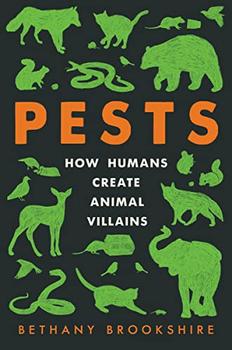
by Bethany Brookshire
Published 2023
An engrossing and revealing study of why we deem certain animals "pests" and others not - from cats to rats, elephants to pigeons - and what this tells us about our own perceptions, beliefs, and actions, as well as our place in the natural world.
by Simon Barnes
Published 2015
This fascinating scientific foray into the animal kingdom examines how the world's creatures - weird, wonderful, and everything in between - are inextricably linked.
by Mary Roach
Published 2014
The irresistible, ever-curious, and always best-selling Mary Roach returns with a new adventure to the invisible realm we carry around inside.
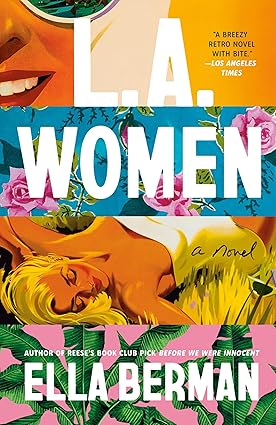
L.A. Women by Ella Berman
Two ambitious writers in 1960s LA face betrayal when one writes a novel based on the other's life.






Your guide toexceptional books
BookBrowse seeks out and recommends the best in contemporary fiction and nonfiction—books that not only engage and entertain but also deepen our understanding of ourselves and the world around us.

