
-
Your next favorite book
is waiting.
Summary | Excerpt | Reading Guide | Reviews | Beyond the Book | Read-Alikes | Genres & Themes | Author Bio

And Other Serious Discoveries of Silly Science
by Carly Anne York Book Reviewed by:
This article relates to The Salmon Cannon and the Levitating Frog

 In The Salmon Cannon and the Levitating Frog¸ Carly Anne York discusses how "silly science"—science driven by curiosity that may not have an immediate real-world application—can lead to important findings and innovations. But before they lead to anything, these research projects, especially those that are unusual or somewhat gross, may be subjected to criticism and even outright ridicule.
In the 1970s, US Senator William Proxmire created the Golden Fleece Awards, a tongue-in-cheek "award" for federally funded research that Proxmire deemed wasteful; he often picked obscure or odd science for his ridicule. Then, in 2012, as a response to the Golden Fleece Awards, US Representative Jim Cooper created his own, opposite award to shine a spotlight on obscure studies whose outcomes had led to important innovations or inventions: The Golden Goose Award.
In 2024, Mathew Schwaller, Heather Lynch, and Christian Che-Castaldo were awarded a Golden Goose Award for their work entitled "From Poop to Protection: Satellite Discoveries Help Save Antarctic Penguins and Advance Wildlife Monitoring." Schwaller first conceived the idea of using satellite imagery to track penguin populations in the 1980s. During his postdoctoral work, Schwaller discovered that penguin guano (their droppings) in Antarctica left a bright pink stain—courtesy of the penguins' diet of krill—that contrasted dramatically with the surrounding rocks and ice. Since satellite imagery couldn't capture individual penguins, these pink spots could serve as a proxy for the number of penguins in an area. However, at that time, the cost of doing satellite imagery research was too high to make the idea viable (it would have cost $600,000 just to buy enough data storage tapes for all the imagery data; as Schwaller put it, "Everybody loves penguins, but nobody loves penguins that much").
By 2008, Landsat satellite imagery was more advanced, with data open for use by the public, and Schwaller began developing an algorithm to carry out his decades-old idea. Simultaneously, postdoctoral researcher Heather Lynch began participating in field studies for penguin research in Antarctica. These studies required scientists to count individual penguins on the ice in extreme weather conditions, which was very labor intensive and costly; Lynch, who had a background in experimental physics, theorized that satellite images could be used to perform these counts instead. As she began researching the idea, she discovered Schwaller's work, and the two connected in 2014 (later bringing in Dr. Che-Castaldo to help with the statistical work).
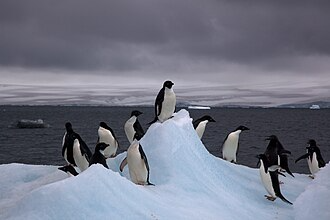
The group began organizing historical data on penguin populations and Landsat satellite imagery of guano stains, and eventually created a Mapping Application for Penguin Populations of Protected Dynamics (MAPPPD), an open database that provides information on penguin populations in Antarctica and shows real-time fluctuations (or as close to real-time as possible). The team also used satellite imagery to identify several large colonies of Adélie penguins nesting on the Danger Islands off the coast of Antarctica. Until that point, the Islands had not been considered biologically important, but after on-the-ground surveys confirmed it, the Islands were named an Antarctic Specially Protected Area to safeguard the 1.5 million Adélie penguins living there.
Although the modeling used in MAPPPD isn't perfect, the program has provided valuable data on how penguin populations have fluctuated in the past decades. And since Antarctica is more dramatically affected by climate change than much of the world, changes in penguin populations may provide an indicator of significant changes at the poles. Additionally, the algorithms and imagery techniques used for the penguin research have now been adapted to track walruses, seals, and African elephants, among other animals, and it's also been suggested that the technology could be used to track mammal populations near Chernobyl, where it's still dangerous for humans to spend any significant length of time. Although many people, surely including Proxmire, would consider studies of penguin poop to be "silly science" and a waste of federal funds, Schwaller, Lynch, and Che-Castaldo have demonstrated how an unusual idea can help humans learn more about the natural world.
Adélie penguins (Pygoscelis adeliae) on iceberg. Photo by Jason Auch, CC BY 2.0. Image courtesy of Wikipedia.
Filed under Nature and the Environment
 This article relates to The Salmon Cannon and the Levitating Frog.
It first ran in the August 13, 2025
issue of BookBrowse Recommends.
This article relates to The Salmon Cannon and the Levitating Frog.
It first ran in the August 13, 2025
issue of BookBrowse Recommends.

L.A. Women by Ella Berman
Two ambitious writers in 1960s LA face betrayal when one writes a novel based on the other's life.







Your guide toexceptional books
BookBrowse seeks out and recommends the best in contemporary fiction and nonfiction—books that not only engage and entertain but also deepen our understanding of ourselves and the world around us.


