
-
Your next favorite book
is waiting.
Summary | Excerpt | Reviews | Beyond the book | Read-Alikes | Genres & Themes | Author Bio

A Novel
by Siphiwe Gloria Ndlovu Book Reviewed by:
Siphiwe Gloria Ndlovu's outstanding fourth novel is narrated by a self-described nameless woman, originally from the City of Kings (Bulawayo, Zimbabwe). As the story opens, she's traveled to the "New Country" (which isn't named but is likely England) on a scholarship funded by the Good Foundation — a charity established by the Good family to "give back" to the continent they've plundered for generations. She enters into a long-term relationship with the Goods' only son, John B. Good IX, a photojournalist who documents wars in Africa. When the Good Museum — where the family displays their spoils — hosts an exhibition of his photos, he is confronted by a protester who questions his ethics, leading him to kill himself later that day.
Our narrator has experienced visions all her life, but John B. Good IX's untimely death increases their frequency, and she is visited nightly by spectral women from past generations. The Good family — who by this time has insisted she be artificially inseminated and bear their deceased son three children — deems her mad and imprisons her in their attic. Inspired by a pair of ornate silver wings in the museum and using an upcoming Good Foundation anniversary celebration as an excuse, she devises a ruse that allows her to take up residency in a distant castle back on her home continent. Although the structure is nearly vacant, populated by just a few servants, she feels safe, and begins to pen the stories of three of the women who haunt her, ultimately uncovering their ties to her own life. In the process of discovering who these remarkable women were, she herself becomes whole — no longer "half-broken."
The narrative is a complex blending of literary styles. The book's jacket calls it "African gothic" and the story's overall framework plays with tropes common to the gothic genre (e.g., the madwoman in the attic, apparitions, bloody specters). The narrator's overlaying tale has a hallucinogenic quality to it. As the protagonist delves into past generations, though, the tenor shifts from a spooky ghost story to more traditional historical fiction. Ndlovu focuses on the intergenerational trauma resulting from British colonialism of the 19th and 20th centuries, using the colonizers' actions in Bulawayo to illustrate her points. The story is largely told from the viewpoint of those whose voices are often lost in history ("misremembered, misbegotten and forgotten women"), unfolding through three of the narrator's specters, each of whom represents a different period in Bulawayo's history. Although these storylines overlap (and much of how they overlap isn't apparent until the very end of the book), each is presented as a stand-alone narrative, with current-day interludes from the narrator separating them.
The first-person sections are relayed with a repetition that recalls oral storytelling traditions. One woman, for example, is always referred to as "the venerable woman with the sagacious eyes," while another is always "the woman in white with mud on her hem and blood on her hands." This lends the narrator's chronicle a simplistic, fairytale feel that persists until each history is revealed and the women are given names. At that point, the narration becomes more standard. The author paints the women so realistically that it's hard to remember they're fictional.
Referring positively to how people have defied oppressive rules and systems in the past, Ndlovu states in an interview, "the history we've created, it is messy, it is chaotic." She brilliantly illustrates this in the way she reveals her characters' stories. The lives of her three heroines are presented in reverse chronological order, so the one who lived most recently is introduced first. Within each section are digressions, family revelations, visions of the future, etc.; in short, none is a linear tale. There are minor female apparitions that pop up non-chronologically during the narrator's reflections as well. It's not necessarily a chaotic telling, but it can be hard to follow.
References to literary and historic personages are frequent but rarely explained. Allusions to King Solomon's Mines, a novel by H. Rider Haggard (see Beyond the Book), are cleverly scattered across the early chapters of the book, for example. In another instance, a woman named Isabella Van Wagenen manifests to the protagonist; curious, I looked her up and discovered that was one of the names used by abolitionist Sojourner Truth. I felt that reading the book was like a scavenger hunt at times, trying to recognize these obscure references when they appeared and subsequently googling them for more information. Although the novel can be read at face value, and certainly the digressions can be distracting, stumbling across these Easter eggs also adds flavor to the reading experience; it's worth the time to follow the rabbit trails, in my opinion.
I suspect that The Creation of Half-Broken People is going to be a polarizing book; readers will either love it or hate it. While I reveled in its originality and complexity, I imagine those looking for a more straightforward reading experience will find it frustrating. That said, I highly recommend it to those seeking well-written historical fiction that's a bit different from the norm, as well as readers who would like to learn more about the ongoing effects of colonialism in Africa.
 This review was originally published in The BookBrowse Review in April 2025, and has been updated for the
December 2025 edition.
Click here to go to this issue.
This review was originally published in The BookBrowse Review in April 2025, and has been updated for the
December 2025 edition.
Click here to go to this issue.

If you liked The Creation of Half-Broken People, try these:
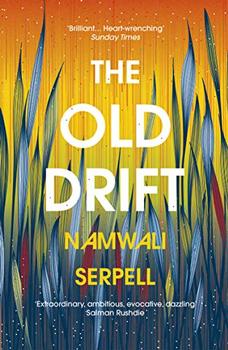
by Namwali Serpell
Published 2020
An electrifying debut from the winner of the 2015 Caine Prize for African writing, The Old Drift is the Great Zambian Novel you didn't know you were waiting for.
by Jennifer McVeigh
Published 2014
The Fever Tree is a compelling portrait of colonial South Africa, its raw beauty and deprivation alive in equal measure.
by Helen Oyeyemi
Published 2006
Helen Oyeyemi draws on Nigerian mythology to present a strikingly original variation on a classic literary theme: the existence of "doubles," both real and spiritual, who play havoc with our perceptions and our lives.
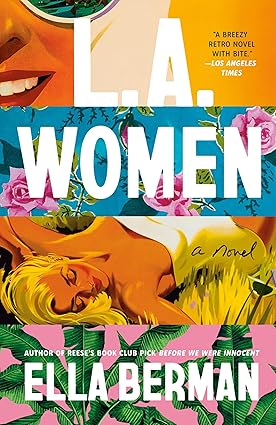
L.A. Women by Ella Berman
Two ambitious writers in 1960s LA face betrayal when one writes a novel based on the other's life.




Your guide toexceptional books
BookBrowse seeks out and recommends the best in contemporary fiction and nonfiction—books that not only engage and entertain but also deepen our understanding of ourselves and the world around us.

