
-
Your next favorite book
is waiting.
Summary | Excerpt | Reading Guide | Reviews | Beyond the book | Read-Alikes | Genres & Themes | Author Bio
 Book Reviewed by:
It wasn't a cruel accident that Crystal Mayberry entered the foster care system at the age of five and stayed there her entire childhood. Through no fault of her own, she was born into a family intimately acquainted with generational poverty, drug abuse, and violence. Following dozens of placements and a revolving door of group homes, even Crystal's aunt threw in the towel after trying to parent her, and Crystal abandoned her education at the age of sixteen. Financially supported by SSI (Social Security Income), she took the monthly $754 for granted until it was suddenly removed. While she had been eligible as a minor with a sexual abuse and mental illness history, she was ineligible as an adult. Now Crystal Mayberry was a woman in deep poverty.
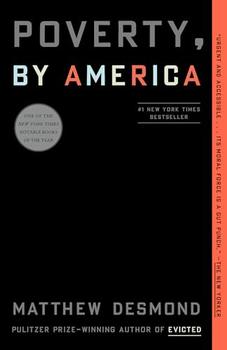
Crystal's heartbreaking struggle is one of many absorbing passages in Poverty, by America, authored by Princeton sociologist Matthew Desmond. The data Desmond offers is sobering, upsetting, and stark. One in eight children live in poverty. Thirty-eight million Americans cannot afford basic necessities. One million public school students are homeless, living in motels, cars, shelters, and abandoned buildings. Two million people don't have running water or a flushing toilet.
A writer and educator who won the 2017 Pulitzer Prize for General Nonfiction for his first book Evicted: Poverty and Profit in the American City, Desmond has an innate sensitivity towards those stigmatized by poverty. He notes that rents and incomes are no longer proportional. Rents have soared while incomes have stagnated. It's not a supply and demand problem, either. In 2021, rental units in Birmingham, Alabama, and Syracuse, New York, had a vacancy rate of 19% and 12%, respectively. Yet the rents in those cities increased by 14% and 8%.
Often invisible to others, poor families spend more than 50% of their incomes on rent, yet capitalist theory and public opinion view any kind of government aid, even for housing, as a threat. Early in the COVID pandemic, when businesses shut down and the government handed out stimulus checks and rental assistance, poverty numbers plummeted among every demographic, and the child poverty rate declined the most. Nevertheless, pandemic benefits were criticized for inciting laziness.
"Poverty isn't simply the condition of not having enough money," Desmond explains, "It is the condition of not having enough choice." It can be difficult, impossible even, for those with only a high school diploma to get ahead. This demographic made 2.7% less in 2017 than they made in 1979, with numbers adjusted for inflation. In Desmond's view, the lack of a unionized workforce is responsible, because unions protect wages. Without this protection, profits ascend and labor costs fall. Real wages (also known as inflation-adjusted wages) have grown by only 0.3% a year since 1979, when the growth was 2% a year. "The real wages for many Americans today," Desmond writes, "are roughly what they were forty years ago."
Desmond is an advocate for an increased minimum wage, arguing that if the minimum had been higher in New York City from 2008 through 2012, more than five thousand premature deaths could have been prevented, as poverty contributes to anxiety and financial stress. "A higher minimum wage is an antidepressant." When the minimum wage increases, child abuse reports decrease, as do teen births.
Poverty, by America leans upon history, since poverty is like an old oak tree with a million gnarly roots. I was surprised to learn that tipping waitstaff began after slavery, when former slaves who worked at restaurants were not paid and had to depend on the charity of diners. Desmond wants to do away with the sub-minimum wage for waiters. In another section of the book, he compares the aftermath of the 2008 recession with the financial effects of the COVID pandemic. After the 2008 recession, families in the bottom half of income levels had to wait a decade for their incomes to return to pre-recession levels. But after what Desmond calls "the COVID-induced recession," the same families had to wait just a year because of government intervention by way of stimulus payments and rental assistance. He introduces the term "poverty abolitionist" to describe those who are committed to eliminating poverty by creating and supporting policy, organizing, and strategizing for those who are financially vulnerable.
In Evicted, Desmond follows eight struggling families in Milwaukee, documenting their troubles. He elevates their humanity above their financial insecurity. This second book is more of a sociological document, and while it may lack the kind of personal narratives readers devour, Desmond's scholarship and his unpacking of the multi-layered systems that keep poverty intractable, like housing, employment, banking, and government, is brilliant.
Having read both books in different years, I have reached the same conclusion from each. Matthew Desmond is optimistic but also out of patience. He wants us to care. He wants us to ask ourselves what kind of country we want to pass on to our children. He is begging those of us who haven't fallen through the cracks to shake off our self-absorption and myriad distractions and think of those who are suffering. While he loathes the "why" of poverty, as we all should but sadly don't, he is demanding for us to shake off our emotional malaise and do something. Do better.
He believes passionately in the capacity of the unseen and the poor, but also, and this is the important part, he believes that we have the potential to change how we approach the system of poverty and the people caught in its heavy-handed grip. Because poverty, he repeatedly reminds us, isn't an accident.
 This review
first ran in the December 6, 2023
issue of BookBrowse Recommends.
This review
first ran in the December 6, 2023
issue of BookBrowse Recommends.

If you liked Poverty, by America, try these:

by Liaquat Ahamed
Published 2026
From the author of the Pulitzer Prize–winning Lords of Finance, a magnificent and timely reckoning with the first truly global financial calamity and the famous banking family at the center of the whirlwind.
by Josh Mitchell
Published 2022
From acclaimed Wall Street Journal reporter Josh Mitchell, the dramatic, untold story of student debt in America.

by Marty Makary
Published 2021
One in five Americans now has medical debt in collections and rising health care costs today threaten every small business in America. Dr. Makary, one of the nation's leading health care experts, travels across America and details why health care has become a bubble.
L.A. Women by Ella Berman
Two ambitious writers in 1960s LA face betrayal when one writes a novel based on the other's life.







Your guide toexceptional books
BookBrowse seeks out and recommends the best in contemporary fiction and nonfiction—books that not only engage and entertain but also deepen our understanding of ourselves and the world around us.

