
-
Your next favorite book
is waiting.
Summary | Excerpt | Reviews | Beyond the book | Read-Alikes | Genres & Themes | Author Bio
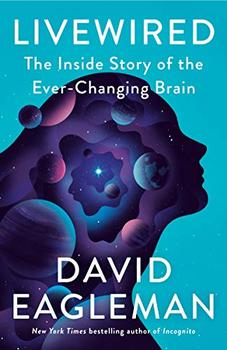
The Inside Story of the Ever-Changing Brain
by David Eagleman Book Reviewed by:
Imagine being able to absorb streams of information through your skin while you go about your day. Or having 360-degree vision. Or super-sonic hearing. According to David Eagleman, these abilities are all in the realm of the possible — and we may be able to take advantage of them sooner rather than later. In Livewired: The Inside Story of the Ever-Changing Brain, Eagleman, a neuroscientist at Stanford University and CEO of NeoSensory, a company that builds brain-based sensory interfaces, posits that the brain is a "dynamic, adaptable, information-seeking system" that is constantly reconfiguring itself in response to changes in the environment, a condition he terms "livewired." For the author, the brain offers vast possibilities that we are only beginning to explore.
He starts by describing the ways our brains develop. We're born with a brain that is "remarkably unfinished." Throughout our lives, our experiences "sculpt the vast, microscopic tapestry of [our] brain cells and their connections." Our brains literally reshape themselves based on external stimuli: "[W]hat you do over and over becomes reflected in the structure of the brain." Although we have the greatest flexibility — or plasticity — to shape our brains early in childhood, we can continue to change them throughout our lives.
Eagleman imagines an almost limitless future for human enhancement. He contends that "there's no meaningful reason to limit inputs to the senses that happen to be typical for our species." He describes sensory inputs as a sort of "plug-and-play" system in which we can choose what information we want to receive and how we want to receive it through brain-based interface devices. As he notes, much research has already succeeded in offering proof of concept for his ideas. For example, blind people have been able to distinguish visual items — seeing distance, shape, size and direction of movement — using a small stimulation device placed on the tongue. In another experiment, researchers outfitted participants with helmets that allowed them to see in 360 degrees, enabling them to dodge someone sneaking up on them or even catch a ball thrown from behind. Biohackers who have embedded magnets under the skin in their hands have developed the ability to sense magnetic fields.
Eagleman suggests that we can reconfigure our brains not only to change ourselves but also the world around us: "In the not-too-distant future, it seems inevitable that we will mind-control robots in factories, underwater, or on the surface of the moon, all from the comfort of our couches." According to the author, our brains can perceive a robotic avatar as another limb of our bodies. Again, he bases his conjectures on research already being done on artificial limbs and avatar robotics.
He concludes by considering how the principles of livewiring could be incorporated into what we build. For example, he suggests that the International Space Station could reconfigure itself through "motor babbling" (a trial-and-error method of moving, similar to how babies learn to move their bodies) and that we could create a smart electrical grid that automatically adapts to changes in the environment. He also offers the possibility of houses that move themselves to avoid flooding or seek the greatest sun exposure.
As far-fetched as some of his ideas seem, Eagleman grounds all of his predictions in extensive research, citing dozens of experiments. And although the book can get technical in its descriptions of how the brain works, he makes good use of analogies and anecdotes to keep the material approachable regardless of the reader's prior knowledge.
At some points, Eagleman gets too wrapped up in the "gee-whiz" factor of future possibilities. He would have done well to consider some of the ethical issues around human enhancement (see Beyond the Book) and smart technology as well. Moreover, his discussion of the role of technology in education is superficial. He acknowledges that he's a "cyber-optimist" on education and believes that the internet will unlock a much richer level of it, but he doesn't tackle issues such as technology's effects on attention and concentration, or the need for greater information literacy.
However, the author is a skilled storyteller and an assured guide. Fans of Oliver Sacks' narrative science will find much to enjoy in this neurological tale, as will anyone with an interest in the vast possibilities of our brains. As Eagleman writes, "We are no longer a natural species who has to wait millions of years for Mother Nature's next sensory gift. Instead, like any good parent, Mother Nature has given us the cognitive capacity to go out and shape our own experience." We are already surpassing our natural limitations; the future may be unlimited.
 This review was originally published in The BookBrowse Review in September 2020, and has been updated for the
May 2021 edition.
Click here to go to this issue.
This review was originally published in The BookBrowse Review in September 2020, and has been updated for the
May 2021 edition.
Click here to go to this issue.

If you liked Livewired, try these:
by Mary Roach
Published 2026
From the New York Times bestselling author of Stiff and Fuzz, a rollicking exploration of the quest to re-create the impossible complexities of human anatomy.

by Michael Pollan
Published 2026
From the #1 New York Times bestselling author of How to Change Your Mind, a panoptic exploration of consciousness—what it is, who has it, and why—and a meditation on the essence of our humanity.
by Walter Isaacson
Published 2022
Winner of the 2021 BookBrowse Nonfiction Award
The bestselling author of Leonardo da Vinci and Steve Jobs returns with a gripping account of how Nobel Prize winner Jennifer Doudna and her colleagues launched a revolution that will allow us to cure diseases, fend off viruses, and have healthier babies.

L.A. Women by Ella Berman
Two ambitious writers in 1960s LA face betrayal when one writes a novel based on the other's life.







Your guide toexceptional books
BookBrowse seeks out and recommends the best in contemporary fiction and nonfiction—books that not only engage and entertain but also deepen our understanding of ourselves and the world around us.

