
-
Your next favorite book
is waiting.
Summary | Excerpt | Reviews | Beyond the Book | Read-Alikes | Genres & Themes | Author Bio

A Novel
by Ethan Joella Book Reviewed by:
This article relates to The Top of the World

Much of Ethan Joella's novel The Top of the World is set in the mid-1970s at the Red Maple Inn, a fictional couples-only resort in the Pocono Mountains. Located in northeast Pennsylvania, the Poconos are a rugged wilderness area that stretches some 2400 square miles. Today, it's an exceptionally popular vacation spot; at just two hours away from both Philadelphia and New York City, it's a quick, easy getaway that offers a wide range of indoor and outdoor activities for the entire family. In the middle part of the 20th century, however, resorts in the area were marketed almost exclusively to newlyweds, earning the Poconos the nickname "the Honeymoon Capital of the World."
The mountains were home to the Lenni Lenape people (who American colonists referred to as the Delaware Indians) for millennia before Europeans displaced them in the 19th century—archeological evidence points to the area having been inhabited for over 10,000 years. The name "Pocono" comes from the Lenni Lenape word pokawachne (or pocohanne), which translates to "stream between two hills" or "stream between mountains."
The Poconos' genesis as a tourist destination occurred in 1829, when Antoine Dutot decided to begin construction of a boarding house near the village of Dutotsburg (now known as the Delaware Water Gap). In 1832, he sold the unfinished building to Samuel Snyder, who completed construction and opened it as a resort—the Kittatinny House—that could accommodate up to 25 guests. Over the next 50 years, it was expanded to accommodate perhaps as many as 500 visitors. Built on a cliff over the Delaware River, the lodge became a tourist destination. Its popularity was further enhanced by regional railroads that sought to encourage passenger travel, and by the late 19th century 15 other hotels and boarding houses had been built in the area.
During the early 20th century, New York City and Philadelphia both became heavily industrialized. City-dwellers looking for an escape from the summer heat often chose to vacation in the Poconos to enjoy the clean, cool air. Then, in 1926, Pennsylvania Power and Light began constructing a hydroelectric power dam. This created Lake Wallenpaupack, a 13-mile-long body of water with 52 miles of shoreline, inviting watersports such as fishing and boating.
The popularity of the Poconos increased throughout the 1940s. Soldiers on leave often went to the mountains to recuperate, and after World War II many took long overdue honeymoons there with their new brides. In 1945 Rudolf Von Hoevenberg opened The Farm on the Hill, a resort specifically for new couples (they had to provide proof of marriage). By 1960, the Poconos were attracting over 100,000 newlyweds a year, and many resorts popped up that catered specifically to young couples. By and large, these were rustic and featured wholesome entertainment like hayrides and volleyball games. Although The Top of the World is set in the mid-1970s, well after this boom, this is very much the type of resort featured in the book.
 Then came the sexual revolution of the 1960s, when it appeared tourists were ready for something a little more risqué. Morris Wilkins, owner of the Cove Haven Resort, decided to create a much more explicitly romantic venue, which included heart-shaped everything (bed, sink, mirrors)—but most famously, a heart-shaped tub filled with bubbles. Other features included a massive jacuzzi shaped like a champaign glass, wall-to-wall shag carpeting, and mirrored walls and ceiling. (Check it out here!) The trend caught on, and the Poconos became known as the Honeymoon Capital of the World, attracting even more visitors than the previous title holder, Niagara Falls.
At one point there were over 300 resorts operating in the Poconos, but the area couldn't sustain such a large number of businesses catering to just couples, and many pivoted to offer family-friendly accommodations (think Kellerman's in the movie Dirty Dancing). And with the advent of other forms of tourism, many have still found themselves unable to compete. As has happened across the country, small "mom and pop" operations have shut down as large corporations able to offer different experiences to their guests have entered the picture. Camelback Resort, for example, offers winter skiing and indoor water parks, while Mount Airy Casino Resort offers Las Vegas–style gambling and an 18-hole golf course. Cove Haven, with its heart-shaped tubs, is still around, however, for those looking for a bit of nostalgia.
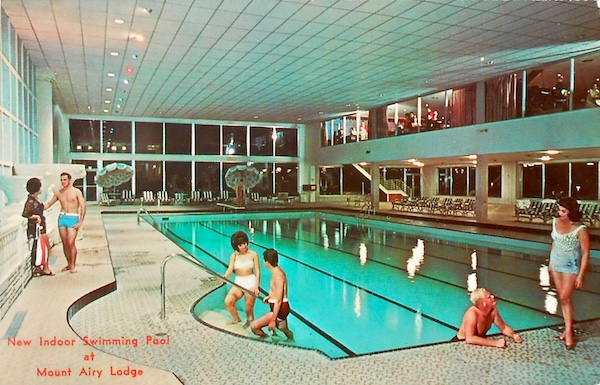
Promotional photograph marketing the new indoor swimming pool at Mt. Airy Lodge in the Poconos, circa 1960s, courtesy of Yesterdays-Paper (CC BY 3.0)
Filed under Places, Cultures & Identities
 This article relates to The Top of the World.
It will run in the July 15, 2026 issue of BookBrowse Recommends.
This article relates to The Top of the World.
It will run in the July 15, 2026 issue of BookBrowse Recommends.

L.A. Women by Ella Berman
Two ambitious writers in 1960s LA face betrayal when one writes a novel based on the other's life.






Your guide toexceptional books
BookBrowse seeks out and recommends the best in contemporary fiction and nonfiction—books that not only engage and entertain but also deepen our understanding of ourselves and the world around us.

