
-
Your next favorite book
is waiting.
Summary | Excerpt | Reviews | Beyond the Book | Read-Alikes | Genres & Themes | Author Bio
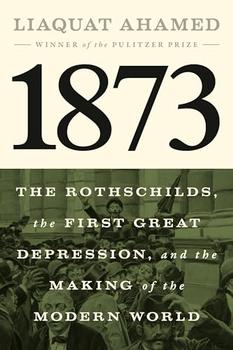
The Rothschilds, the First Great Depression, and the Making of the Modern World
by Liaquat Ahamed Book Reviewed by:
This article relates to 1873

 In his book of economic history 1873, Liaquat Ahamed connects much of the modern world to the events of 1873, which saw a stock market crash after years of frenzied speculation and, in the aftermath, the first international financial crisis. What made the crisis so impactful was not simply the bursting of the bubble but the Western monetary policy response to it. In these years, Europe and the United States moved away from a bimetallist system, in which their currency and liquidity were based on their reserves of gold and silver, to the gold standard, so that silver reserves no longer had any bearing on the country's money supply. (Some countries, like Britain, were already on the gold standard.)
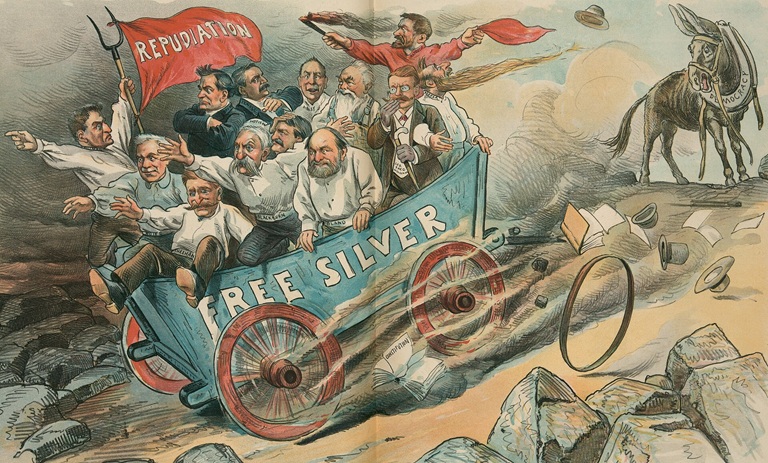
The demonetization of silver exacerbated the collapsing economy and caused prices to fall. In the wake of this deflation, some experts argued that the way to correct it was to expand the supply of currency and ease credit by remonetizing silver, returning to a bimetallist standard. Those who advocated remaining on the gold standard were called "goldbugs."
Ahamed writes that to readers now, the controversy of bimetallism seems "almost quaintly esoteric and the rancor generated by the arcane debate barely comprehensible." But at the time, it was a huge question, and people had real stakes in the outcome. Bimetallism attracted support from people harmed by the falling prices—farmers, miners, manufacturers. Goldbugs tended to be bond investors and bankers, because falling prices meant the value of their financial assets was greater.
In Britain, which had always had the gold standard, bimetallists were a fringe group, thought of as eccentric; Ahamed writes that when Oscar Wilde wanted to signal that a character was a little weird, he would make them a bimetallist. In the United States, there was popular support for bimetallism, but not from the political establishment.
However, at one point in the late 1880s, bimetallism gained some momentum in the US. It had started out in the Western states, led unsurprisingly by owners of silver mines. But as deflation continued and grain prices declined, the movement gained momentum with Midwestern farmers, who saw expanding the money supply as a way to lift prices for their products. Their slogan for bimetallism became "Free Silver." Then, in the late 1880s, the Populist Party, an insurgent movement of Midwest farmers, embraced the Free Silver movement and imbued the cause with an anti-Wall Street message, denouncing "bloated bondholders" and "moneycrats." One Populist orator, the incendiary Mary Elizabeth Lease, said in a speech in 1890 that "Wall Street owns the country" and that the government was no longer "of the people, by the people and for the people," but "of Wall Street, by Wall Street and for Wall Street."
Unfortunately, Ahamed writes, "in the hands of the Populists, the campaign for Free Silver became entangled in a web of absurd conspiracy theories," including the fabricated theory that the demonetization of silver had been orchestrated by the Rothschilds. After that, the Rothschilds' name began to "acquire villainous connotations in the American heartland." Because they were Ashkenazi Jewish, the international finance dynasty was frequently the target of antisemitic tropes and attacks.
While popular, the Free Silver movement never achieved impactful policy changes.
Political cartoon "A down-hill movement" by C.J. Taylor, 1896, courtesy of the Library of Congress
Filed under People, Eras & Events
 This article relates to 1873.
It will run in the July 15, 2026 issue of BookBrowse Recommends.
This article relates to 1873.
It will run in the July 15, 2026 issue of BookBrowse Recommends.
Theo of Golden by Allen Levi
One spring morning, a stranger arrives in the small southern city of Golden. No one knows where he has come from…or why…






Your guide toexceptional books
BookBrowse seeks out and recommends the best in contemporary fiction and nonfiction—books that not only engage and entertain but also deepen our understanding of ourselves and the world around us.

