
-
Your next favorite book
is waiting.
Summary | Excerpt | Reviews | Beyond the Book | Read-Alikes | Genres & Themes | Author Bio

Stories
by Sarah Braunstein Book Reviewed by:
This article relates to Baby in a Box

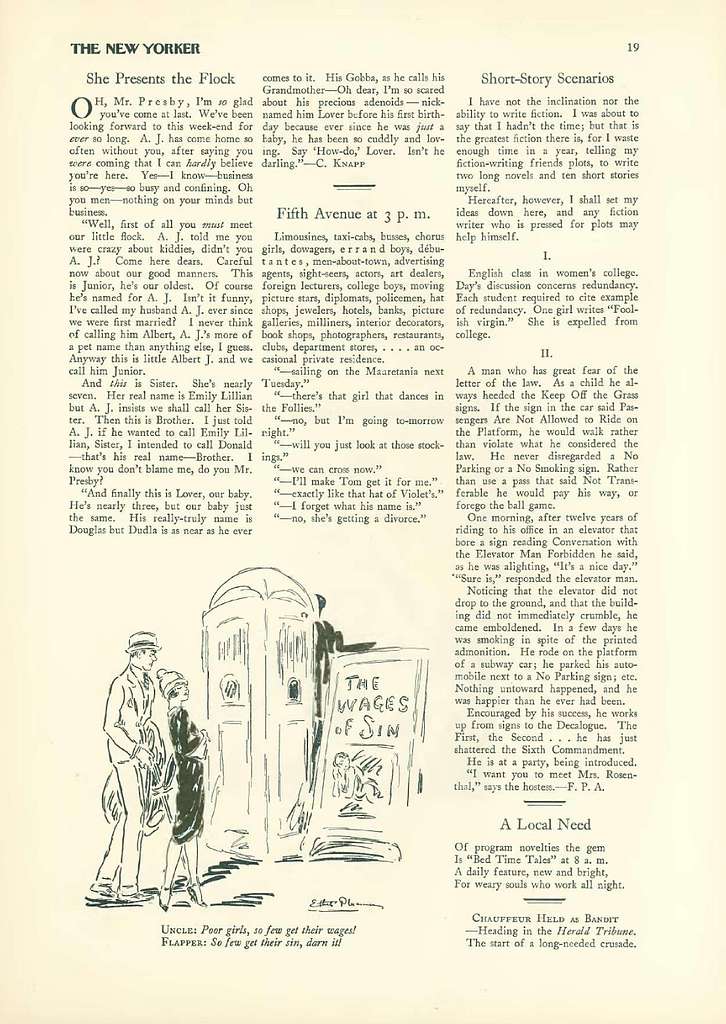 Four stories from Sarah Braunstein's Baby in a Box were first published in The New Yorker, a magazine with a 101-year history of showcasing excellent short fiction from the likes of John Cheever, Mavis Gallant, Jhumpa Lahiri, Alice Munro, Vladimir Nabokov, Philip Roth, and William Trevor.
While short stories can be difficult to sell to publishers (and thus to readers), The New Yorker has a reputation as one of the premier platforms for short fiction. Being published in it can be one marker of a writer at their pinnacle. In her recent work of literary history, Middlemen, Laura B. McGrath notes that having a breakout story in a big-name literary magazine is considered a sign of a potentially successful novelist, so literary agents will often browse magazines' short fiction to find new clients to contact. Certain stories that are famous in their own right first appeared in The New Yorker, such as Shirley Jackson's "The Lottery," Annie Proulx's "Brokeback Mountain," and Muriel Spark's novella The Prime of Miss Jean Brodie. Publication in The New Yorker is a goal for many MFA students.
The magazine tends to publish the same writers again and again, though, which makes it harder for debut authors to break through (although the selection of a "20 under 40" list in 2010 injected some fresh blood). In March 2019, Joshua Loong gathered statistics on the number of stories printed in The New Yorker—then, 13,290—and its most published authors out of 2,327 total. His rundown of the most prolific writers includes some household names and some virtual unknowns: S. J. Perelman with 271 stories, followed by James Thurber (270), John O'Hara (226), Frank Sullivan (191), W. E. Farbstein (184), E. B. White (179), and John Updike (169). The danger of repeat work by established authors is that it can lead to cultural hegemony—especially by white men. When Frank Kovaric surveyed the stats for The Millions in 2011, he found that only around 35% of the short fiction writers The New Yorker had featured from 2001 through 2010 were women. In 2021, the archive editor for The New Yorker also raised concerns about the general lack of racial diversity in the print magazine.
The current fiction editor for The New Yorker, Deborah Treisman, chose 78 of the magazine's best stories for a centenary anthology in 2025. In the introduction, she traced the evolution of the typical New Yorker story: from a sketch with a punchline through plotless realism to "mini-novels." Over the decades, she remarks, the author roster has become more diverse, while different editors have had diverging opinions about more autobiographical material. Towards the turn of the millennium, she spotted "a loosening of language, an openness to oddness in voice or in pacing, an influx of styles as varied as those of George Saunders, Haruki Murakami, Lorrie Moore, Junot Díaz, David Foster Wallace, [and] Zadie Smith."
The challenge is to keep finding fresh voices, new approaches, and consistently exceptional writing. In 1994, Roger Angell, then a senior editor, described the hard work of assessing short stories for inclusion in The New Yorker as follows: "Reading short-fiction manuscripts can be wearing and wearisome from day to day and week to week. Every human situation, every sort of meeting or conversation, is something you have read before or know by heart. But then here comes a story—maybe only a couple of paragraphs in that story—and you are knocked over. Your morning has been changed; you are changed."
There are 47 issues of The New Yorker annually, each typically containing one short story. There is also a series on the website called "The Writer's Voice" where the featured author reads their story after it has appeared in the magazine, plus a monthly fiction podcast on which Treisman has an author come on to discuss someone else's famous short story. It's all evidence that The New Yorker is still a major tastemaker when it comes to short fiction.
A page of the story "She Presents the Flock" by Clarence Knapp in the first issue of The New Yorker (February 21, 1925), via Picryl
Filed under Books and Authors
 This article relates to Baby in a Box.
It first ran in the June 10, 2026
issue of BookBrowse Recommends.
This article relates to Baby in a Box.
It first ran in the June 10, 2026
issue of BookBrowse Recommends.





These are not books, lumps of lifeless paper, but minds alive on the shelves
Click Here to find out who said this, as well as discovering other famous literary quotes!

Can you name the title?
Test your book knowledge with our daily trivia challenge!
Your guide toexceptional books
BookBrowse seeks out and recommends the best in contemporary fiction and nonfiction—books that not only engage and entertain but also deepen our understanding of ourselves and the world around us.
