
-
Your next favorite book
is waiting.
Summary | Excerpt | Reading Guide | Reviews | Beyond the Book | Read-Alikes | Genres & Themes | Author Bio

A Novel
by Douglas Stuart Book Reviewed by:
This article relates to John of John

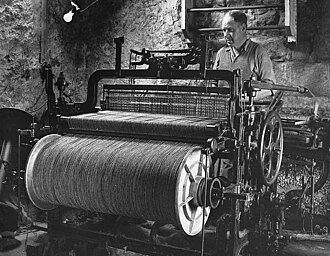 The protagonists of Douglas Stuart's novel, John of John, are John and Cal Macleod, a father and son who live on a croft (a small, rural family homestead used for subsistence farming) on the remote Isle of Harris in Scotland's Outer Hebrides. In addition to raising sheep, the men are among the many individuals on the islands who weave cloth in their homes, which is then marketed as Harris Tweed.
Sheep herding has been a primary industry on the islands of the Outer Hebrides (also known as the West Hebrides) for millennia; archeological evidence suggests the first sheep were introduced by the Vikings some 6,000 years ago. In addition to meat (lamb and mutton), the animals provide wool which in turn is handwoven into cloth—a practice that has persisted for around 3,000 years. The heavy, durable cloth has been such a part of the islanders' lives that, at one point, blankets made from it were often bartered for goods and used for paying rent.
The dissolution of the Scottish clan system in the 18th century resulted in the selling off of ancestral lands in the Highlands, often to sporting enthusiasts. These new estate owners began outfitting their employees in "estate tweeds"—fabric woven in distinct patterns specific to the landowner. Tweed from the Island of Harris came to the attention of Catherine Murray, the Countess of Dunmore, in 1846. Impressed by the fabric's beauty and quality, she commissioned yards and yards of it for the employees of her North Harris Estate and became an advocate for tweed specifically from that area of the country. The cloth, now called Harris Tweed, was quickly designated as the best of the best.
Over time, some enterprising individuals sought to copy Harris Tweed, producing fabric of a poorer quality. The onslaught of counterfeit cloth became such a concern that in 1993 British Parliament enacted the Harris Tweed Act, which specified Harris Tweed must be "handwoven by the islanders at their homes in the Outer Hebrides, finished in the Outer Hebrides, and made from pure virgin wool dyed and spun in the Outer Hebrides." To date, it's the only fabric in the world with protection of this type (similar to the way the sparkling wine known as Champagne can only be produced in the Champagne region of France). The Harris Tweed Authority (also known as "The Guardians of the Orb," so-called because of the orb design of their stamp of authenticity) was also established to oversee production and maintain quality.
The manufacturing of Harris Tweed is a lengthy process:
This process has remained largely unchanged for over 100 years.
Image from The Harris Tweed Authority, CC BY-SA 3.0 Unported.
Filed under Places, Cultures & Identities
 This article relates to John of John.
It first ran in the May 6, 2026
issue of BookBrowse Recommends.
This article relates to John of John.
It first ran in the May 6, 2026
issue of BookBrowse Recommends.
Theo of Golden by Allen Levi
One spring morning, a stranger arrives in the small southern city of Golden. No one knows where he has come from…or why…




Your guide toexceptional books
BookBrowse seeks out and recommends the best in contemporary fiction and nonfiction—books that not only engage and entertain but also deepen our understanding of ourselves and the world around us.


