
-
Your next favorite book
is waiting.
Summary | Excerpt | Reading Guide | Reviews | Beyond the Book | Read-Alikes | Genres & Themes | Author Bio

A Novel
by Che Yeun Book Reviewed by:
This article relates to Tailbone

 Che Yeun's debut novel, Tailbone, is set in Seoul, South Korea, during the 2008 global financial crisis. In it, the unnamed narrator observes how the crash impacts the women in her boarding house, all of whom are sex workers.
The international Great Recession was triggered in mid-September 2008, when the housing bubble in the United States collapsed. Lax lending practices and inadequate oversight led to widespread mortgage defaults, which in turn sent the stock market into a tailspin. Virtually every country's economy was impacted to some degree, although the severity varied widely.
South Korea was especially hard hit by the downturn because of its reliance on foreign investment and income from exporting goods, both of which were severely curtailed during this period. The won lost 60% against the US dollar by the end of 2008, significantly reducing buying power and sparking rampant inflation. It was the second-worst performing currency, after the Icelandic krona. Exports declined sharply as overseas demand fell. The country's two major stock indices, the Korea Composite Stock Price (KOSPI) and the Korea Securities Dealers Automated Quotation (KOSDAQ), dropped 22.67% and 30.14%, respectively.
As depicted in Tailbone, the impact of this economic decline on South Korea's citizens was massive and cut across all class lines. Unemployment skyrocketed while household savings plummeted; the amount of debt also increased as people took out high-interest loans to stay afloat. Many, such as our narrator's parents, hadn't fully recovered from the 1997 Asian Financial Crisis, remaining deep in debt and underemployed, and this latest crisis only made matters worse. The stock market crash combined with these other financial stressors resulted in a national spike in stress and a marked increase in suicides.
South Korea actually rebounded from the financial crisis faster than most countries, exhibiting a so-called "V-shaped recovery." The government and financial sectors had prudently implemented policies after the 1997 downturn that allowed the nation to weather the storm more successfully. In early November 2008, the government also announced a 14 trillion won ($11 billion) stimulus package to prop up the economy. Programs were implemented to stabilize the financial sector; for example, Korea's banks were instructed to lower interest rates on CDs and bonds, and guarantee foreign-currency deposits. To stimulate the economy the government decided to "front-load" its purchases so that most of its budget would be spent in the first quarter of 2009. It also eased rules for construction and relaxed regulations around environmental, land use, and labor issues. These policies had the effect of stimulating the economy, but as they were largely aimed at benefitting business and industry, they also led to underemployment and the shrinking of South Korea's middle class.
Because of this response, South Korea avoided falling into a full-blown recession, posting GDP growth of 0.7% for 2009, and a remarkable increase of 6.3% by the end of 2010. Still, many households didn't recover for years. The financial crisis exacerbated the wealth gap, dramatically shrinking the middle class, and debt incurred during the economic decline continued to burden low- and middle-income adults. While the middle class has rebounded somewhat as of 2025, many families continue to struggle.
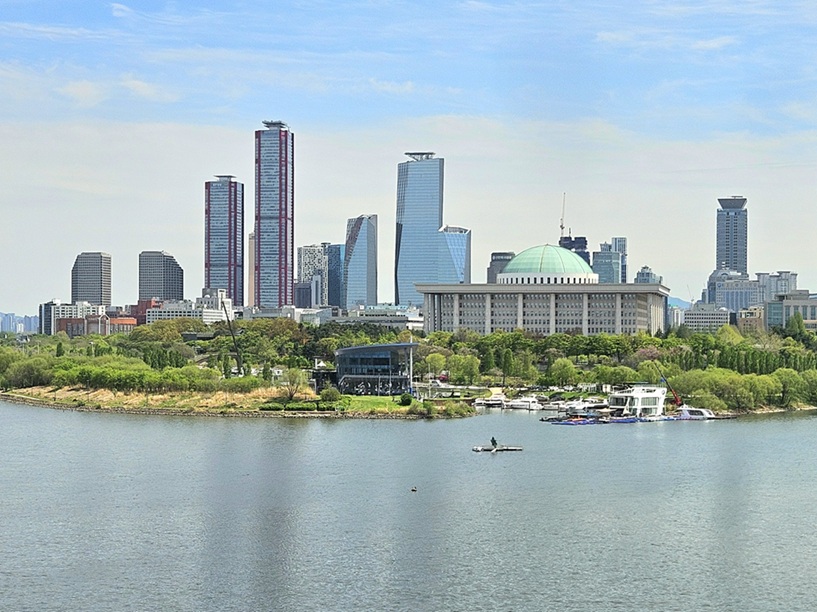
Yeouido, the river island that contains Seoul's financial district, photo by Kimhs5400, courtesy of Wikimedia Commons CC BY 4.0
Filed under People, Eras & Events
 This article relates to Tailbone.
It first ran in the April 22, 2026
issue of BookBrowse Recommends.
This article relates to Tailbone.
It first ran in the April 22, 2026
issue of BookBrowse Recommends.

L.A. Women by Ella Berman
Two ambitious writers in 1960s LA face betrayal when one writes a novel based on the other's life.






Your guide toexceptional books
BookBrowse seeks out and recommends the best in contemporary fiction and nonfiction—books that not only engage and entertain but also deepen our understanding of ourselves and the world around us.


