
-
Your next favorite book
is waiting.
Summary | Excerpt | Reading Guide | Reviews | Beyond the Book | Read-Alikes | Genres & Themes | Author Bio

A Novel
by Nikesha Elise Williams Book Reviewed by:
This article relates to The Seven Daughters of Dupree

In Nikesha Elise Williams's novel The Seven Daughters of Dupree, Gladys, the fifth generation of Dupree women, leaves southern Alabama for Chicago with her new husband, Eugene, in 1953. Eugene worked for the railroad, ferrying passengers between the Midwest and the Deep South but also carrying news of northern cities that offered freedom from oppressive Jim Crow systems like those Gladys and her family lived with in Lands' End, Alabama.
The movement captured in Williams's novel was part of the Great Migration, in which millions of Black Americans left the South for better social and economic opportunities in northern cities. Chicago was a particularly common destination, and the city's Black population grew by about 500,000 between 1916 and 1970.
The Great Migration was influenced by two coinciding factors: increasing violence toward and oppression of Black people in the South and limited European immigration during World War I. Stockyards and other factories in Chicago increased their hiring of Black men as immigrant labor sources were curtailed during the First World War. World War II then repeated these trends a few decades later.
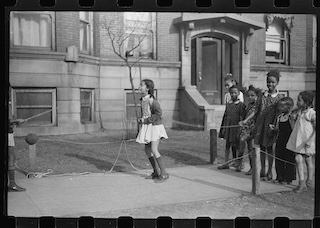 At the same time, these decades saw lynchings and violence taking place across the South, exemplified in The Seven Daughters of Dupree by Gladys's rape at the hands of white men in Lands' End. News of better opportunities reached the South through sources like the Chicago Defender, which Eugene smuggles into Lands' End on his trips south from Chicago in the novel. These forces worked in concert to inspire a massive internal migration of Black people seeking safety and prosperity, and it reshaped Chicago's social fabric and developed vibrant neighborhoods like Bronzeville on the city's South Side.
But the Great Migration was not without violence and unrest. Race riots broke out in East St. Louis, Illinois, in 1917, and in Chicago in 1919. Segregation, restrictive housing covenants, and violence became the norm, and this in turn influenced Chicago's neighborhoods and social life, even to the present day.
The Great Migration was far more than a simple demographic shift. It showed that racial violence extended far outside the boundaries of the former Confederacy, but also demonstrated the resilience of Black Americans and the universal commitment to finding better conditions for oneself and one's family, no matter the risk.
Photograph of girls jumping rope on a street in Chicago's Black Belt, 1941, courtesy of Farm Security Administration via Library of Congress Prints & Photographs
Filed under Society and Politics
 This article relates to The Seven Daughters of Dupree.
It first ran in the March 11, 2026
issue of BookBrowse Recommends.
This article relates to The Seven Daughters of Dupree.
It first ran in the March 11, 2026
issue of BookBrowse Recommends.

L.A. Women by Ella Berman
Two ambitious writers in 1960s LA face betrayal when one writes a novel based on the other's life.






Your guide toexceptional books
BookBrowse seeks out and recommends the best in contemporary fiction and nonfiction—books that not only engage and entertain but also deepen our understanding of ourselves and the world around us.

