
-
Your next favorite book
is waiting.
Summary | Excerpt | Reviews | Beyond the Book | Read-Alikes | Genres & Themes | Author Bio

 Book Reviewed by:
This article relates to Halsey Street

 Quite a few years ago my mother and I drove to Chicago for a wedding she was hired to officiate; she is an Episcopal priest. It was a four-hour road trip with most of it laughing and joking and singing to old school R&B (hip-hop horrifies my mother). But I noticed a change in her as we entered Chicago. Her face suddenly lost its color. Her jaws narrowed and her eyes were glass. Her grip on the steering wheel was akin to holding onto a life raft to stay alive. "What is wrong?" I asked. She took a deep breath, turned to me, and said, "I hate Chicago."
Was she transferring the rage of her father into this present space? He was denied employment in Chicago because they didn't hire black engineers at the time. Was she referring to the intractable boundaries and barriers and streets that she couldn't cross (State Street on the southside), and neighborhoods that embraced racial covenants (Hyde Park)? Or perhaps it was the Chicago version of the Mississippi Appendectomy civil rights activist Fannie Lou Hamer spoke of, where women go into the emergency room with an inflamed appendix and leave surgery sterilized, their uterus and ovaries gone. This happened to my mother when she was twenty-five years old.
Fictional character Penelope Grand doesn't have regional angst. The Bed-Stuy neighborhood that raised her was tight-knit, intimate, and freeing. It gave her a sense of place, but Penelope's woes center around her detached mother Mirella. Their relationship is documented in the remarkable novel Halsey Street by Naima Coster and what is apparent to me is that Penelope—a daughter returning home to take care of her father—can't shake the malignancy of abandonment in the same way my mother can't shake the wounds of racism.
Home is a combination of things. It is the city itself. The streets and hangouts and restaurants. The theaters and shops and friends. But home is also the people who live inside the house where you were raised and that is where the complications arise. While my mother hated Chicago for how it diminished her as a black girl, she was also the daughter of an alcoholic. She had to negotiate the chaos that alcoholics present inside a family, and the secrets that cannot be shared, while also figuring out how to fit her dreams into a city that wanted to isolate her. She never blamed her alcoholic mother, understanding the collateral damage of racism. She blamed the city.
While Penelope doesn't blame Brooklyn for her pain, she holds her mother Mirella to an impossible standard. When she first arrived in the United States, Mirella was forced to sleep on the floor and be someone's maid. She later married an older man and by marrying him was thrust into an all-black community that marginalized her presence. Unacquainted with her mother's story, Penelope summed up Mirella as a bad wife and an awful mother while simultaneously nursing her hometown anxiety.
Hometown anxiety is a term that describes the combination of feelings that may occur when you return home for a visit, particularly when that home was a source of trauma. "As soon as you walk into your kitchen at home, you are flooded with memories that are attached to being in the home," according to psychologist Dr. Susan Albers-Bowling. "There could also be a lot of guilt that you may have some conflicting emotions."
Penelope's memories, upon returning to her childhood home, are painful. For instance, she thinks back to how her mother never really understood the record store that Penelope's father Ralph owned, nor why he invested all his financial capital into it when she was searching for the American Dream and a better life. While Mirella was dutiful, she hadn't assimilated into the requirements of American motherhood. By the time Penelope was eight years old Mirella believed her daughter's needs had been met. "Penelope was old enough to watch herself; she went to school; she was fed; she was clean; she needed nothing else." Mirella's detachment triggered Penelope's disdain. What made the relationship even more corrosive was that Mirella didn't understand Penelope's creative dreams, that she wanted to draw and paint, which Mirella thought was foolish. It only widened the gulf between them and made Penelope feel unseen.
My mother didn't feel seen in Chicago, but upon her return, she focused on me. We stayed in Hyde Park at my Aunt Cynthia's and if she noticed the irony she didn't mention that a half-century earlier my aunt couldn't have rented there, much less owned a building. We went to the Lake Meadows townhouses where we lived before moving to California and the University of Chicago Laboratory School where my mother graduated in 1955. During the wedding, which I crashed, she was happy and relaxed. Her anxiety disappeared.
Hometown anxiety isn't completely cured by a daughter, a wedding, or even a night out. But adoration helps mitigate the sting of a recurring wound. As soon as Penelope meets Marcus Harper in her Brooklyn neighborhood she is drawn to him and he to her. Marcus thinks Penelope a wonderful artist. What is supposedly her greatest failure, he embraces lovingly. "Your work is spectacular. I'm no art critic, but really-wow. These paintings are terrific…I've never known anyone like you. You are exquisite." His compliments mute the reality of the situation with her injured father, her mother's abandonment, and her own hypocrisy. She loathes gentrification but enjoys the gift it has bestowed upon her in Marcus.
Like all anxiety, hometown anxiety takes years to dissolve. I think of my mother and that weekend in Chicago. Eventually, we had a great time, but she didn't return to Chicago for years after, not until the illness of Aunt Cynthia. Now she anticipates her yearly Christmas visits, and while she still remembers what Chicago used to be, the wounds of that time have dried up. She can enjoy a homecoming by celebrating the education and memories the city gave her instead of the freedoms the city took away.
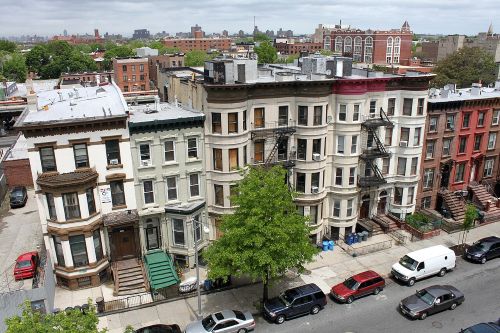
From the roof in Bed-Stuy
Photo by Eli Duke, CC BY-SA 2.0
Filed under Books and Authors
 This article relates to Halsey Street.
It first ran in the January 28, 2026
issue of BookBrowse Recommends.
This article relates to Halsey Street.
It first ran in the January 28, 2026
issue of BookBrowse Recommends.

L.A. Women by Ella Berman
Two ambitious writers in 1960s LA face betrayal when one writes a novel based on the other's life.






Your guide toexceptional books
BookBrowse seeks out and recommends the best in contemporary fiction and nonfiction—books that not only engage and entertain but also deepen our understanding of ourselves and the world around us.


