
-
Your next favorite book
is waiting.
Summary | Excerpt | Reviews | Beyond the Book | Read-Alikes | Genres & Themes | Author Bio

 Book Reviewed by:
This article relates to On Morrison

 When I was in middle school my father sold a film to Columbia Pictures about his black Chicago childhood. He soon discovered the script had been changed. Chicago was replaced by a small Texas town. The black teenagers were now white. There was an unspoken understanding that what was missing from my father's script was a necessary feature for marketing: the white gaze.
The white gaze, a term popularized by Nobel Prize-winning author Toni Morrison, refers to the intentional centering of the white experience, regardless of story. Some writers deliberately set a white character count for themselves to get projects greenlighted. Not Morrison. As noted in the literary criticism book On Morrison by Harvard professor Namwali Serpell, Morrison exponentially rejected the white gaze. "I've spent my entire writing life trying to make sure the white gaze was not the dominant one in any of my books."
Morrison was frequently asked why she didn't write about white people. She answered with annoyance, responding once with, "You can't understand how powerfully racist that question is, can you…You could never ask a white author, 'When are you going to write about black people?'" Morrison's need to tell black stories presented a personal challenge as she spoke of "The little white man that sits on your shoulder and checks out everything you do or say. You sort of knock him off and you're free."
In Toni Morrison's slave-narrative masterpiece Beloved, rotten men and victimized women occupy the same space within a single document. It is this brilliance of slavery and loathing that is so unforgettable. It wasn't a difficult choice for Morrison, I imagine, to keep the gut-heart paradigm of cruel men unbreakable and immoral. Anything less would be a betrayal to Morrison's core audience. And history.
Morrison is sensory dependent, however. Early in the novel, a pregnant Sethe is running for her life, heart beating, legs moving, sweating when her water breaks and she collapses in the woods, not far from the river that will take her to freedom. Suddenly, the character Amy Denver appears out of nowhere as her angel. Amy is a white indentured servant who delivers Sethe's baby while offering her compassion and nurture. Therein is the visual irony of 1855 Kentucky. A pregnant Sethe hunted down by white monsters only to be saved by white charity. It's as if Morrison is chiding her readers about white generosity. It exists but in isolated moments.
Beloved remains a story of violence and despair, self-loathing, and rage. Later in the novel, a desperate Sethe, hunted again, slits her two-year-old daughter's throat. That daughter returns from the grave to judge Sethe and mercilessly haunt her.
Novelists are faced with a myriad of choices. Toni Morrison could have written a story where Sethe was arrested and judged by a white judge and jury for child murder, posing a question of moral justification. But that would be the white gaze. Morrison kept it simple. A white atrocity here. A black atrocity there.
I've always thought of Beloved as literary math. A civilized Venn diagram of oppressors and oppressions, black murder and white savagery. To tell of the bestial behavior of white slaveholders upon black bodies, there must be white characters. But that is not the white gaze Morrison is concerned with. That is storytelling.
Morrison refused to make an ancestor story an abolitionist story. She refused to make a ghost story a white redemption story. Her vision for Beloved was about the parallel truths of ugliness and abuse, even when black folk do the unthinkable of slitting a daughter's throat. There's no antidote to be had, not when slavery abuse infects the body and mind. There is no pill to take, no inhaler to make yourself breathe. You just have to live it. Even if a haint (evil spirit) is in your house. Even if your boys run away. Even if your dead daughter Beloved walks out of the grave. The black experience is complicated and rich and is of mercy and survivorship.
Filed under Books and Authors
 This article relates to On Morrison.
It first ran in the February 25, 2026
issue of BookBrowse Recommends.
This article relates to On Morrison.
It first ran in the February 25, 2026
issue of BookBrowse Recommends.
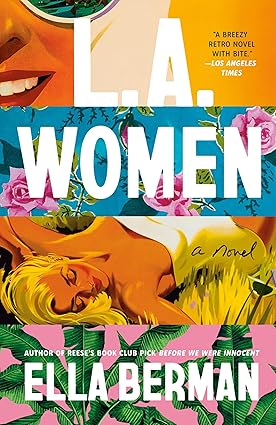
L.A. Women by Ella Berman
Two ambitious writers in 1960s LA face betrayal when one writes a novel based on the other's life.






Your guide toexceptional books
BookBrowse seeks out and recommends the best in contemporary fiction and nonfiction—books that not only engage and entertain but also deepen our understanding of ourselves and the world around us.

