
-
Your next favorite book
is waiting.
Summary | Excerpt | Reviews | Beyond the Book | Read-Alikes | Genres & Themes | Author Bio

 Book Reviewed by:
This article relates to This Is Where the Serpent Lives

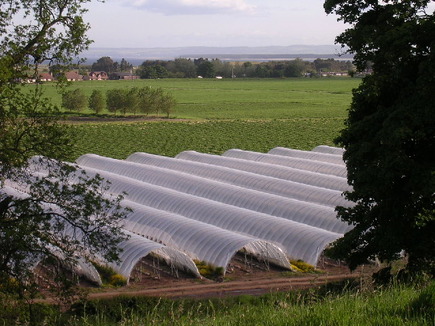 In Daniyal Mueenuddin's This Is Where the Serpent Lives, the character Saqib defies the odds of his caste by becoming an entrusted manager of a business venture for Hisham Atar, the son of Colonel Atar, whose estate Saqib's family has served for generations in Lahore, Pakistan. Hisham has given Saqib the task of implementing tunnel farms on a remote piece of family land to see if he can turn a profit growing cucumbers.
Tunnel farming is an agricultural technique in which crops are grown in long rows under structures created with curved metal hoops of a dome-like shape that are covered with plastic. These structures serve to cocoon the space underneath where seeds will be planted, protecting against outside weather elements. Temperature and moisture can differ depending on the crop and its specific growing conditions.
The idea of tunnel farming is to re-create the conditions of the regular farming season to grow seasonal produce out of season—in other words, being able to grow summer vegetables in the winter. These vegetables are then sold for higher prices at market because they are less available and demand is higher.
Tunnels are similar in principle to greenhouses, but they differ significantly in practice. Whereas greenhouses are permanent structures with climate control systems, like heaters and coolers, tunnels are simpler structures that rely mostly on passive solar heating and passive ventilation. Also, in greenhouses, plants are usually grown in containers; in tunnels, on the other hand, the plants are grown directly in the soil, and the tunnel is simply a covering—the size and permanence of which can vary—that goes over them.
There are a few different types of tunnels. Low tunnels are close to the ground—farmers have to crawl through them—and have the lowest crop yield. Caterpillar tunnels, sometimes called walk-in tunnels, are higher than low tunnels, such that farmers can walk through them easily. These have a larger crop yield, but are still not very permanent structures; usually the tunnel slips over rebar for a quick setup and can be moved to another area of land easily. Finally, high tunnels, also called hoop houses, are the largest and most permanent fixtures (although still less permanent than greenhouses). They tend to have steel pipe frames set into the ground and may be covered with one or two layers of greenhouse-grade plastic. High tunnels offer the maximum yield and easier soil preparation.
The tunnel farming technique offers protection from harsh weather elements, as well as from insects and wild animals, and can extend the season of harvest for certain crops. According to Green Group Pakistan, tunnel farming can also require up to 40 percent less water (because soil requires less water in the winter, and the heat captured by the tunnels allows farmers to grow crops in colder weather). In Pakistan, the tunnels are usually temporary and are taken down after the growing season ends.
Image of tunnel farming by Val Vannet, CC BY-SA 2.0.
Filed under Nature and the Environment
 This article relates to This Is Where the Serpent Lives.
It first ran in the February 11, 2026
issue of BookBrowse Recommends.
This article relates to This Is Where the Serpent Lives.
It first ran in the February 11, 2026
issue of BookBrowse Recommends.

L.A. Women by Ella Berman
Two ambitious writers in 1960s LA face betrayal when one writes a novel based on the other's life.





Your guide toexceptional books
BookBrowse seeks out and recommends the best in contemporary fiction and nonfiction—books that not only engage and entertain but also deepen our understanding of ourselves and the world around us.


