
-
Your next favorite book
is waiting.
Summary | Excerpt | Reviews | Beyond the Book | Read-Alikes | Genres & Themes | Author Bio

A Novel
by Larissa Pham Book Reviewed by:
This article relates to Discipline

 In Discipline, Larissa Pham's debut novel, the main character is a former painter who pursued an MFA but dropped out after an affair with her college mentor and professor ended badly. The book is divided into two parts, and each of the five chapters in Part One is titled after a painter. Pham weaves these artists into the text as the main character, Christine, stumbles across their work—in a museum, for instance, or a bar. In an interview with Vogue magazine, Pham explains that visual art is central to her life, which is why Christine is drawn to and compelled by it. "It's something that I gave Christine for a number of reasons, but I think because I do like writing about visual art," says Pham. Christine provides interesting commentary on each artist as she encounters them.
Vija Celmins
In Chapter 1, Christine is in a museum in Chicago when she comes across Celmins' painting of photorealistic ocean waves, and then she travels to a different museum where she analyzes another piece, which she describes as "a vitrine containing rocks and pebbles arranged on a white base."
Vija Celmins, born in 1938 in Riga, Latvia, is an American artist renowned for her meticulous renderings of simple subjects like ocean surfaces, night skies, galaxies, rocks, desert floors, and spider webs. Her drawings and paintings often resemble photographs at first glance; as Christine notes, "they seemed photorealistic, but I could tell from the slightly matte finish and the suggestion of brushstrokes that they were painted." In 1966, Celmins had her first solo show in Los Angeles, featuring her initial photorealistic paintings of images such as warplanes and burning houses (though she claimed she was not interested in autobiographical work, these motifs are often linked by critics to her childhood in Latvia and Germany during World War II). Her style primarily involves graphite, charcoal, and oil, with some pieces taking months or even years to complete. For Celmins, a work of art exists solely as itself. She is often associated with minimalism, photorealism, and conceptual art, earning high respect from artists and critics for demonstrating how quiet, disciplined work can be intense, loud, and expressive.
Edward Hopper
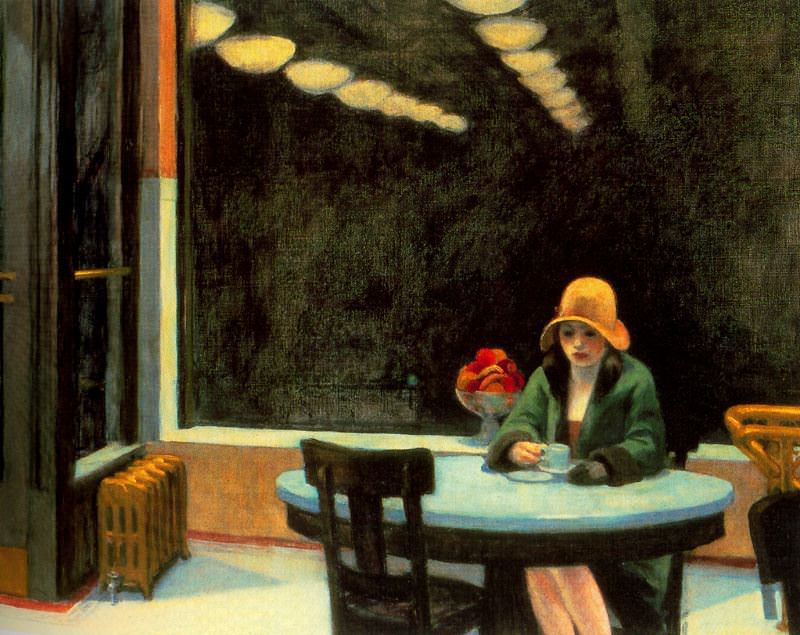
In Chapter 2, Christine encounters a Hopper piece at a bar: "Next to the jukebox hung a framed print of an Edward Hopper painting of a woman wearing a hat, drinking coffee alone: streaks and smudges marked the glass."
Edward Hopper, born in 1882, was an American artist famous for capturing modern American life. His paintings frequently depict urban and suburban scenes, such as diners, apartments, hotels, and gas stations, as well as solitary figures. His work is characterized by light and shadow, with sunlight often slicing through empty spaces. His most renowned piece is Nighthawks (1942), a late-night diner scene that has become a symbol of urban loneliness. Hopper significantly influenced the visual portrayal of 20th-century American life, emphasizing the theme of loneliness in modern cities, and his style has influenced film noir and directors like Hitchcock and Wim Wenders.
Helen Frankenthaler
In Chapter 3, Christine encounters a Frankenthaler painting called Sphinx in a museum: "The Frankenthaler painting was smaller than I had recalled it being. Less exciting. A stripe of pinkish paint streaked its way horizontally across the canvas, limited with a brown brushstroke that followed its underbelly. The top of the canvas and the right corner looked as though they had been dipped in dark green paint, which fanned and spread down the right side of the painting. But aside from these two motifs, nearly the entirety of the canvas was untreated empty space."
Helen Frankenthaler, born in 1928, was an influential American abstract painter and among the most important artists of the postwar era. She is celebrated for transforming abstract painting with her innovative soak-stain technique, which involves thinning oil or acrylic paints and pouring them onto unprimed canvas, allowing the color to soak into the fabric. Her notable work using this technique Mountains and Sea is often regarded as a pivotal moment in modern art. She broke major ground as a woman in the male-dominated art world of the 1950s–1960s and helped define Color Field painting, directly influencing artists such as Morris Louis and Kenneth Noland.
Alex Katz
In Chapter 4, Christine encounters a Katz at a gallery: "A man, seen from the back, sitting on a beach. Four figures behind him, all in a state of repose. The rendering of it sleek, streamlined, insouciant."
Alex Katz, born in 1927, is an American artist renowned for his portraits of friends, poets, artists, and his wife, Ada. His works often depict figures close-up, set against flat backgrounds and simplified landscapes, notably scenes from Maine. Katz's style features clean edges, smooth surfaces with minimal brushwork, and restrained facial expressions. Influenced by advertising, billboards, and film stills, he played a significant role in shaping contemporary figurative painting. Katz was painting large, flat-faced figures before this became a trend in Pop Art, serving as a vital bridge between Abstract Expressionism and subsequent art movements.
Agnes Martin
The final artist mentioned is in Chapter 5, as Christine recalls a flashback from a trip upstate where she attended a museum with her ex-boyfriend. "In the center galleries, taking up two rooms, was a series of Agnes Martin paintings, most of them the pastel-striped compositions I had encountered before, which invariably reminded me of children's clothes, or color-coded spreadsheets. But there was one painting that nearly didn't seem like a painting at all. It had a white ground, covered in a fine graphite grid. The lines were thin but unwavering, the grid completely regular, without accent or error… I saw from the checklist that it was titled The Beach, from 1964, and then we wondered together why it was called that — if it came from a memory of sand or water."
Agnes Martin was an American abstract painter born in 1912, known for her tranquil, meditative artworks featuring grids, stripes, and subtle colors. While often described as minimal, her style carries a deep emotional and spiritual core rather than just logic or mechanization. She is noted for her hand-drawn grids, gentle horizontal lines, and soft, subdued hues, creating pieces that evoke stillness, serenity, and reflection. Although linked to minimalism, she rejected that label, drawing inspiration from Zen Buddhism, Taoism, and transcendental philosophies. Martin believed art should express universal feelings such as joy, innocence, and beauty rather than personal stories. She proved that minimal art can be tender and emotionally rich, and that quiet, restrained works can possess profound power.
Vija Celmins, Edward Hopper, Helen Frankenthaler, Alex Katz, and Agnes Martin each take distinct approaches to perceiving and experiencing the world in their work. They demonstrate how perception, emotion, and meaning can arise from both everyday life and abstract forms. Larissa Pham emphasizes these features in her lush descriptions of the work Christine encounters in Discipline.
Edward Hopper's Automat (1927)
From Des Moines Art Center, via Wikimedia Commons
Filed under Music and the Arts
 This article relates to Discipline.
It first ran in the February 11, 2026
issue of BookBrowse Recommends.
This article relates to Discipline.
It first ran in the February 11, 2026
issue of BookBrowse Recommends.
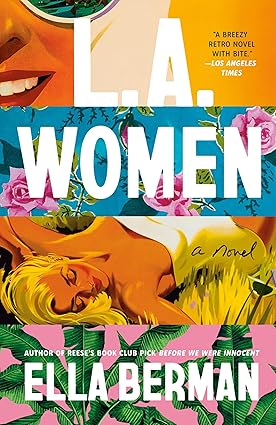
L.A. Women by Ella Berman
Two ambitious writers in 1960s LA face betrayal when one writes a novel based on the other's life.






Your guide toexceptional books
BookBrowse seeks out and recommends the best in contemporary fiction and nonfiction—books that not only engage and entertain but also deepen our understanding of ourselves and the world around us.


