
-
Your next favorite book
is waiting.
Summary | Excerpt | Reviews | Beyond the Book | Read-Alikes | Genres & Themes | Author Bio

 Book Reviewed by:
This article relates to Talking It Over

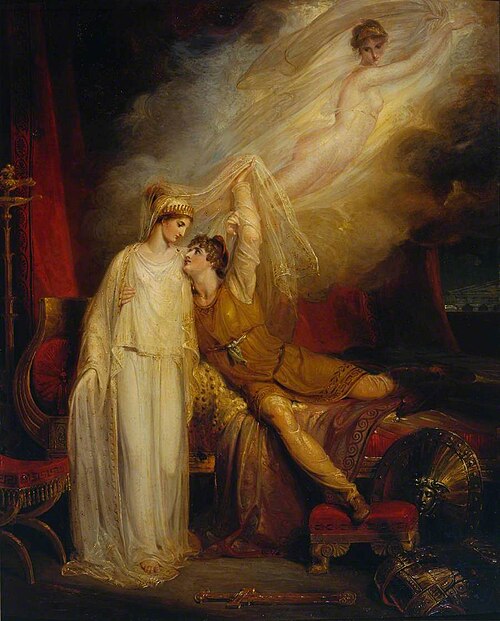 Love triangles—stories in which one person must decide between two possible partners or embarks on a forbidden romance while bound to someone else—have been central to literature for millenia: In Greek mythology, Helen was married to King Menelaus of Sparta but, by some accounts, fell in love with Paris and joined him in Troy (in other versions, she was abducted); her remarriage is said to have caused the Trojan War. The Book of Genesis sets up a rivalry between Jacob's two wives, sisters Leah and Rachel, that continues into the next generation. Ancient Celtic legend tells of Guinevere's betrayal of King Arthur with one of his trusted knights, Lancelot, leading to the downfall of Camelot.
These classical cases exemplify two essential characteristics of the love triangle: the emotional thrill of the suited lovers finding each other at last; and the collateral damage involved. The stakes of an affair can be high, affecting not just the three individuals concerned but their families, their offspring, and maybe even entire kingdoms.
Outside of the realm of myth, more realistic stories, too, can place great weight on the choice of a romantic partner. Sometimes the significant cost of adultery will be emphasized as part of a moralizing message. At other times, the resolution of a love triangle may be romanticized as a meant-to-be inevitability, such as in Jane Austen's Pride and Prejudice, where Lizzie Bennet reverses her preconceived opinions and ends up with Mr. Darcy.
Julian Barnes's Talking It Over (and its sequel, Love, etc.) revolve around a love triangle—one that adheres to the classic tropes in some ways but departs from them in others. For example, Barnes presents the swap of partners as something fated and life-changing for all three partners. Gillian's initial impression of Oliver is negative, as Lizzie's was of Mr. Darcy, and only gradually shifts from tolerance into love. Unlike many will-they-won't-they romances, though, this story is not angst-filled, but rather matter of fact. Because the characters are justifying their actions retrospectively, they speak as if, at every stage, it was a fait accompli and not an agonizing choice.
Barnes also subverts the notion that one romantic partner is the "correct" one while the other one would be all wrong. Gillian instead argues that both Stuart and Oliver were right for her. "The other two, they each want one thing, for me to be with them. I want two things. Or rather, I want different things at different times." Instead of ending with Gillian and Oliver's wedding as the culmination of the correct romance, then, the novel goes on to depict this second marriage as equally unstable. Readers are also invited to question whether marriage will cure Oliver of promiscuity. The fact that Gillian's father left her mother for his teenage pupil seems like potential foreshadowing. And in the final pages, Gillian trumps up accusations against Oliver to create an explosive scene staged for Stuart's benefit.
Contemporary publishers' increased openness to the depiction of varying relationship types and sexualities expands the possibilities for what a love triangle in a story can look like, as in Torrey Peters's Detransition, Baby or Taylor Jenkins Reid's The Seven Husbands of Evelyn Hugo. There is such a hint in Talking It Over. Stuart and Oliver's school acquaintance, Val, suggests a homoerotic explanation for Oliver's jealousy of Gillian: "Listen, if Stuart, who's all cut out to be a husband, lasts as short a time as he did… what chance for Oliver, who's got no money, no prospects and is basically queer? How long will the marriage last once he starts calling her Stuart in bed?" (In a contemporary novel, this theory may not be as sensationalized as it was in 1991, however.) And in the only joint speech designation of the novel, "Oliver & Stuart" together say, "Get that bitch out of here."
Barnes has repeated the love triangle setup multiple times across his career—from his second novel, Before She Met Me (1982), all the way through to Departure(s) (2026). For Barnes and for many others, the love triangle is a useful basis for character portraits and explorations of memory, time, and choice versus fate.
The Reconciliation of Helen and Paris After His Defeat by Menelaus (1805) by Richard Westall, from Wikimedia Commons.
Filed under Books and Authors
 This article relates to Talking It Over.
It first ran in the January 28, 2026
issue of BookBrowse Recommends.
This article relates to Talking It Over.
It first ran in the January 28, 2026
issue of BookBrowse Recommends.
Theo of Golden by Allen Levi
One spring morning, a stranger arrives in the small southern city of Golden. No one knows where he has come from…or why…






Your guide toexceptional books
BookBrowse seeks out and recommends the best in contemporary fiction and nonfiction—books that not only engage and entertain but also deepen our understanding of ourselves and the world around us.


_-_The_Reconciliation_of_Helen_and_Paris_after_his_Defeat_by_Menelaus_-_T00088_-_Tate.jpg)