
-
Your next favorite book
is waiting.
Summary | Excerpt | Reviews | Beyond the Book | Read-Alikes | Genres & Themes | Author Bio

A Life Reimagined
by Lea Ypi Book Reviewed by:
This article relates to Indignity

 Indignity author Lea Ypi's grandfather—her grandmother Leman Ypi's husband—was charged by the Hoxha regime with espionage because of his interactions with British nationals in Albania. Vandeleur Robinson, Eliot Watrous, and Brigadier Edward Hodgson are all described in the author's index first as "Asllan's friend" and second as members of the British intelligence and military services. Together, those descriptors landed Asllan Ypi a twenty-year prison sentence with hard labor, despite the British government's support of communist antifascist forces during the war.
During World War II, British Prime Minister Winston Churchill tasked his country's new Special Operations Executive with encouraging undercover activities in areas occupied by Axis forces using the now-infamous directive "Set Europe ablaze!" Various SOE units focused on supporting guerrilla resistance to Nazi occupation throughout Europe and Asia.
US General and future President Dwight D. Eisenhower credited the SOE with disrupting Nazi communications and transport networks, playing a crucial role in the eventual Allied victory. Resistance to German occupation occasionally turned to internecine warfare, however, and British support generally considered an Axis defeat before postwar politics.
In one particularly tense chapter of Indignity, a young Asllan argues with his bureaucrat father Xhafer Bey about political ideology and national identity. Asllan is mainly frustrated at the former Prime Minister's collaboration with the Italian fascist regime, angry that his father would agree to work for an occupying force. Xhafer's response is bleak: "There may be nations out there who make history. We are not among them, dear boy. To us history is done."
Britain's involvement in Albania during World War II was characterized by problems related to its lack of presence in the region. The British government relied almost completely on Margaret Hasluck, a former ethnographer who had worked there, to train SOE operatives who would be parachuted into the country and tasked with cultivating local resistance. "As a result of these difficulties, British intervention in Albania had become increasingly schizophrenic. One day they thought they supported the partisans in the mountains, the next they had hedged their bets on King Zog, who had in the meantime moved to London and ran his own resistance movement from a suite at the Ritz Hotel," writes Ypi.
After the fall of Mussolini in Italy in 1943, Nazi forces moved in to take control. A variety of resistance groups arose, allied, and disbanded, and an older and more jaded Asllan remarks on how each movement was "supported by a different coalition of states, each claiming to represent the people's will."
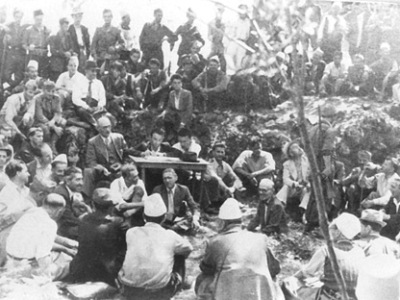
"First, the communists made a deal with the liberal nationalists, then they fought each other," he says. That first deal was at the Mukje Conference, where the nationalists, progressives, and communists agreed to jointly organize Albanian resistance to the Axis powers; soon after, however, Albanian communist groups split from the Mukje pact at the Labinot Conference. "At one stage, both groups swore loyalty to the antifascist cause, at another they traded accusations of betrayal." Various groups collaborated with or attacked the occupying regime in turns.
Asllan describes his British friend, Robinson, as "utterly confused" by these proceedings.
After Nazi forces withdrew from Albania in 1944, the communist forces of Enver Hoxha—who Leman Ypi finds so off-putting in Indignity—prevailed in the battle for control. Forty years of brutal dictatorship ensued, including Asllan Ypi's imprisonment for his relationship with the British.
"The Allies will win the war," Leman tells a German family friend in the book, towards the end of the occupation. His reply: "The Allies, yes. Not you."
Mukje agreement, 1943, via Wikimedia Commons
Filed under People, Eras & Events
 This article relates to Indignity.
It first ran in the January 14, 2026
issue of BookBrowse Recommends.
This article relates to Indignity.
It first ran in the January 14, 2026
issue of BookBrowse Recommends.
L.A. Women by Ella Berman
Two ambitious writers in 1960s LA face betrayal when one writes a novel based on the other's life.






Your guide toexceptional books
BookBrowse seeks out and recommends the best in contemporary fiction and nonfiction—books that not only engage and entertain but also deepen our understanding of ourselves and the world around us.


