
-
Your next favorite book
is waiting.
Summary | Excerpt | Reviews | Beyond the Book | Read-Alikes | Genres & Themes | Author Bio

A Novel
by Nadia Davids Book Reviewed by:
This article relates to Cape Fever

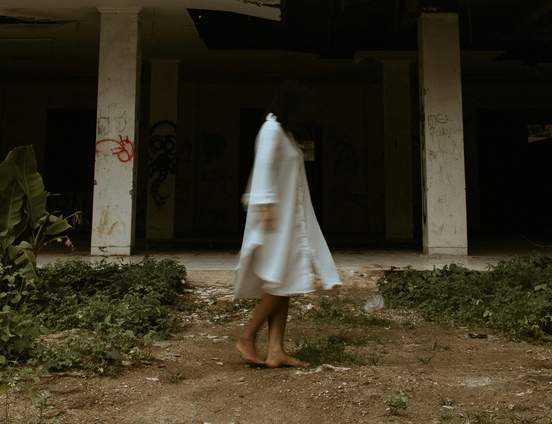 Fans of the gothic, horror, or supernatural genres will certainly be familiar with the image of an ethereal woman clad in white or gray. Captured in fleeting glances and shrouded in mystery, the so-called Gray Lady has become a mainstay of ghostly fiction, and examples of the figure can be found in folklore and real-life testimonies across different countries, languages, and cultures. There are reported repeated sightings of Gray Ladies in the Willard Public Library in Indiana; at Oxford University; in the Dark Hedges of Northern Ireland; at Fort St. Angelo in Malta; at Dudley Castle in the United Kingdom; and at Cumberland College in New Zealand.
The backstory of a Gray Lady ghost can vary, but it is almost always based in tragedy. Usually, she is thought to be the spirit of a young woman who has been doomed by love—whether having been murdered by a violent partner, died in childbirth, or died by suicide following great betrayal or the loss of her children.
What differentiates a Gray Lady from other ghosts is her benevolence. This is not a poltergeist rattling chains and trying to harm or scare people away. In some instances, she will offer comfort to a shaken protagonist, her passiveness a contrast to the presence of a more threatening entity. In others, she will attempt to help the protagonist by guiding them towards the truth of a central mystery. In many stories and supposed sightings, Gray Ladies appear by someone's bedside, silently watching over them in the night—a nod, perhaps, to her maternal connotations. Though she never harms anyone, her presence is often met with fear, which may represent our complex relationship with the concept of ghosts: On the one hand, many revel in the idea of life after death, and yet few can imagine a fate worse than an eternity destined to wander the Earth alone.
Key to the endurance and significance of the Gray Lady archetype is her characteristic silence. In both fictional stories and reported sightings, a Gray Lady almost never speaks. She is always beautiful and melancholic; often watchful and motherly; but above all else, she remains silent. In this way, the Gray Lady ghost is a reflection of the Victorian trope of the "Angel in the House," a "perfect woman" who embodied the feminine ideal: modest, pious, devoted to her family and her home, and sacrificial. The Gray Lady is both an encapsulation of these societal expectations for women and a warning about the tragedy those stifling expectations could lead to.
In Nadia Davids' novel, Cape Fever, protagonist Soraya regularly encounters her own so-called Gray Women that adhere to many of the above archetypes. Their inclusion in a story about women trying to take back control of their own lives adds further thematic and emotional depth to the novel.
Image from Asep Saeful Bahri.
Filed under Cultural Curiosities
 This article relates to Cape Fever.
It first ran in the January 14, 2026
issue of BookBrowse Recommends.
This article relates to Cape Fever.
It first ran in the January 14, 2026
issue of BookBrowse Recommends.

L.A. Women by Ella Berman
Two ambitious writers in 1960s LA face betrayal when one writes a novel based on the other's life.





Your guide toexceptional books
BookBrowse seeks out and recommends the best in contemporary fiction and nonfiction—books that not only engage and entertain but also deepen our understanding of ourselves and the world around us.

