
-
Your next favorite book
is waiting.
Summary | Excerpt | Reviews | Beyond the Book | Read-Alikes | Genres & Themes | Author Bio

A Novel
by Bryan Washington Book Reviewed by:
This article relates to Palaver

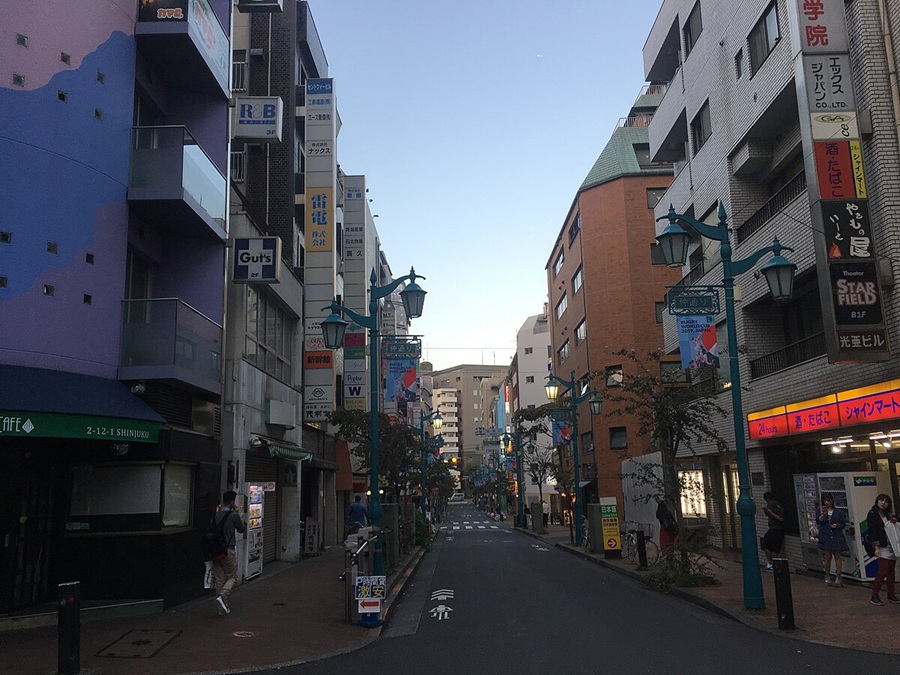 Shinjuku Ni-chōme, commonly referred to as Ni-chōme, is a lively, small neighborhood in the heart of Tokyo, and is said to have the highest concentration of gay bars in the world. It features prominently in Bryan Washington's novel Palaver as a key setting for one of its main characters. Known as Japan's LGBTQ+ cultural hub, the neighborhood has over 300 gay bars and nightclubs packed into five blocks, along with restaurants, love hotels, saunas, and cruising spots called hattenba. The area is easily accessible, situated within walking distance of Shinjuku Station, the world's busiest train station. This concentration of LGBTQ+ friendly venues helps create a safe and inclusive environment for a community that is still stigmatized to some extent by mainstream Japan.
Ni-chōme has been recognized as a gay neighborhood since the American Occupation of Japan (1945-1952). By 1948, a gay tea shop was operating in Shinjuku, and during the 1950s, openly gay bars began to appear. The area's transformation is tied to the decline of Tokyo's red-light districts following the 1956 Prostitution Prevention Law. As the sex industry moved away, a gay subculture developed. Today, Ni-chōme remains a leading spot for LGBTQ+ rights and visibility in Japan.
Washington explains in a 2018 essay for The Awl, "...but the sheer quantity of queer spaces shouldn't be confused with queer visibility: while some of Tokyo's more dubious enterprises are loud on the street…gay life in Japan is almost entirely under the radar. If you're not seeking queer spaces out, you won't even remotely run the risk of finding them." Despite key milestones, including a counseling room for young gay men established in 1976, the first AIDS vigil in 1986, the first iteration of Tokyo's International Lesbian and Gay Film Festival in 1992, and Japan's first gay pride parade in 1994, the Japanese LGBTQ+ community still faces many obstacles. In 2025, the Japanese Supreme Court ruled the country's ban on same-sex marriage constitutional, in response to several lawsuits brought by same-sex couples. Japan is the only country in the G7 (a group of seven economically significant nations including the US, Canada, Germany, Italy, and the UK) that neither fully acknowledges same-sex couples nor provides them with explicit legal protections. However, it's not unique in Asia, where only Taiwan, Thailand, and Nepal permit same-sex marriage.
In addition to limited legal protections, Japan's LGBTQ+ community and Ni-chōme face obstacles like social stigma, gentrification, an aging population, and online dating taking social interactions outside of real-life spaces. Nevertheless, Ni-chōme continues to thrive, adapting to social changes while remaining a crucial hub for community, advocacy, and the celebration of LGBTQ+ identity, as Bryan Washington highlights in Palaver.
Shinjuku Ni-chōme in 2019, courtesy of LittleT889 via Wikimedia Commons CC BY-SA 4.0
Filed under Places, Cultures & Identities
 This article relates to Palaver.
It first ran in the January 14, 2026
issue of BookBrowse Recommends.
This article relates to Palaver.
It first ran in the January 14, 2026
issue of BookBrowse Recommends.

L.A. Women by Ella Berman
Two ambitious writers in 1960s LA face betrayal when one writes a novel based on the other's life.







Your guide toexceptional books
BookBrowse seeks out and recommends the best in contemporary fiction and nonfiction—books that not only engage and entertain but also deepen our understanding of ourselves and the world around us.


