
-
Your next favorite book
is waiting.
Summary | Excerpt | Reviews | Beyond the Book | Read-Alikes | Genres & Themes | Author Bio

Margaret C. Anderson, Book Bans, and the Fight to Modernize Literature
by Adam Morgan Book Reviewed by:
This article relates to A Danger to the Minds of Young Girls

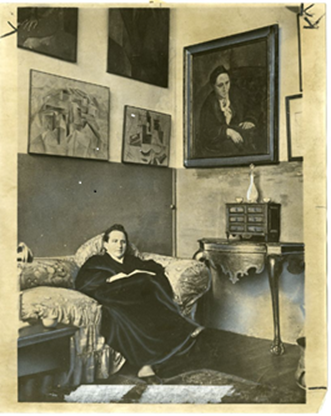 In Gertrude Stein's salon, where every Saturday the leading artists of the time gathered, along with writers, film directors, painters, sculptors, and even bullfighters, a portrait of Stein painted by none other than Picasso (and surrounded by Matisses and Cézannes) presided over the room, just as Stein dominated the space. This was the same circle in which Margaret Anderson moved during her Paris years, and she was a fixture of this very salon. Like Stein, Anderson was an editor and conversation-maker, a catalyst and promoter of ideas. But her interest in fostering creative exchange had begun long before Paris in the salons of Chicago, where The Little Review, the magazine she founded, first took shape.
It was in one of these salons, that of Chicago Evening Post editor Floyd Dell and his wife, Margery Currey, that the idea for The Little Review was born. The couple routinely "hosted a group of proto-modernist poets, writers, actors, painters, professors, critics, and sculptors in Currey's one-room studio," where "writers and queer artists like Margaret could be themselves and support one another's ideas," as Adam Morgan writes in A Danger to the Minds of Young Girls.
This salon was just one of many such spaces in Chicago, often hosted by women: like Anna Morgan, a pioneering drama teacher; Jane Addams, who cofounded a settlement house for poor immigrants and later won the Nobel Peace Prize; Clara Laughlin, writer and radio broadcaster; and Harriet Monroe, founder of Poetry magazine.
Further east, New York's cultural figures met at Mabel Dodge's home, at least until Anderson arrived and transformed the largest room in her apartment "to serve as Greenwich Village's new literary salon." All of Anderson's residences were places of encounter and creation, even when she lived in a tent by Lake Michigan, attracting intellectuals and conversation wherever she went: "her camp became an outdoor literary salon," writes Morgan. In Washington, DC, meanwhile, Georgia Douglas Johnson, poet and playwright, created one of the most important communities of the Harlem Renaissance through her S Street Salon weekly gatherings.
These were only a handful of the salons that animated the early 20th century, and only a fraction of those that history has witnessed. Literary salons are not exclusively a phenomenon of the 1920s; they are part of a centuries-long tradition of spaces where culture was shaped, not in institutional halls, but in private rooms. And crucially, they have often been led by women.
Salons gained prominence in 17th- and 18th-century France, particularly during the Enlightenment. "In contrast to other institutions of the Enlightenment public sphere, it revolved around a woman," writes one scholar. Their private nature guaranteed two things: freedom to speak and exchange ideas, and accessibility for women, who were otherwise usually excluded from the public sphere.
For generations in the Western world, women were barred from publishing, universities, and participating in political discourse, and generally discouraged from entering public intellectual life. Salons offered an alternative route. By hosting, women not only gained access to conversations they weren't allowed to join elsewhere, but placed themselves at the center (like Stein and her portrait), the arbiters of discourse (like Anderson through her magazine), the ones bringing everyone together (like Douglas in her S Street salon).
"It was the hostess who became aware of which guests advanced the conversation, who were good listeners as well as thought-provoking speakers, and often decided who was to be invited back. As the facilitator she would sometimes become the enforcer of civil discourse," explains a post on the blog The Salon Host. In the peak era for salons in France, figures like Louise Dupin and Madame de Staël pushed forward political debate, philosophy, and new ideas. "In an era of absolutism," writes Alan Riding in the New York Times, "they created an arena away from the royal court where ideas could be discussed and behavior examined." Their influence grew so substantial that when Napoleon rose to power, he tried to stop it. He exiled Madame de Staël, then France's most influential salonnière, and promoted his own, state-sanctioned salons in an attempt to control the conversation, silence political dissent, and relegate women back to domestic duties.
Salons did not reemerge as spaces of intellectual freedom until the early 20th century, animated, again, by women—and many of them queer.
Margaret Anderson belonged to this lineage. Like the salonnières who preceded her, she steered the intellectual currents that would define new models of thinking, like modernism. Like those before her, she did not only merely write and publish—she built the rooms where ideas happened.
Gertrude Stein in her home in 1930, courtesy of Library of Congress
Filed under Society and Politics
 This article relates to A Danger to the Minds of Young Girls.
It first ran in the January 14, 2026
issue of BookBrowse Recommends.
This article relates to A Danger to the Minds of Young Girls.
It first ran in the January 14, 2026
issue of BookBrowse Recommends.

L.A. Women by Ella Berman
Two ambitious writers in 1960s LA face betrayal when one writes a novel based on the other's life.






Your guide toexceptional books
BookBrowse seeks out and recommends the best in contemporary fiction and nonfiction—books that not only engage and entertain but also deepen our understanding of ourselves and the world around us.

