
-
Your next favorite book
is waiting.
Summary | Excerpt | Reviews | Beyond the Book | Read-Alikes | Genres & Themes | Author Bio

A Novel
by Ling Ma Book Reviewed by:
This article relates to Severance

 Many contemporary novels feature alternating dual or multiple timelines, and many make free use of flashbacks, weaving backstory into the main narrative as it progresses. Ling Ma's Severance employs both of these techniques, creating layered narratives that interact with one another and eventually intersect. This approach serves several purposes within the story, but it is also born of the story itself, which is, among other things, an exploration of the nature of memory and nonlinear time.
The novel begins with a prologue, where the reader is introduced to a small group of survivors of an apocalyptic event in a defunct United States. The first chapter takes a step back to what first-person narrator Candace Chen calls the beginning of "The End," meaning presumably the beginning of societal meltdown, but the focus is first on the beginning of the end of her relationship with her boyfriend Jonathan, on the day he tells her that he is leaving New York on a friend's boat, with or without her, a decision that is at odds with Candace's craving for routine and stability. It is also around this time that Candace learns of the existence of Shen Fever, the virus that will eventually wipe out most of humanity. These two factors (Candace's now-crumbling relationship with Jonathan and Shen Fever) act as the main driving forces behind the story, which is already operating on a dual timeline structure (following the narrative of Candace and the survivor group after the devastation of the virus, and the narrative of Candace going about her life after Jonathan has broken the news that he is leaving).
Starting in Chapter 3, Candace begins narrating a new timeline that draws the reader back to her arrival in New York. She has an affair with an older man named Steven, and receives a box of items belonging to her mother following her death in hospice. In the box is a bag of dried shark fins, which inspires Candace and her roommate to throw a dinner party, during which Candace happens to meet her downstairs neighbor—Jonathan—via the fire escape. From this point on, all three established timelines continue intermittently, more or less chronologically but not entirely, with the third timeline sometimes splitting along work/life lines—Steven leverages connections to help Candace get a job in the Bibles division of a publishing company, for which she sometimes travels to Shenzhen, and her blooming relationship with Jonathan is portrayed in a different narrative pocket. Interspersed are flashbacks concerning Candace's Chinese immigrant parents, her childhood in Salt Lake City, and time spent with family in Fuzhou. Eventually, the third timeline catches up to the second, and the second to the first; the book ends in the "present-day" narrative that started with the prologue.
This structure gives the story a porous feel, suggesting that Candace's past and the past of the world are continually seeping into her apocalyptic present. Backstories can serve to explain "how we got here" or a character's motivations. Ma's novel does these things, but it also does more. It tells a backstory that feels complete unto itself and lowers the stakes of the larger narrative. We already know most (though not all) of the bad things that will happen to Candace, because we learn them, or can at least deduce them, very early on. She and Jonathan will part ways. Shen Fever will infect everyone she knows, as far as she knows. But we are assured that she will outlive her friends, neighbors, and colleagues.
Severance is a novel about, among other things, the way time can seem to loop into itself and back onto itself, and this is shown literally. The "fevered" who have been infected by the virus repeat familiar movements without any apparent consciousness of what they are doing. The leader of the group of survivors, Bob, insists on killing the fevered, considering this a mercy because, according to him, they are no longer really alive. Candace raises the question of whether the virus may be triggered, or whether one may be made more susceptible to it, by nostalgia—one survivor falls prey to illness while in her childhood bedroom.
With this interpretation in the mix, it's easy to consider that maybe there's something special about Candace and the other still-surviving survivors, that they aren't lost in or dependent upon the past—and with Candace, at least, it might make sense. She is a practical and somewhat disaffected person; she may have built-in defenses against nostalgia owing to the difficulties of being a child of immigrants and the fact that her parents are dead. We can choose to see this in a romantic and admirable light: Candace doesn't need what other people need because she hasn't had what other people have, and therefore is invulnerable. There is something seductive here that also feels distastefully close to Bob's philosophy—a twin mechanism of individualism and fate (he believes survivors are "chosen") that gives off the vibe of Protestantism and American superhero mythology.
But Candace seems caught in a time loop, or loops, of her own. One could entertain the possibility that her story is coming from her fevered mind once she's finally succumbed to the virus. Even if we don't take the metaphor of the time loop literally, the narrative seems to be suggesting that survival may not be the point, and that perhaps survival isn't what we think it is—or what Bob thinks it is. Candace's memories ultimately seem to be what sustain her. Thoughts of Jonathan and her family offer her not only hope and purpose but a sense of direction and even, in one dreamlike scene, concrete advice. Over Severance's multiple timelines, Ma shows us scenarios of collapse and radical change—mass debilitation and death, parting from revelatory love, leaving one's homeland—that people survive, while questioning both how this is possible and what the costs are. She shows how people cling to routine under pressure, doing what they know even when what they know doesn't make sense, such as when Candace continues to work at her job long after all her coworkers have left the office, for money she'll never be able to spend.
We can look at Candace's working life—the way she defers to and is dominated by others in response to what she feels is a legitimate need for security, and we can look at how she carries that mindset into an actual survival scenario. And because of the way Ma's novel is structured, we can compare the two situations side by side and see to what extent she behaves similarly, but also differently. How she may have changed, what she may have learned, and how the past may reach up to her through layers of time to influence her actions. Being caught in a loop can represent wishful thinking, denial. But a loop can also be useful, because it creates repetition, a chance to see the same scenario coming around again, to make a different choice this time, to get things right.
A clock hanging from the side of a building, courtesy of Dylan Patterson via Unsplash
Filed under Books and Authors
 This article relates to Severance.
It first ran in the November 5, 2025
issue of BookBrowse Recommends.
This article relates to Severance.
It first ran in the November 5, 2025
issue of BookBrowse Recommends.
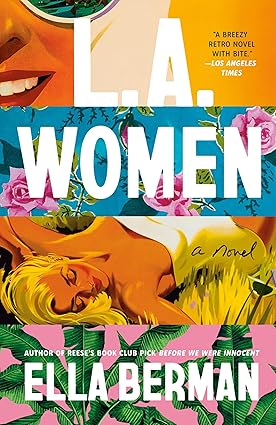
L.A. Women by Ella Berman
Two ambitious writers in 1960s LA face betrayal when one writes a novel based on the other's life.


Your guide toexceptional books
BookBrowse seeks out and recommends the best in contemporary fiction and nonfiction—books that not only engage and entertain but also deepen our understanding of ourselves and the world around us.

