
-
Your next favorite book
is waiting.
Summary | Excerpt | Reading Guide | Reviews | Beyond the Book | Read-Alikes | Genres & Themes | Author Bio

 Book Reviewed by:
This article relates to To Kill a Mockingbird

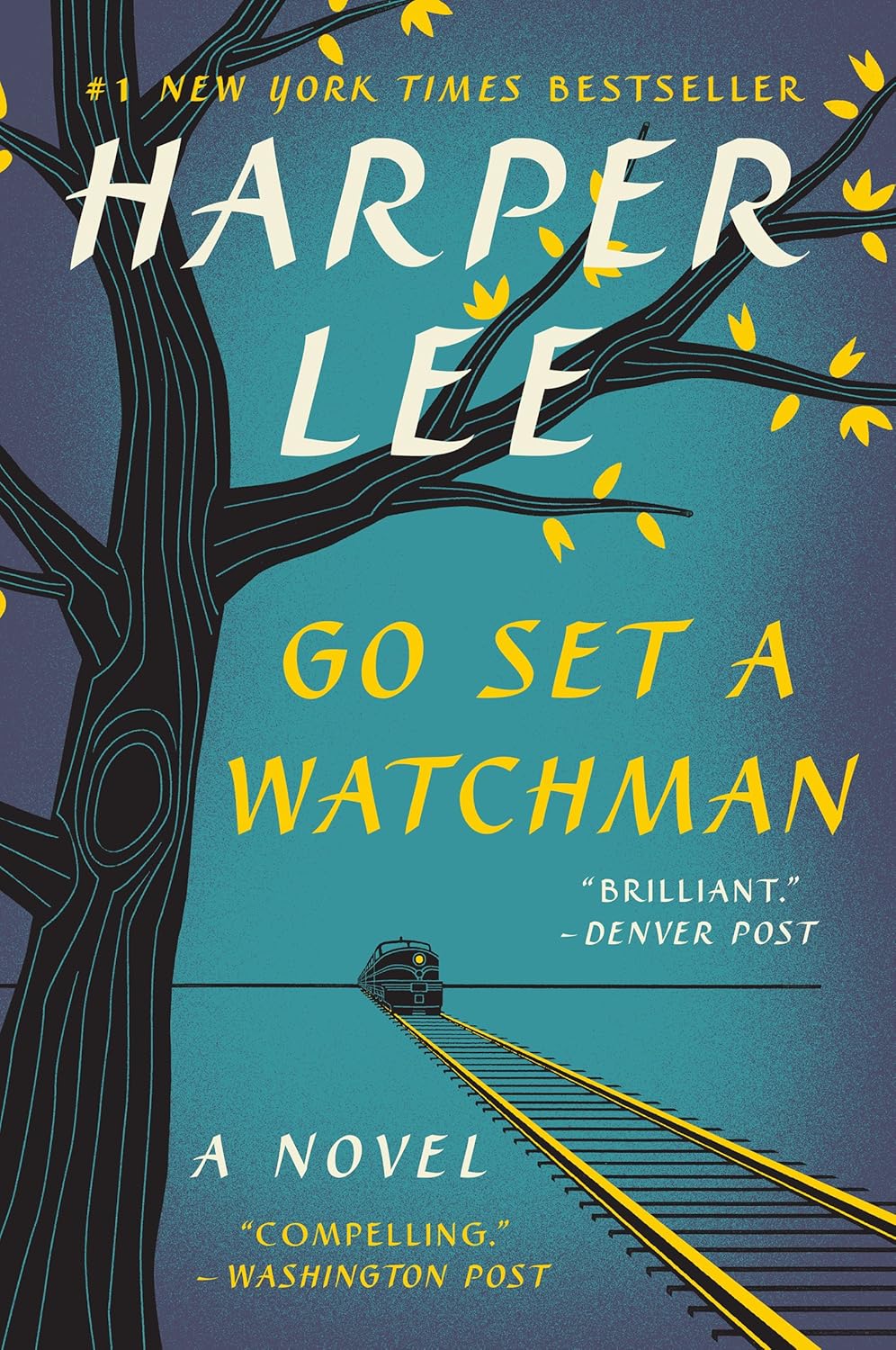 To Kill a Mockingbird (1960), set in the fictional town of Maycomb, Alabama, tells the story of Jean Louise "Scout" Finch, a six-year-old girl growing up with her brother, Jem, and their widowed father, Atticus Finch, an upstanding lawyer who takes on the defense of a young Black man falsely accused of raping a white woman. Go Set a Watchman (2015) ostensibly resumes the story twenty years later, when Jean Louise returns home from New York for a visit and discovers that her father, whom she has idolized all her life, is in fact a racist man.
When HarperCollins announced Go Set a Watchman's impending publication in 2015, controversy followed. At the age of 89, after a lifetime of saying she would never again publish a novel, and while residing in an assisted living facility after suffering a stroke, Harper Lee gave her permission for the book to be published: "In the mid-1950s, I completed a novel called Go Set a Watchman […] I am humbled and amazed that this will now be published after all these years." It was published almost exactly as it was found (by Lee's lawyer Tonja Carter, in a safe deposit box), with only superficial copy editing.
In fact, Go Set a Watchman predates To Kill a Mockingbird. Lee had first submitted it to Lippincott in 1957, where it was read by veteran editor Tay Hohoff: "the spark of the true writer flashed in every line," she later recalled. However, rather than accepting the manuscript as it was, she instead commissioned Lee to work on it and come back with a revised version.
Although they share characters, themes, descriptions, and some passages, Go Set a Watchman is a far cry from Mockingbird, which in 1961 would win the Pulitzer Prize. In Watchman, the linear narrative is interrupted by flashbacks that take us back to Jean Louise's childhood and her relationships with her brother, her friends, and her father. Hohoff suggested Lee focus on those flashbacks and write the entire novel in the voice of the child Scout. Those vivid, humorous, sharply observed passages would become the heart of To Kill a Mockingbird.
As a result of focusing the novel on young Scout, and therefore setting the action twenty years back, the novel loses some of its political immediacy, which the editor wanted to tone down so that it would not get lost among other civil rights writings of the time. It also improves on the inconsistency of Watchman, which alternates uncertainly between a dominant third person and first-person passages, and shifts the point of view from one character to another. The result is a more focused and emotionally coherent story: the coming-of-age of a young girl discovering, for the first time, the moral fractures of the adult world.
The transformation extended to character as well as structure. Jem, dead in Watchman, became a vital presence in Mockingbird, providing Scout with a companion. Henry Clinton, a reserved and patient childhood friend, counterpoint and suitor to Jean Louise in Watchman, was eliminated in Mockingbird, his role absorbed, in part, by the exuberant Dill. Also lost were the details of adolescent awakening that Watchman had contained: the first dance, the first crush, the first shocks of womanhood. In their place appears Boo Radley, the reclusive neighbour who became both mystery and moral parable. As the scholar Julia Winspear has noted, Hohoff likely encouraged Lee to give "the children their own intrigue to supplement the crux of the plot."
Most strikingly, Mockingbird introduced the trial of Tom Robinson, only mentioned in passing in Watchman. In Lee's first version, Atticus wins his case; in Mockingbird he loses, and in doing so becomes one of the great characters and moral figures of American literature, an embodiment of dignity. In Watchman, by contrast, he is exposed as a former member of the Ku Klux Klan and a current leader of a segregationist council, defending the "Southern way of life."
This reversal makes clear that Go Set a Watchman and To Kill a Mockingbird are not successive chapters in a single story, but two distinct literary works. The former is the raw material of the latter: a draft filled with contradictions and flashes of brilliance. Its Atticus is no saint, but a man of his time. For some readers, this version offers a harsher, more realistic portrayal of the racial dynamics of the era, and a story about the disappointment of a daughter who realizes that the father she has looked up to all her life is not who she believed him to be: "The one human being she had ever fully and wholeheartedly trusted had failed her; the only man she had ever known to whom she could point and say with expert knowledge, 'He is a gentleman, in his heart he is a gentleman,' had betrayed her, publicly, grossly, and shamelessly."
Go Set a Watchman can be, in this light, a valuable read, a companion piece that enriches and contextualizes To Kill a Mockingbird, while also offering a rare glimpse into the creative process that turns a tentative first draft into a lasting work of art. Between the two lies not twenty years of fictional time, but the transformation of raw material into a fully realized vision—a classic.
Filed under Books and Authors
 This article relates to To Kill a Mockingbird.
It first ran in the November 5, 2025
issue of BookBrowse Recommends.
This article relates to To Kill a Mockingbird.
It first ran in the November 5, 2025
issue of BookBrowse Recommends.
L.A. Women by Ella Berman
Two ambitious writers in 1960s LA face betrayal when one writes a novel based on the other's life.






Your guide toexceptional books
BookBrowse seeks out and recommends the best in contemporary fiction and nonfiction—books that not only engage and entertain but also deepen our understanding of ourselves and the world around us.

