
-
Your next favorite book
is waiting.
Summary | Excerpt | Reading Guide | Reviews | Beyond the Book | Read-Alikes | Genres & Themes | Author Bio

A Novel
by Madeline Bell Book Reviewed by:
This article relates to The Austen Affair

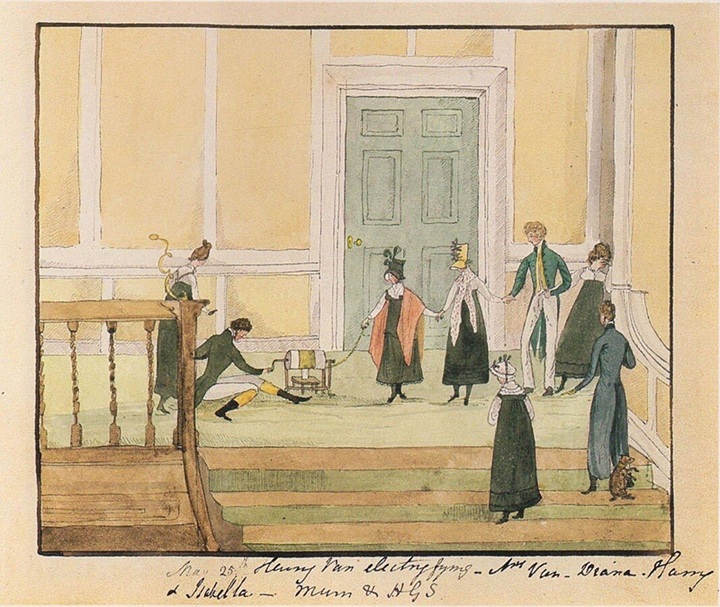 In The Austen Affair, Madeline Bell imagines what would happen if two 21st-century actors—Tess Bright and Hugh Balfour—were hurled back in time to the early 1800s. In the middle of a heated disagreement on set, an electrical accident sends them into the Regency countryside. There, amid picnics, balls, and the difficult act of sorting out their feelings for one another, they must also figure out how to return home.
The closest thing they find to a solution is another electrical oddity: an electrifying machine. During a dinner party being held at the home of Hugh's ancestors, one of the houseguests mentions this curious invention—a real Regency pastime and pseudo-medical machine that delivered mild shocks to create amusement. Essentially, it was a static electricity generator. A group of people would form a circle, holding hands, and let the electricity pass through them in mild shocks. For Tess and Hugh, it becomes a possible means of recreating the accident that sent them back in time. For us readers, it's also a good example of the Regency era taste for inventions that blurred the line between science and spectacle.
In fact, the electrifying machine was only one of many unusual, if not eccentric, entertainments that Regency society embraced. Another fun invention was the velocipede, also known as the "dandy horse" or "pedestrian curricle." This predecessor of the bicycle was a two-wheel wooden vehicle with no pedals powered by the rider pushing their feet against the ground. It became popular among aristocrats, who would use it in parks and promenades, resulting in funny caricatures and in warnings against its use for both health (doctors said it could cause hernias) and road safety reasons.
Other curiosities of the kind could be found at the seaside. At the time, bathing was common both for health and recreation, and at coastal resorts, propriety demanded that bathers use bathing machines—wooden huts on wheels that could be rolled into the sea. Inside, one could change privately before stepping straight into the water.
Outdoor pastimes were quite popular. Beyond the above-mentioned, there were more traditional ones, such as fern collecting, which was especially popular among women, who likely relished the opportunity to be outside unaccompanied. This fascination with outdoor activities might be further explained by the late-18th and early-19th-century turn to nature as a retreat and source of wisdom.
Nothing embodies the spirit of that turn quite like the craze for "ornamental hermits." According to the Smithsonian Magazine, between about 1714 and 1830, it became fashionable for wealthy landowners to install hermits in their gardens. Some aristocrats placed adverts looking to hire a "hermit," a man who would refrain from cutting his hair or nails and wander around, shoeless and preferably carrying a book, in order to embody the introspection, intellectualism, and harmony with nature prized at the time, and to surprise and amuse houseguests, all while showing off the landowner's status. Others turned to mannequins for the role. This "became a representation of the aspiration to the simple life, the life of rural retirement characterized by philosophical and scientific curiosity," according to historian Gordon Campbell, who wrote a book on the subject called The Hermit in the Garden: From Imperial Rome to Ornamental Gnome.
Indoors, Regency society could be just as inventive. Alongside more common diversions, like reading aloud, singing, dancing, card playing, and staging amateur plays, most featured in both Jane Austen's novels and The Austen Affair, there were unexpected hobbies such as shoe-making: families would invite cobblers to demonstrate their craft and then would attempt to stitch together their own shoes.
These pastimes prove that, despite the way we often imagine the past—stiff and formal—the Regency world could be rather quirky. Madeline Bell fully captures this spirit in The Austen Affair.
"Electrifying," circa 1812 by Diana Sperling (1791-1862) courtesy of Wikimedia Commons
Filed under People, Eras & Events
 This article relates to The Austen Affair.
It first ran in the October 8, 2025
issue of BookBrowse Recommends.
This article relates to The Austen Affair.
It first ran in the October 8, 2025
issue of BookBrowse Recommends.

L.A. Women by Ella Berman
Two ambitious writers in 1960s LA face betrayal when one writes a novel based on the other's life.






Your guide toexceptional books
BookBrowse seeks out and recommends the best in contemporary fiction and nonfiction—books that not only engage and entertain but also deepen our understanding of ourselves and the world around us.


