
-
Your next favorite book
is waiting.
Summary | Excerpt | Reviews | Beyond the Book | Read-Alikes | Genres & Themes | Author Bio

A Novel
by Kiran Desai Book Reviewed by:
This article relates to The Loneliness of Sonia and Sunny

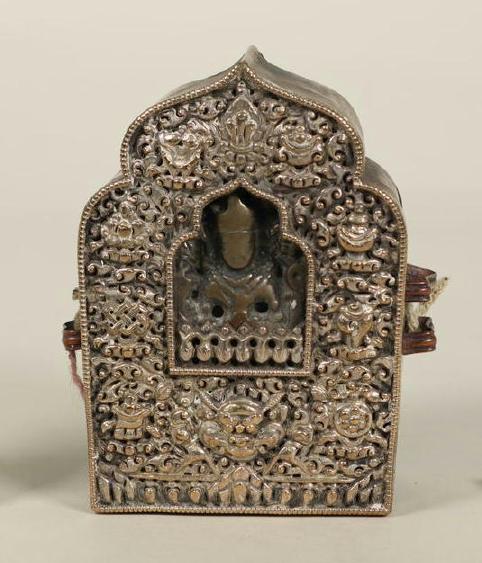 In Kiran Desai's novel The Loneliness of Sonia and Sunny, Sonia has a talisman, inherited from her grandfather, that she takes with her wherever she goes for protection and inspiration. She's told it's a gau box from Tibet, "fashioned from tarnished, battered silver that was carved intricately with curly clouds swirling to dragons. It could be worn about the neck as a heavy pendant, or attached to a belt, or carried in a mountain pack over the high Himalayan passes where travelers would need a supernatural guide through the wilderness."
Gau boxes (also called a ghao or gao) are small, portable containers that have become integral to Tibetan Buddhism. Their use dates back to the 7th century, when Buddhism was first introduced to Tibet. Originally made of leather or cloth, they were created to store medicinal herbs and important objects, but by the 16th century they'd become a sort of portable shrine made of metal such as silver, gold or brass, and were intricately carved by artisans. They were a tool for meditation, prayer, and protection, and also a symbol of faith worn as a continual reminder of a person's spiritual journey. Each gau was blessed by a lama to consecrate it and give it protective properties.
Gau boxes remain an important part of Tibetan Buddhism today, and they come in many sizes, shapes, and designs, each of which has a unique meaning or purpose. The smallest size, miniature gau boxes, are about an inch in diameter and are designed to be worn around the neck on a chain. They contain personal items of blessing or protection. The largest ones are usually part of a shrine and contain larger relics, such as small statues, and aren't generally considered easily portable. Most gau boxes have a lid—either hinged or one that fits tightly over the lower portion—which has a window set in it through which one might view the box's contents. They're commonly decorated with one or more of the eight auspicious symbols of Buddhism:
Gau boxes may contain just about anything, but some of the most common items include mantras, sacred relics (like bone fragments or ashes of revered figures), mandalas, and images of deities. In The Loneliness of Sonia and Sunny, Sonia's gau box contains one such deity—Badal Baba, the Hermit of the Clouds—painted by her grandfather. It's thought that the images impart the qualities associated with the deity to the wearer—for example, a picture of Manjushri, the Bodhisattva of Wisdom, might imbue one with wisdom. Gau boxes are highly valued and are often considered an important family heirloom, passed down through generations; they're also considered a symbol of Tibetan identity and a vital way of preserving the culture.
Image of gau box courtesy of the Canterbury Museum, CC BY-NC.
Filed under Places, Cultures & Identities
 This article relates to The Loneliness of Sonia and Sunny.
It first ran in the September 24, 2025
issue of BookBrowse Recommends.
This article relates to The Loneliness of Sonia and Sunny.
It first ran in the September 24, 2025
issue of BookBrowse Recommends.

L.A. Women by Ella Berman
Two ambitious writers in 1960s LA face betrayal when one writes a novel based on the other's life.




Your guide toexceptional books
BookBrowse seeks out and recommends the best in contemporary fiction and nonfiction—books that not only engage and entertain but also deepen our understanding of ourselves and the world around us.

