
-
Your next favorite book
is waiting.
Summary | Excerpt | Reading Guide | Reviews | Beyond the Book | Read-Alikes | Genres & Themes | Author Bio

 Book Reviewed by:
This article relates to Heart the Lover

 I should start by letting you know that I am a gamer of the decidedly antiquated sort. I grew up in a family that often played table games together, and although my siblings have all moved on to far more sophisticated digital gaming, I have remained analog and still adore an old-fashioned board or card game.
So, along with my literary interest in the Lily King novel Heart the Lover, I was intrigued by one of the central recurring elements, the card game Sir Hincomb Funnibuster, which provides the novel with its name. The main characters play Sir Hincomb Funnibuster in college, and it pops up again in later sections of the book. In this game, according to the narrator, the various suits represent different families, and "every king is the head of his family: Spade the Gardener, Club the Policeman, Heart the Lover, and Sir Hincomb Funnibuster who is the king of diamonds." It's a lively affair in which players request cards from other players Go-Fish style, but only by using specific phrasing, such as "May I please have Spade the Gardener's twins," and they then must say "Thank you" before touching new cards. If a player does not follow the specific etiquette, the turn passes to the first person to shout "Sir Hincomb Funnibuster."
As someone who happily recalls the boisterous games of my own college years, particularly a rousing drinking game called Zoom, Schwartz, Profigliano in which players have to remember a number of similarly specific call-and-response rules, I was surprised that I had never heard of Sir Hincomb Funnibuster. Had the author invented it? If not, where did it come from? I turned to Hoyle's Rules of Games, the classic card game bible, which listed nothing resembling Sir Hincomb Funnibuster, although a global word search for "Sir," in checking the book for spelling variants, provided an interesting but completely unrelated fact, which is that the game Cribbage was "invented and christened by the English poet Sir John Suckling, who lived 1609–1642." Another mystery. Who was this oddly named card-playing nobleman who died at the age of thirty-three? (I imagined a frenzied game in which a desperate opponent arises from an ornate games table to smite Sir Suckling over the head with a cribbage board. This image faded when I learned that Cribbage boards were a later invention, and early players kept score with pen and paper.)
I next checked The Book of Card Games by Nikki Katz, and there was nothing listed that sounded remotely like Sir Hincomb Funnibuster, although Katz did mention that Sir John Suckling was also a known playwright and poet. (I now imagined Sir Suckling wandering across the empty stage of a London theatre—perhaps distracted by ideas for new cribbage rules—and falling through a wooden trap door left propped open for an actor's entrance. A tragic death. But, no, this scenario was also unlikely, as London theatres were closed in 1642 due to a puritanical parliament that considered them immoral.) Turning my attention back to Sir Hincomb Funnibuster, I did find that Katz mentioned several trick-taking card games (La Belle Lucie, Black Maria, and Double Pedro) which involve verbal exchanges, but these seemed far away from the game described by King in the novel.
As a web search turns up nothing on Sir Hincomb Funnibuster, other than references to King's novel, I decided to pursue the story of Sir John Suckling, and I located an English poetry site where I learned that the poet and playwright lost his inheritance as a result of living the high life, gambling, and playing cards. (This seems particularly poignant if he lost his shirt playing Cribbage!) In 1639, Suckling fought in the Bishop's War, but after he became embroiled in an unsuccessful plot to free the Earl of Strafford, who had been jailed for high treason, Suckling fled to France. He is believed to have died by suicide in Paris after ingesting poison.
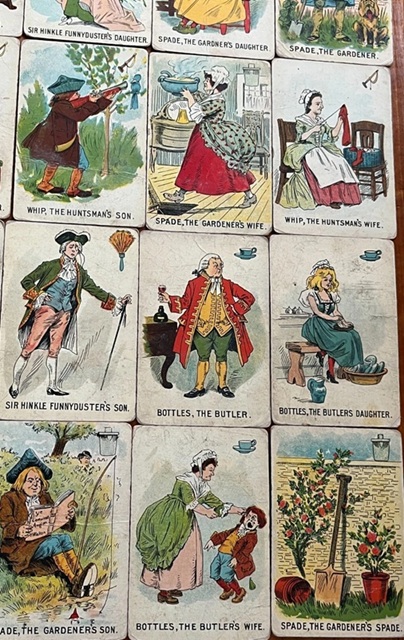
Returning to my primary subject, my search for variant spellings finally paid off when I found a reference to a 1903 Parker Brothers board game called Sir Hinkle Funny-Duster which used a set of 20 brightly printed cards to represent the Funnyduster Family, the Butler's Family, the Huntsman's Family, and the Gardener's Family. The mechanics of this now-familiar-sounding game also required that the cards be asked for by name and that the receiver always say "Thank you." This is clearly a close match to the Sir Hincomb Funnibuster card game. From here, it is easy to imagine that either Parker Brothers got the idea from an existing card game, or that someone later created a version of the Parker board game using a deck of regular playing cards. In fact, a further web search locates a 1967 diary entry by the American game designer Sid Sackson that discusses the idea of "creating a game based on SIR HINKLEFININDUSTER [sic]." Eureka! Case closed.
Parker Brothers' Sir Hinkle Funny-Duster card game, courtesy of jnkhobbies1 on eBay
Filed under Cultural Curiosities
 This "beyond the book article" relates to Heart the Lover. It originally ran in September 2025 and has been updated for the
September 2025 edition.
Go to magazine.
This "beyond the book article" relates to Heart the Lover. It originally ran in September 2025 and has been updated for the
September 2025 edition.
Go to magazine.

L.A. Women by Ella Berman
Two ambitious writers in 1960s LA face betrayal when one writes a novel based on the other's life.






Your guide toexceptional books
BookBrowse seeks out and recommends the best in contemporary fiction and nonfiction—books that not only engage and entertain but also deepen our understanding of ourselves and the world around us.

