
-
Your next favorite book
is waiting.
Summary | Excerpt | Reviews | Beyond the Book | Read-Alikes | Genres & Themes | Author Bio

Stories
by Carrie R. Moore Book Reviewed by:
This article relates to Make Your Way Home

On the slave ship The York, nearing St. Simons Island on the Georgia coast, Igbos and other West Africans were below deck and chained to one another like property. They were to be auctioned off once they reached land. The Igbos were from the region we now know as Nigeria but that in the early 1800s was a series of independent states, kingdoms, and empires. They were resistant to slavery. Their three-month voyage from West Africa to St. Simons Island had been excruciating.
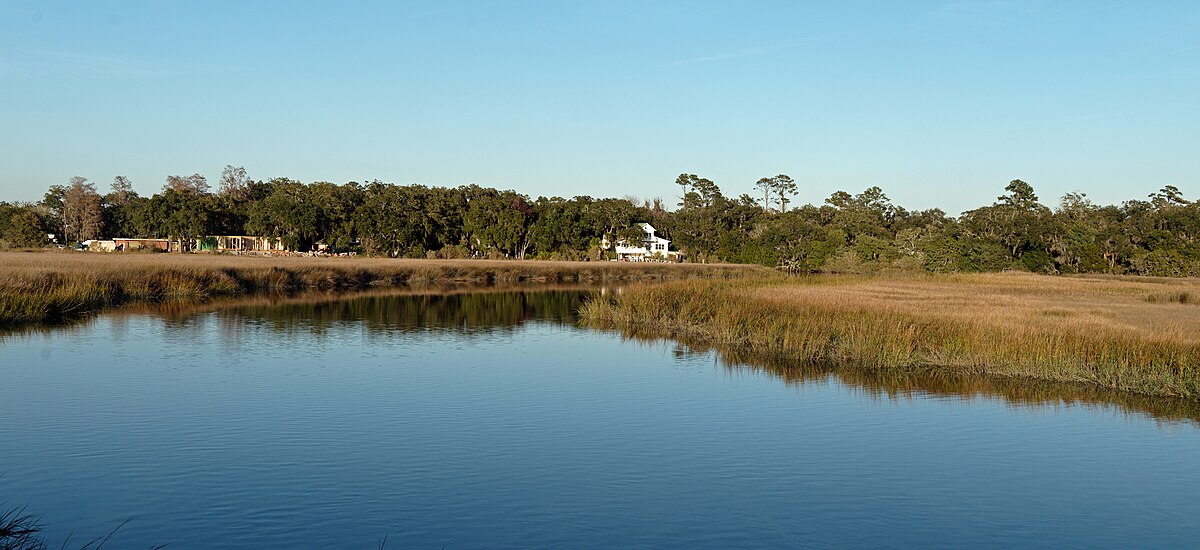
Somehow, about 75 Igbo slaves took control of the ship and drowned their enslavers. The ship was grounded in Dunbar Creek. The Igbos' captors' deaths only solved one problem. Traders were on shore waiting to take them to slave markets. That's when the Igbos started chanting, "The Water Spirit brought us, the Water Spirit will take us home." They had no intention of being bought and sold into slavery and believed their god Chukwu would protect them in death. An overseer of a nearby plantation was the witness of what happened next.
Roswell King of the Pierce Butler Plantation, which was near the creek, said that the Igbos descended from the ship, then marched into the marshy water of Dunbar Creek and died by suicide. King and another man identified as Captain Patterson recovered thirteen bodies. Others remained missing and perhaps survived. Historians have verified that this first "freedom march"—as the incident was later called—really occurred. Early accounts of the rebellion were mythologized into Gullah folklore. The Igbos were said to have sprouted wings and flown back to Africa.
Centuries later, Georgia native Carrie R. Moore has set one of the stories in her debut collection Make Your Way Home on St. Simons Island. The main female character in the story "Surfacing" has a ritual. Before Grace enters the ocean, she imitates her mother, who prayed "something in Gullah Geechee before she went waist-deep." Grace remembers the story of the Igbos rejoining their ancestors. "Walking east into the water and singing, the memory of home, lapping at their minds, until the waters closed over them. Depending on who told the story, they got to one side or another."
What the Igbo people did that May in 1803 was to calculate the horror of chattel bondage and choose freedom. The ocean wasn't an expansive canvas of water but a portal to a better place. A scene in the 2018 film Black Panther pays homage to their resistance and that of others like them when the character Killmonger says, "Bury me in the ocean with my ancestors who jumped from ships, 'cause they knew death was better than bondage."
Dunbar Creek has become a symbol for what Africans and their descendants had to endure. The killing of oneself to avoid dehumanizing and degrading chattel slavery. The hope lies in the understanding that water represents both birth and death.
Years after the Igbos' mass suicide, a similar act of resistance took place when Margaret Garner, a runaway slave in Ohio, was surrounded by federal marshals in Cincinnati. She slit her two-year-old daughter's throat to prevent her from being returned to slavery. Toni Morrison was inspired to fictionalize Garner's story in the Pulitzer Prize-winning novel Beloved and also collaborated with composer Richard Danielpour on the opera Margaret Garner. Morrison told NPR, "The interest is not the fact of slavery, but of what happens internally, emotionally, psychologically, when you are in fact enslaved and what you do...to try to transcend that circumstance."
Amir Jamal Touré, a Gullah Geechee Fellow at Georgia Southern University, offers an interpretation of the Igbos' act and its message: "No man owns my soul. Only God owns my soul."
The area of Igbo Landing, Glynn County, Georgia, U.S.
Photo by Jud McCranie, CC BY-SA 4.0
Filed under People, Eras & Events
 This article relates to Make Your Way Home.
It first ran in the August 13, 2025
issue of BookBrowse Recommends.
This article relates to Make Your Way Home.
It first ran in the August 13, 2025
issue of BookBrowse Recommends.

L.A. Women by Ella Berman
Two ambitious writers in 1960s LA face betrayal when one writes a novel based on the other's life.




Your guide toexceptional books
BookBrowse seeks out and recommends the best in contemporary fiction and nonfiction—books that not only engage and entertain but also deepen our understanding of ourselves and the world around us.


