
-
Your next favorite book
is waiting.
Summary | Excerpt | Reading Guide | Reviews | Beyond the Book | Read-Alikes | Genres & Themes | Author Bio

 Book Reviewed by:
This article relates to Their Eyes Were Watching God

 While it's now considered a classic of American literature, Zora Neale Hurston's Their Eyes Were Watching God was not especially well-received at the time of its publication in 1937. It was Hurston's second novel (after Jonah's Gourd Vine), and she had also published poetry, co-written a play with Langston Hughes, and received two Guggenheim fellowships for her anthropological work.
The book received many positive reviews in the press; the New York Times Book Review declared, "Indeed, from first to last this is a well nigh perfect story–a little sententious at the start, but the rest is simple and beautiful and shining with humor." However, some of Hurston's peers had other opinions. Richard Wright famously complained of its "facile sensuality," and stated his belief that Hurston's work "is not addressed to the Negro...but to a white audience whose chauvinistic tastes she knows how to satisfy." Some critics and scholars posit that the harsh words of Wright and other Black thinkers at the time were a reflection of misogynoir and respectability politics—Hurston wrote frankly about desire and sex from a woman's perspective, along with other aspects of life in Black communities that could be viewed by some as immoral. For Wright and his cohort of upstanding male writers, literature was meant to serve as a tool for fighting racism and uplifting Black lives. Henry Louis Gates, Jr. (among other scholars) posits that it was Hurston's refusal to align herself with any particular fixed political ideology that resulted in her work lapsing into obscurity for decades.
Their Eyes Were Watching God sold fewer than 5,000 copies between its publication in 1937 and the 1960s, when it went out of print. It was rediscovered in the 1970s, in part due to an article written by Alice Walker for Ms. Magazine reflecting on the author's legacy. It was also at this time that African American Studies programs began proliferating across college campuses, resulting in a general resurgence of interest in Black writers, thinkers, and artists whose work may not have received the recognition it deserved at the time it was created.
In 1977, the University of Illinois Press published Prof. Robert E. Hemenway's Zora Neale Hurston: A Literary Biography. Hemenway told his editor that Their Eyes Were Watching God was out of print and the publishing rights likely available at a good price. The editor contacted the rights-owner, a publisher called J. B. Lippincott Company, and made an offer, which was accepted, with the agreement dictating University of Illinois Press could publish the work for ten years. The first edition from the Press sold a modest 7,200 copies, but the number rose year by year; ultimately totaling 350,000 over the ten-year period of rights-holding.
Because of the book's profitability, Harper and Row (which had acquired Lippincott in 1978) refused to extend the period of ownership to University of Illinois beyond the ten years. The first edition printed by Harper after reclaiming the rights reportedly sold 75,000 copies in the first month. The book is currently published under Harper's Amistad imprint, which focuses on books by Black authors.
Their Eyes Were Watching God was further popularized by a 2005 TV movie adaptation starring Halle Berry as Janie and produced by Oprah Winfrey's Harpo Productions.
Portrait of Zora Neale Hurston: Eatonville, Florida (ca. 1940)
Courtesy of Florida Memory
Filed under Books and Authors
 This article relates to Their Eyes Were Watching God.
It first ran in the July 16, 2025
issue of BookBrowse Recommends.
This article relates to Their Eyes Were Watching God.
It first ran in the July 16, 2025
issue of BookBrowse Recommends.
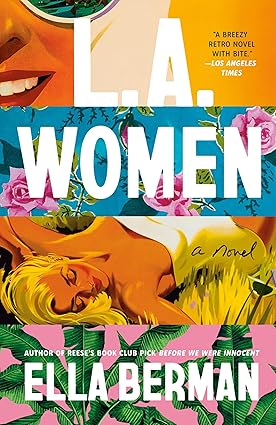
L.A. Women by Ella Berman
Two ambitious writers in 1960s LA face betrayal when one writes a novel based on the other's life.






Your guide toexceptional books
BookBrowse seeks out and recommends the best in contemporary fiction and nonfiction—books that not only engage and entertain but also deepen our understanding of ourselves and the world around us.

