
-
Your next favorite book
is waiting.
Summary | Excerpt | Reviews | Beyond the Book | Read-Alikes | Genres & Themes | Author Bio
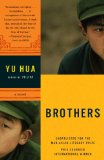
A Novel
by Yu Hua Book Reviewed by:
This article relates to Brothers

China's Cultural Revolution, which Chairman Mao Zedong formally announced in
1966, was a reaction to his earlier attempt, known as "The Great Leap Forward", to increase China's economic base by moving the country away from its agrarian economy to an industrialized one using the massive supplies of cheap humans rather than expensive imported machines. The Second Five Year Plan, better known as "The Great Leap Forward", was unveiled by Mao in 1958. As a first step, collectives across the countryside were merged into even larger "people's communes" so that by the end of 1958 approximately 25,000 communes with an average of 5,000 households had been set up.
A cornerstone of "The Great Leap Forward" was the creation of small backyard steel furnaces in every commune, with ridiculously ambitious production targets. Feeding and stoking the furnaces took laborers and equipment from the fields which, in combination with poor weather conditions, resulted in a dramatic decrease in food production. At the same time, the people responsible for producing the steel had little instruction and the furnaces were not of the standard needed to produce a quality product. Because of this, countless millions of serviceable household and farm tools were converted into low quality pig iron while famine spread across much of the country. The result was death by starvation for between 20 and 43 million Chinese (estimates vary widely).
Communist Party members laid the blame on the Party leadership, and Mao resigned as the State Chairman of the People's Republic of China (although he retained his position as Chairman of the Chinese Communist Party). The new chairman, Liu Shaoqi, insisted that the country must adopt more Western means of developing the economy, relying on education and technical expertise, and a power struggle ensued between the two factions of the Communist party.
The Cultural Revolution
In early 1963, Mao and his followers began a propaganda campaign in an attempt
to create an anti-intellectual environment, and thus weaken his political opponents. Mao's philosophies appealed particularly to China's youth, and grass-roots student groups supporting his policies proliferated across the country, eventually becoming known as the Red Guards.
Mao announced the "Great Proletarian Cultural Revolution" on August 8, 1966. He
elevated the Red Guards to a national movement, and urged its members to "struggle against and crush those persons in authority who are taking the capitalist road, to criticize and repudiate the reactionary bourgeois academic authorities." The Red Guards subsequently began their own education campaign,
traveling to outlying villages to spread Mao's teachings. As their numbers grew,
so did their power.
The more than 11 million Red Guards became increasingly violent in their zeal to
promote the Cultural Revolution. Teachers and others in academic fields bore the
brunt of the anti-intellectual campaign, although those with any type of perceived bourgeois connection were also attacked, as were people affiliated with religious institutions. Thousands of innocent people were relocated, tortured, beaten and killed. Religious and academic buildings were looted and destroyed. Almost all books were burned and, for a year, all schools were closed throughout China.
Party members appealed to Mao to rein in the Red Guards, but Mao approved of their actions and refused to interfere. Mao forbade the police to hinder the Red Guards, and any who tried to keep the Red Guards from acting were labeled counter-revolutionaries. As the violence spiraled out of control, Mao and his followers used the atmosphere of chaos to purge the Party of political enemies. The Red Guards were given control of the army and, again, those who objected were denounced and purged.
By 1969 Mao had consolidated his power. The "Down to the Countryside Movement" was announced, which relocated young city "intellectuals" (pretty much all urban students, of middle school age or older, who were viewed by authorities as 'privileged') to the countryside in order to learn from the workers and farmers.
The Red Guards were dismantled and Mao declared the Cultural Revolution over,
although political and social turmoil continued until his death in 1976.
Filed under People, Eras & Events
 This "beyond the book article" relates to Brothers. It originally ran in February 2009 and has been updated for the
January 2010 paperback edition.
Go to magazine.
This "beyond the book article" relates to Brothers. It originally ran in February 2009 and has been updated for the
January 2010 paperback edition.
Go to magazine.
Theo of Golden by Allen Levi
One spring morning, a stranger arrives in the small southern city of Golden. No one knows where he has come from…or why…






Your guide toexceptional books
BookBrowse seeks out and recommends the best in contemporary fiction and nonfiction—books that not only engage and entertain but also deepen our understanding of ourselves and the world around us.

