
-
Your next favorite book
is waiting.
Summary | Excerpt | Reading Guide | Reviews | Beyond the Book | Readalikes | Genres & Themes | Author Bio

 Book Reviewed by:
Her chestnut hair, usually back-combed and bombastically curled, hung limp over her freckled cheeks. She pulled out her own pen and scribbled furiously over "confident," her lines as jagged as a lightning bolt. In all capitals, she wrote ARROGANT with so much force that she punctured the paper.
"Give that back!" I cried, surging to my feet. My ankles tingled from squatting. "The Global Tribune already got a warning from MacArthur's office. If I get us another, we might get blocked from the embassy briefings!"
Censorship was supposed to be patriotic, but Barbara wasn't with the press. Unrepentantly, she underlined ARROGANT before returning my article, her thumbprint smudged into the ink. I shooed her away, smoothing the crinkled paper before inserting it back into my typewriter.
Barbara and I had arrived in Japan on the same flight in July 1950, shortly after the North Korean People's Army-KPA for short-invaded South Korea, and the US initiated a "police action" under the United Nations. I'd been covering the Korean War for the past five months, but while every other correspondent was chasing MacArthur's top officers, I had been hanging around with Barbara and the other flight nurses of the Medical Air Evacuation Squadron. Being a female war correspondent was hard enough. It was even harder when you looked like the enemy.
Though I was born and raised in San Francisco, I was ethnically Chinese, with straight black hair and eyes that folded at the corners. My nose was small but broad like my father's, and my lips were plump like my mother's. Despite my perfect English and my Californian slang, American officers often balked when I tried to talk to them, let alone press them for information.
It was annoying, but at twenty-eight I had spent most of my life prying open side doors when the entrance was blocked. Many correspondents can attack a front-page story head-on, shark-style, but some of us can advance only if we get really good at picking the glitter from the dust. I began my career by writing about the Women Air Force Service Pilots, which few other outlets covered in detail. Through that series, I shone enough to get an assignment abroad. Though my bosses were initially reluctant to send a woman to a war zone, no one else at the Global Tribune was fluent in Japanese and Mandarin, as I was. My language skills-and my promise to use them to get scoops like no other-finally tipped the scales in my favor.
Over the past months, I'd made friends. The flight nurses helped me arrange interviews with patients, and the pilots let me hitch rides to Korea. Because of them, I was churning out stories on every major battle. Today, however, was going to be different.
"There he is!" Barbara shrieked when the office door squeaked open. "There's George!"
I snapped my head up so quickly that a joint in my neck popped.
George Miyashita slumped into the hangar, so exhausted that he wobbled, his sparse mustache a stain on his upper lip. Among the pilots, he was my favorite. He spent most of his free time at the pool on base and had the broad shoulders of a swimmer-and washboard abs if you caught him at the right angle.
The technicians who had been loading fuel barrels into the cargo hold slowed to stare. When George saw us, he recoiled. "No!" he yelled. "I told you all no!"
George and the other pilots had been flying nonstop for five days, because our leaders had underestimated a Communist "bandit" and his "peasant army." "We're going all the way to the Yalu," one of the generals had said. "Don't let a bunch of Chinese laundrymen stop you!" Though the police action was supposed to end at the 38th parallel-the line separating the two Koreas-MacArthur had sent our boys surging into the North so quickly that they had had to spread themselves thin along narrow mountain roads. Pilots had airdropped turkeys and potatoes near the Chinese border so that troops could celebrate Thanksgiving.
Excerpted from The Young Will Remember by Eve J. Chung. Copyright © 2026 by Eve J. Chung. Excerpted by permission of Berkley Books. All rights reserved. No part of this excerpt may be reproduced or reprinted without permission in writing from the publisher.
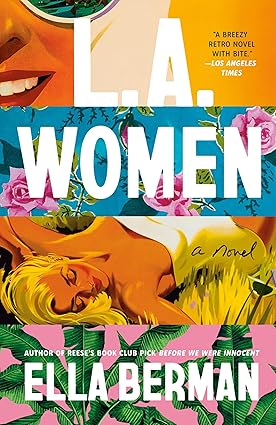
L.A. Women by Ella Berman
Two ambitious writers in 1960s LA face betrayal when one writes a novel based on the other's life.






Your guide toexceptional books
BookBrowse seeks out and recommends the best in contemporary fiction and nonfiction—books that not only engage and entertain but also deepen our understanding of ourselves and the world around us.


