
-
Your next favorite book
is waiting.
Summary | Excerpt | Reading Guide | Reviews | Beyond the Book | Readalikes | Genres & Themes | Author Bio

A Novel
by Anna North Book Reviewed by:
He and his wife were fighting, he says. They fought all the time, as he has never fought with anyone before or since. He believes she hated him. He knows it is not an excuse.
That night, he says, she came at him, trying to claw his face. She had done it before, he says, he has the scar beneath his eye to prove it. This time he stuck his arms out in front of him to try to keep her back. But she lost her footing and fell down the stone stairs to the basement of that house, their little house that used to stand on the edge of the moss, where the factory is now.
No, he says, it was not self-defense. Or, he doesn't know. He does not ask for a lawyer. He is glad they finally found her, he says. When he buried her in the moss, he thought for sure she would be discovered in a day or two. That was in 1961. Ever since then her death has haunted him. She attacks him in his dreams, scratching and screaming. Now he is free.
It is not Agnes's job to pass judgment on the husband. Her only job is to confirm that the woman lying here in the coroner's office in Ludlow, England, is Isabela Navarro, born in 1940 in Málaga, Spain, and that she was killed by blunt trauma to the skull. The folder contains a photograph of Isabela, taken at her wedding in 1959. She is handsome, with a strong chin and high cheekbones, and looks forceful, her head held high. But her shoulders are narrow and rounded forward, a pronounced kyphosis that would surely have led to back pain in middle age, if she had lived long enough to see it.
"Would you like tea or anything before we—" Kieran begins.
"No, no thanks, no," she says, which is the answer he is hoping for, but also the truth. She wants to get to the exam room.
Her sneakers squelch down the hallway. She must buy boots, but what kind, where? Anyway her Chuck Taylors comfort her, they remind her of home, even when their bright red has gone wine-dark in the wet.
In the elevator she and Kieran stand an awkward distance from one another, the quiet chatters in her ears. When they reach the basement he turns to her.
"I should warn you, the remains look"—he pauses—"unusual."
"Unusual how?" Agnes asks.
Kieran shakes his head as he pushes open the exam room door. "You'll see what I mean."
If she believed in God or the supernatural she would call it sacred: the moment when she sees a body for the first time. She remembers, always, the day it came to her that this would be her life. In graduate school, her father had discouraged her from pursuing forensic work—too stressful, was his rationale, all the red tape, the interaction with law enforcement. But when the medical examiner in Las Minas needed an expert in dentition and her adviser recommended her, she felt a pull, not merely because she knew she was the best in the region, but also because she had never encountered a decedent like this before—lying out in the open air, the story of the death unwritten. Her subjects to that point had been in museum collections or computer databases, the questions of their lives all settled and hardened into history.
She drove out to the desert on a white-hot day in August. The remains were still at the find site, in the center of a parched square surrounded by caution tape. The medical examiner and two police officers stood aside for her as she came across the sand.
She can see it now, that first body. It was almost completely skeletonized, the skull whipped pale and clean by the desert wind, the long bones beginning to fissure in the heat. A polyester jacket hung limp over the ribs and shoulders, in color a sun-bleached dirty blue. Four teeth were missing from the maxilla, and this was why the medical examiner had called Agnes: He wanted to know if they had been lost premortem or knocked out at the time of death.
Eye to eye with the body, as she photographed his skull (the chin and brow ridge marked him out, more likely than not, as male), as she bent low to peer inside his mouth and saw the jagged edges where his incisors had snapped off, probably forced backward by a blunt object like the butt of a gun, what overtook her was a calm and tender feeling, a kind of love. This, she felt as she measured the maxilla and mandible, was a person who had been hurt and then abandoned out in the heat, and now he needed a particular kind of skillful care that only she could offer him. She spent hours there on the hard-packed sand, sweating into her coveralls, because she wanted to be sure to get it right, to understand and record his body's story, to witness him. His feet were very long and narrow; he would have had a hard time finding shoes.
Excerpted from Bog Queen by Anna North. Copyright © 2025 by Anna North. Excerpted by permission of Bloomsbury Publishing. All rights reserved. No part of this excerpt may be reproduced or reprinted without permission in writing from the publisher.
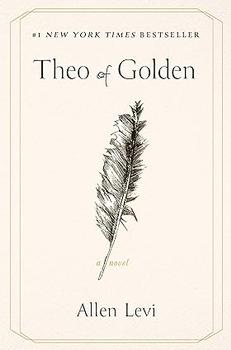
Theo of Golden by Allen Levi
One spring morning, a stranger arrives in the small southern city of Golden. No one knows where he has come from…or why…






Your guide toexceptional books
BookBrowse seeks out and recommends the best in contemporary fiction and nonfiction—books that not only engage and entertain but also deepen our understanding of ourselves and the world around us.


