
-
Your next favorite book
is waiting.
Summary | Excerpt | Reviews | Beyond the Book | Readalikes | Genres & Themes | Author Bio

A New Life
by Graham Watson Book Reviewed by:
Some journalists looked beyond sex and wondered if such an accomplished narrative could have been written by an amateur, or if an already-famous writer was testing them. Enquiries with Jane Eyre's publisher found even they had been kept in the dark. They had rushed the novel into print only two months after accepting its handwritten manuscript, knowing nothing of its author beyond his name and location; Currer Bell asked for all correspondence to go through a vicarage near Bradford. Yet when they sent press clippings, delivery was delayed because the postmen could not find anyone with that name. 'It would be better in future not to put the name Currer Bell on the outside,' came the reply, 'if directed simply to Miss Brontë they will be more likely to reach their destination safely. Currer Bell is not known in this district and I have no wish that he should.' This pretence continued for another eight months of near-daily communication until the author was forced to reveal herself in person.
While Elizabeth, with thousands of others, was intrigued by Jane Eyre's passion and unconventionality, she doubted it was a man's work. Her friend, fellow writer Harriet Martineau, was convinced knowledge of feminine activities gave them away. 'Passages about sewing on brass rings could have been written only by a woman – or an upholsterer,' she observed dryly. Strangely, the deprivations of Jane Eyre's girlhood were so like Harriet's that her relatives thought she had written it and teased her to confess. While she could honestly deny it, she began to suspect there might be a spy in her midst, extorting information from confidantes or observing her at close hand to repurpose her life for their fiction. But who?
Harriet was staying with friends in November 1849 when a gift copy of Currer Bell's new novel, Shirley, came bypost. She scrutinised the handwriting in the accompanying note for clues. It looked 'cramped and nervous' she surmised, the inelegant hand of a compulsive writer. And what of the writer's sex? There was a potential slip. They had written:'Currer Bell offers a copy of Shirley to Miss Martineau's acceptance, in acknowledgement of the pleasure and profit she has derived …' They stopped, inked a line through 'she' and replaced it with 'he', before continuing 'has derived from her works'. That settled it: Currer Bell was a woman in disguise. Harriet decided to test her hunch. She had to prove she had worked them out and was discreet. She addressed a reply to 'Currer Bell Esquire' but started the letter boldly, risking offence for a potential male recipient, hailing him, 'Madam …'
At the same time, another copy went to Elizabeth Gaskell. She read it straight away. Catching up with a friend afterwards she realised they might help identify its author. 'Do you know Dr Epps?' she asked, remembering he was her father's friend. 'I think you do. Ask him to tell you who wrote Jane Eyre and Shirley. Do tell me …'
She must have heard that the homeopath John Epps received aplea for help from William Smith Williams, the editor at Smith Elder & Co. At thebeginning of December 1848, Williams told Epps the sister of one of his authors was in an unexplained decline and wondered if he could recommend treatmentfrom a written description of her symptoms. Epps agreed with stipulations: the questioner could not be anonymous, noting that 'if a lady has not sufficientconfidence in him to give her name when consultinghim, it cannot be expected that he should give his opinion of her case.' Within days, Williams passed him a two-page statement describing a woman not yet 30 with 'a peculiar reserve of character', emaciated and feverish with seizures of coughing. So far, it said, she had refused all medical attention 'insisting that Nature shall be left to take her own course'. It was signed Miss Brontë of Haworth parsonage, near Bradford.10Although Epps replied immediately with homeopathic remedies and generalised advice, it was already too late –it would have been too late for twenty-first century medicine –to avert or relieve the final agonising stage of tuberculosis that killed the author's sister a few days before that Christmas.
Excerpted from The Invention of Charlotte Brontë by Graham Watson. Copyright © 2025 by Graham Watson. Excerpted by permission of Pegasus Books. All rights reserved. No part of this excerpt may be reproduced or reprinted without permission in writing from the publisher.
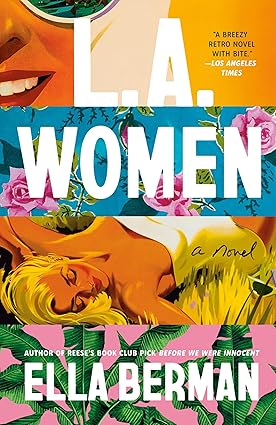
L.A. Women by Ella Berman
Two ambitious writers in 1960s LA face betrayal when one writes a novel based on the other's life.




Your guide toexceptional books
BookBrowse seeks out and recommends the best in contemporary fiction and nonfiction—books that not only engage and entertain but also deepen our understanding of ourselves and the world around us.


