
-
Your next favorite book
is waiting.
Summary | Excerpt | Reviews | Beyond the Book | Readalikes | Genres & Themes | Author Bio
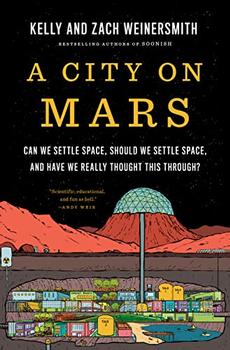
Can We Settle Space, Should We Settle Space, and Have We Really Thought This Through?
by Kelly Weinersmith, Zach Weinersmith Book Reviewed by:
Space solar is valuable if you're already in space, as a way to generate energy without burning fuel. It may also be valuable on Earth in some very narrow cases, such as beaming energy to military bases where fossil fuel delivery would be dangerous. For more practical uses, you're better off with conventional boring renewables. Cover every rooftop with solar panels, followed by the Sahara desert, and then if the planet still needs energy, we can talk about space.
We are skeptical that it will ever be a great financial idea to harvest massive amounts of solar power in space and then use that energy to convert moondust into cement or steel or industrial chemicals. But even if we believe that this'll all happen one day, that one day will not come in time to spare us from any environmental concern of today.
Weinersmith Verdict: Unfortunately, no.
Argument 3: Space Resources Will Make Us All Rich
It's certainly possible, but right now the economics of it aren't looking great. As we'll explore later, no place in space has something like a giant hunk of pure platinum or gold. What space resources do exist are likely to be very expensive to acquire and will remain so even with big improvements in technology.
Also, there's a real difference between access to commodities and universal wealth. Consider aluminum. Discovered in 1825, early on it was so valuable that only the wealthy could afford it. Victorian-era jewelry sometimes includes aluminum as a precious metal. Today, it's a way to cover lasagna. That's because by the late nineteenth century, industrial processes had made aluminum incredibly cheap, effectively flooding the market with a former luxury good. This is a great development, and of course aluminum has uncountable valuable applications from the kitchen to airplanes. But the fact that most of us can buy large quantities of a once-precious metal doesn't mean we're all millionaires.
In our experience, people tend to assume raw minerals are the major factor in human well-being. Although they're necessary inputs into our economies, according to a recent report by the World Bank, nonrenewable resources, in the sense of valuable stuff found in the ground, make up about 2.5 percent of Earth's wealth. And a lot of that is fossil fuels, which are not available in space. The really valuable thing for economies is humans, and our ideas and technology. You can convince yourself by melting down your phone and assessing the value of the resulting glass, metal, and plastic.
Even if space does produce inexpensive access to all sorts of commodities that make someone rich, there's also no reason to assume anything like an equal distribution of wealth back on Earth. In fact, if you believe there's big money in space, the United States is uniquely poised to go get it, potentially harming the economies of less-developed countries dependent on commodities. Some readers will care about this more than others, but even if you don't think wealth distribution has much moral significance, it may still have geopolitical significance. As we'll see later, under some conditions, changes in the balance of power among nations can make war more likely. If space really does make some country especially rich, the consequences don't have to be uniformly good.
Weinersmith Verdict: It's complicated but no, not really.
Argument 4: Space Settlement Will End, or at Least Mitigate, War
There are a few versions of this one, but we've found these three pretty common: space settlement will create more territory so we'll fight less about territory; space settlement will make us rich so we won't want to fight anymore; and space settlement will allow unhappy citizens to just leave for other settlements, which will reduce tension here on Earth.
Excerpted from A City on Mars by Kelly Weinersmith and Zach Weinersmith. Copyright © 2023 by Kelly Weinersmith and Zach Weinersmith. Excerpted by permission of Penguin Press. All rights reserved. No part of this excerpt may be reproduced or reprinted without permission in writing from the publisher.

L.A. Women by Ella Berman
Two ambitious writers in 1960s LA face betrayal when one writes a novel based on the other's life.






Your guide toexceptional books
BookBrowse seeks out and recommends the best in contemporary fiction and nonfiction—books that not only engage and entertain but also deepen our understanding of ourselves and the world around us.


